Optimizing Phage-Antibiotic Synergy Against Biofilms: A Comprehensive RSM Guide for Antimicrobial Researchers
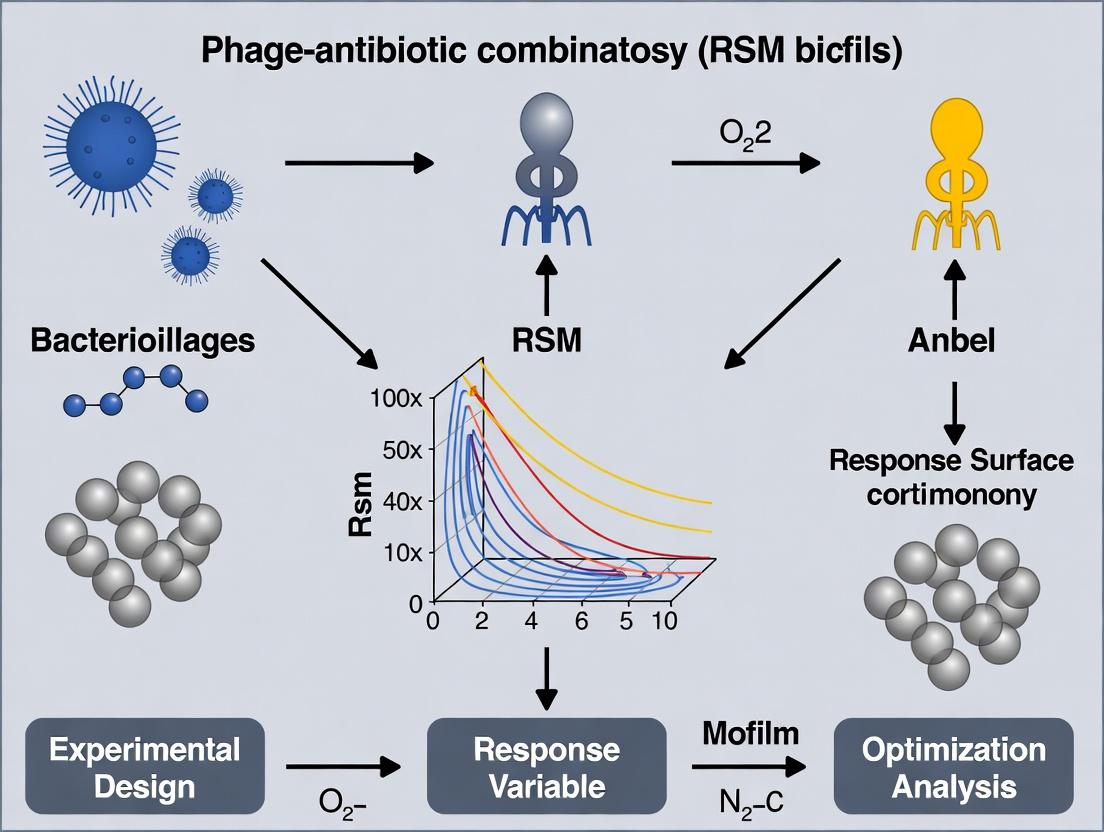
This article provides a comprehensive methodological framework for applying Response Surface Methodology (RSM) to optimize phage-antibiotic combinations (PACs) for biofilm eradication.
Optimizing Phage-Antibiotic Synergy Against Biofilms: A Comprehensive RSM Guide for Antimicrobial Researchers
Abstract
This article provides a comprehensive methodological framework for applying Response Surface Methodology (RSM) to optimize phage-antibiotic combinations (PACs) for biofilm eradication. Tailored for researchers and drug development professionals, it explores the scientific rationale behind PACs, details experimental design and RSM implementation, addresses common optimization challenges, and establishes validation protocols. By integrating foundational science with advanced statistical optimization, this guide aims to accelerate the development of effective, resistance-breaking antimicrobial therapies against persistent biofilm infections.
The Science of Synergy: Why Phage-Antibiotic Combinations Break Biofilm Barriers
This application note details methodologies central to investigating biofilm-mediated tolerance, a critical barrier in infectious disease treatment. The protocols are framed within a Response Surface Methodology (RSM) approach for optimizing phage-antibiotic combinations (PACs). The synergistic disruption of the extracellular polymeric substance (EPS), killing of metabolically active cells, and targeting of dormant persister cells is a promising strategy to overcome biofilm resilience.
Quantitative Data on Biofilm Components and Tolerance Mechanisms
Table 1: Key Components ofP. aeruginosaPAO1 Biofilm EPS and Their Roles
| EPS Component | Primary Function | Approximate % of EPS Matrix (Dry Weight) | Relevance to Tolerance |
|---|---|---|---|
| Alginate | Structural scaffold, cation binding, diffusion limitation | 1-20% (varies with strain/mutation) | Hinders antibiotic penetration; scavenges reactive oxygen species. |
| eDNA | Structural integrity, cation chelation, genetic exchange | 15-30% | Binds cationic antibiotics (e.g., aminoglycosides); contributes to viscosity. |
| Proteins | Adhesion, enzymatic activity, structural support | 40-60% | Includes enzymes that degrade antimicrobials (e.g., β-lactamases). |
| Polysaccharides (Pel, Psl) | Cell-cell & surface adhesion, structural support | 15-30% (Pel/Psl) | Forms a protective hydrated barrier; mediates initial surface attachment. |
Table 2: Comparative Tolerance of Biofilm vs. Planktonic Cells
| Antimicrobial Agent | Typical MIC for Planktonic Cells (µg/mL) | Minimum Biofilm Eradication Concentration (MBEC) (µg/mL) | Fold Increase in Tolerance |
|---|---|---|---|
| Ciprofloxacin | 0.05 - 0.5 | 5 - 50 | 100 - 1000 |
| Tobramycin | 0.5 - 2 | 50 - 500 | 100 - 250 |
| Ceftazidime | 1 - 8 | 100 - 2000 | 100 - 250 |
| Colistin | 0.5 - 2 | 4 - 16 | 8 - 10 |
Experimental Protocols
Protocol 1: Standardized 96-Well Plate Biofilm Cultivation and Treatment for RSM
Purpose: To generate reproducible, high-throughput biofilms for testing PAC efficacy. Materials: Tryptic Soy Broth (TSB), 96-well flat-bottom polystyrene plates, sterile phosphate-buffered saline (PBS), crystal violet (0.1% w/v), acetic acid (30% v/v). Procedure:
- Inoculation: Dilute an overnight culture of target bacteria (e.g., P. aeruginosa PAO1) to 1 x 10^6 CFU/mL in fresh medium.
- Biofilm Formation: Aliquot 200 µL per well into a 96-well plate. Incubate statically for 24-48 hours at desired temperature (e.g., 37°C).
- Washing: Carefully aspirate planktonic cells. Wash biofilm twice with 200 µL PBS to remove loosely attached cells.
- Treatment: Apply 200 µL of serially diluted antibiotics, phage suspensions, or combinations prepared according to the RSM design matrix. Incubate for a specified period (e.g., 24h).
- Assessment: Quantify biofilm biomass via crystal violet staining (absorbance at 595nm) or determine viable counts by sonicating biofilms and plating.
Protocol 2: Isolation and Characterization of Persister Cells from Biofilms
Purpose: To enrich and study the dormant persister subpopulation. Materials: Biofilm cultures, antibiotic of choice (e.g., ciprofloxacin at 10x MIC), PBS, cell homogenizer or sonicator (low power), filtration unit (5 µm pore filter). Procedure:
- Biofilm Dispersal: Harvest mature biofilm (e.g., by scraping from a coupon or well). Suspend in PBS and subject to mild sonication (3x 10s pulses, low amplitude) or gentle homogenization to create a single-cell suspension without lysing cells.
- Killing of Active Population: Add a high concentration of a bactericidal antibiotic (e.g., 10x MIC ciprofloxacin) to the suspension. Incubate for 3-5 hours to kill all metabolically active cells.
- Persister Cell Enrichment: Centrifuge the treated suspension. Wash the pellet 2x with PBS to remove the antibiotic. Optionally, filter through a 5 µm filter to remove any residual aggregates.
- Viability Confirmation: Plate the final suspension on non-selective agar. The resulting colonies, arising from tolerant persister cells, can be used for downstream phenotypic or molecular analysis.
Protocol 3: EPS Extraction and Quantification
Purpose: To isolate and measure major EPS components for correlation with treatment outcomes. Materials: Centrifuge, hot aqueous solvent, ethanol, phenol, sulfuric acid, DNA/RNA/protein quantification kits. Procedure for Polysaccharide/Alginate:
- EPS Harvest: Collect biofilm and centrifuge (10,000 x g, 30 min, 4°C). Retain the supernatant (soluble EPS).
- Precipitation: Add 3 volumes of cold ethanol to the supernatant. Incubate at -20°C overnight.
- Collection: Centrifuge (12,000 x g, 30 min) to pellet crude EPS. Re-suspend in water.
- Quantification: Use the phenol-sulfuric acid method with glucose/alginate as a standard (absorbance at 490nm). Procedure for eDNA:
- Extraction: Treat biofilm suspension with DNase-free proteinase K. Precipitate eDNA from the supernatant using isopropanol.
- Quantification: Measure concentration using a fluorescent nucleic acid stain (e.g., PicoGreen) or spectrophotometry (A260).
Visualizations
Diagram Title: RSM Workflow for Phage-Antibiotic Biofilm Study
Diagram Title: Phage-Antibiotic Combination Mode of Action
The Scientist's Toolkit: Key Research Reagent Solutions
| Item | Function/Benefit | Example Product/Catalog |
|---|---|---|
| Polystyrene Microtiter Plates | Standardized, high-throughput substrate for reproducible biofilm formation. | Corning 96-well Flat Bottom Cell Culture Plate. |
| Crystal Violet Stain (0.1%) | Simple, quantitative staining of total biofilm biomass. | Sigma-Aldrich C6158 or prepared in-house. |
| Tetrazolium Salt (e.g., XTT) | Metabolic assay for viable cells within biofilms, alternative to CFU. | Cell Proliferation Kit II (XTT), Roche. |
| DNase I, Proteinase K | Enzymatic digestion for EPS component analysis and biofilm dispersal. | Molecular biology grade enzymes. |
| Alginate from P. aeruginosa | Standard for EPS polysaccharide quantification assays. | Sigma-Aldrich A7004. |
| Syto 9/Propidium Iodide | Fluorescent live/dead viability staining for CLSM imaging. | LIVE/DEAD BacLight Bacterial Viability Kit. |
| Phage Depolymerase | Recombinant enzyme for targeted EPS disruption in PAC strategies. | Research-grade (e.g., P. aeruginosa phage-derived). |
| Calgary Biofilm Device | Standardized system for growing 96 identical biofilms for MBEC testing. | Innovotech MBEC Assay. |
This application note details methodologies central to a broader thesis employing Response Surface Methodology (RSM) to optimize Phage-Antibiotic Combination (PAC) therapies against bacterial biofilms. Understanding the mechanistic basis of phage lytic activity and penetration is critical for designing effective, synergistic PAC regimens. These protocols enable the quantification of key parameters for RSM model input.
Lytic Mechanisms: Quantitative Data & Protocols
Quantitative Metrics of Lytic Activity
Table 1: Key Quantitative Parameters for Phage Lytic Activity
| Parameter | Typical Measurement Range | Significance for RSM/PAC |
|---|---|---|
| Adsorption Rate Constant (k) | 10⁻⁹ to 10⁻¹¹ mL/min | Determines speed of infection initiation; influences PAC timing. |
| Latent Period | 10 - 60 minutes | Critical for modeling phage population dynamics. |
| Burst Size | 20 - 200 PFU/infected cell | Impacts efficacy and required phage dose. |
| One-Step Growth Kinetics | Varies by phage-host pair | Foundational data for pharmacodynamic modeling. |
Protocol: One-Step Growth Kinetics
Objective: Determine latent period and burst size. Reagents: Target bacterial culture (mid-log phase), high-titer phage stock (≥10⁸ PFU/mL), fresh growth medium, anti-phage serum or dilution buffer. Procedure:
- Mix bacteria (∼10⁸ CFU/mL) with phage at an MOI of ~0.01 to ensure most cells are infected by a single phage.
- Allow adsorption for 5-10 min. Quench with a 1:100 dilution in pre-warmed medium containing neutralizing anti-phage serum or a 10³-fold dilution in buffer.
- Immediately (t=0) and at 5-min intervals, sample and titrate for plaque-forming units (PFU). Perform titers in triplicate.
- Plot PFU/mL vs. time. The latent period is the time before PFU increase. The burst size is calculated as: (Final PFU plateau) / (Initial infected bacteria count).
Biofilm Penetration Capabilities: Quantitative Data & Protocols
Protocol: Biofilm Penetration and Killing Assay (Modified Calgary Biofilm Device)
Objective: Quantify phage penetration and killing in a 96-well plate biofilm model. Reagents: 96-well peg lid (e.g., Nunc Immuno Wash), growth medium (with appropriate carbon source for biofilm), phage suspension in buffer, 0.1% w/v crystal violet (CV) solution, 33% v/v glacial acetic acid. Procedure:
- Biofilm Formation: Place peg lid into a 96-well plate containing 150 µL of bacterial inoculum (~10⁶ CFU/mL) per well. Incubate statically for 24-48h.
- Phage Treatment: Transfer peg lid to a new plate containing 150 µL of phage suspension (e.g., 10⁷ PFU/mL) per well. Incubate for a defined period (e.g., 2-24h).
- Assessment:
- Viability: Transfer pegs to a recovery plate with 200 µL fresh medium and sonicate (low power, 5 min) to disrupt biofilm. Serial dilute and plate for CFU counts.
- Biomass: Place treated pegs in a CV plate (stain 15 min), rinse, then destain in acetic acid plate. Measure OD₅₉₀ of destain solution.
Visualization: Phage-Antibiotic Synergy in Biofilm Context
Title: PAC Synergy Mechanism for Biofilm Eradication
The Scientist's Toolkit: Key Research Reagent Solutions
Table 2: Essential Materials for Phage-Biofilm Research
| Item | Function/Application |
|---|---|
| Peg Lid Biofilm Devices (e.g., Nunc CBD) | High-throughput, reproducible biofilm cultivation for 96-well plate assays. |
| Cellulose Ester Membranes (0.45 µm) | Support for colony biofilms and diffusion-based penetration studies. |
| Phage Buffer (SM Buffer) | Stable, long-term storage and dilution of phage stocks (50 mM Tris, 100 mM NaCl, 8 mM MgSO₄). |
| Neutralizing Anti-Phage Serum | Quenches unadsorbed phage in one-step growth kinetics experiments. |
| Resazurin / AlamarBlue | Metabolic dye for real-time, non-destructive assessment of biofilm viability post-treatment. |
| Exopolysaccharide (EPS) Degrading Enzymes (e.g., DNase I, Dispersin B) | Used as controls or adjuncts to assess the role of specific EPS components in phage penetration. |
| Mucin / Artificial Sputum Medium | For growing biofilms with physiologically relevant matrix composition. |
| Computer-Aided Design (CAD) Flow Cells | For real-time, microscopic visualization of biofilm disruption by phages (e.g., confocal microscopy). |
The exploration of synergistic antibiotic combinations is a cornerstone of strategies to combat multi-drug resistant (MDR) biofilm infections. Within the framework of Response Surface Methodology (RSM) for optimizing phage-antibiotic combinations, understanding intrinsic antibiotic-antibiotic synergies provides a critical baseline and informs the selection of agents for triple-combination therapies. This document details application notes and protocols for key synergistic antibiotic pairings, focusing on β-lactams and quinolones, to be used as a component in broader RSM-driven biofilm eradication studies.
Application Notes & Synergistic Mechanisms
β-Lactams + Quinolones: Enhanced Penetration and Target Vulnerability
The combination of a cell-wall active β-lactam (e.g., Piperacillin, Ceftazidime) with a DNA synthesis inhibitor like a Fluoroquinolone (e.g., Ciprofloxacin) often shows synergy, particularly against Gram-negative bacilli such as Pseudomonas aeruginosa. The β-lactam disrupts peptidoglycan synthesis, causing cell wall stress and enlarging pores in the outer membrane. This facilitates increased intracellular uptake of the quinolone, allowing it to more effectively inhibit DNA gyrase and topoisomerase IV.
Key Application: This combination is frequently leveraged in treating severe nosocomial infections and is a prime candidate for inclusion in RSM models combining with phage, as phage propagation may also be enhanced by antibiotic-induced physiological changes in bacterial cells.
β-Lactams + Aminoglycosides: Classic Time-Dependent & Concentration-Dependent Synergy
The synergy between β-lactams and aminoglycosides (e.g., Gentamicin, Tobramycin) is well-established. β-lactams inhibit cell wall synthesis, which enhances the permeability of the bacterial cell membrane to aminoglycosides, promoting their uptake and binding to the 30S ribosomal subunit.
Key Application: This pairing is a gold standard for treating enterococcal and pseudomonal infections. In biofilm RSM studies, this combination's parameters (sequence, timing) are critical variables to optimize alongside phage administration.
Quinolones + Rifamycins: Dual Nucleic Acid Inhibition
Combining a quinolone with Rifampin can be synergistic against staphylococcal biofilms. Rifampin inhibits RNA polymerase with high efficacy but leads to rapid resistance if used alone. The quinolone targets DNA replication, and the dual pressure on nucleic acid synthesis can reduce the emergence of resistant mutants.
Key Application: Particularly relevant for device-related Staphylococcus epidermidis or Staphylococcus aureus biofilm infections. In RSM design, this combination's potential for resistance suppression is a valuable factor.
Table 1: Summary of In Vitro Synergy for Common Antibiotic Combinations Against Biofilm Models
| Antibiotic Class Combination | Example Agents | Target Pathogen | Common Metric (e.g., FIC Index) | Avg. Biofilm Reduction vs. Best Single Agent | Key Mechanism |
|---|---|---|---|---|---|
| β-lactam + Quinolone | Piperacillin + Ciprofloxacin | P. aeruginosa (PAO1) | ΣFIC ≤ 0.5 | 2.1 - 3.5 log10 CFU increase | Increased membrane permeability & uptake |
| β-lactam + Aminoglycoside | Ceftazidime + Tobramycin | P. aeruginosa | ΣFIC 0.25 - 0.5 | 1.8 - 3.0 log10 CFU increase | Enhanced aminoglycoside uptake via cell wall damage |
| Quinolone + Rifamycin | Levofloxacin + Rifampin | S. aureus (MRSA) | ΣFIC ≤ 0.5 | 1.5 - 2.5 log10 CFU increase | Dual inhibition of DNA/RNA synthesis; resistance suppression |
| β-lactam + β-lactamase Inhibitor | Amoxicillin + Clavulanate | E. coli (ESBL) | Not Applicable (Inactivation) | N/A | Mechanism-based protection of primary agent |
FIC: Fractional Inhibitory Concentration; ΣFIC: Sum of FICs. Synergy is typically defined as ΣFIC ≤ 0.5.
Detailed Experimental Protocols
Protocol 1: Checkerboard Assay for Determining Fractional Inhibitory Concentration (FIC) Index
Objective: To quantitatively assess in vitro synergy between two antibiotics.
Materials:
- Cation-adjusted Mueller Hinton Broth (CA-MHB)
- 96-well sterile, flat-bottom polystyrene microtiter plates
- Antibiotic stock solutions (sterile, prepared per CLSI guidelines)
- Logarithmic-phase bacterial inoculum (adjusted to ~5 x 10⁵ CFU/mL final)
- Multichannel pipettes
Methodology:
- Prepare two-fold serial dilutions of Antibiotic A (e.g., β-lactam) along the x-axis of the plate (columns 1-11). Column 12 is a growth control (no antibiotic).
- Prepare two-fold serial dilutions of Antibiotic B (e.g., quinolone) along the y-axis (rows A-H).
- Add CA-MHB to all wells to standardize volume.
- Inoculate all wells (except sterility controls) with the standardized bacterial suspension.
- Incubate statically at 37°C for 18-24 hours.
- Determine the Minimum Inhibitory Concentration (MIC) of each drug alone and in combination.
- Calculate the FIC for each drug in synergistic wells: FICA = (MIC of A in combination) / (MIC of A alone) FICB = (MIC of B in combination) / (MIC of B alone) ΣFIC = FICA + FICB
- Interpret: ΣFIC ≤ 0.5 = synergy; 0.5 < ΣFIC ≤ 4 = indifference; ΣFIC > 4 = antagonism.
Protocol 2: Time-Kill Kinetic Assay for Synergy Evaluation Against Biofilms
Objective: To measure the bactericidal activity of antibiotic combinations against pre-formed biofilms over time.
Materials:
- 96-well polystyrene plates for biofilm growth
- Tryptic Soy Broth (TSB) with 1% glucose (for biofilm promotion)
- Phosphate Buffered Saline (PBS)
- Antibiotic solutions prepared in appropriate medium
- Sonicator water bath
- Materials for viable cell counting (serial dilution, agar plates)
Methodology:
- Grow biofilms in plates for 24-48 hours under static conditions at 37°C.
- Gently wash wells 2x with PBS to remove planktonic cells.
- Add fresh medium containing: a) No drug (control), b) Antibiotic A at 1xMIC, c) Antibiotic B at 1xMIC, d) Combination of A+B (each at 1xMIC or sub-MIC).
- Incubate the plate under biofilm growth conditions.
- At time points T=0, 2, 4, 6, 8, 24h, disrupt biofilms in selected wells by sonication (low frequency, 5-10 min).
- Perform serial dilutions of the disrupted biofilm suspension and plate on agar for viable count (CFU/mL).
- Plot log10 CFU/mL vs. time. Synergy is defined as a ≥2 log10 decrease in CFU/mL by the combination compared to the most active single agent at 24h.
Diagrams of Pathways and Workflows
Diagram 1: Mechanism of β-Lactam + Quinolone Synergy
Diagram 2: RSM Workflow for Biofilm Synergy Studies
The Scientist's Toolkit: Research Reagent Solutions
Table 2: Essential Materials for Antibiotic Synergy & Biofilm Studies
| Item / Reagent | Function & Application | Example Vendor/Product |
|---|---|---|
| Cation-Adjusted Mueller Hinton Broth (CA-MHB) | Standard medium for antibiotic susceptibility testing (CLSI guidelines); ensures consistent cation concentrations for aminoglycoside/tetracycline activity. | Sigma-Aldrich (70122), BD BBL |
| Polystyrene Microtiter Plates (Flat-Bottom) | Standard substrate for in vitro biofilm formation (e.g., P. aeruginosa, S. aureus) and checkerboard assays. | Corning 3595, Costar 3370 |
| Calgary Biofilm Device (CBD) / MBEC Assay | High-throughput system for growing multiple, identical biofilms on pegs; ideal for testing multiple antibiotic combinations. | Innovotech Inc. |
| Resazurin Sodium Salt | Metabolic dye (alamarBlue) for non-destructive, kinetic measurement of biofilm viability after antibiotic treatment. | Sigma-Aldrich (R7017) |
| Phosphate Buffered Saline (PBS), pH 7.4 | For gentle washing of biofilms to remove non-adherent planktonic cells between treatment steps. | Gibco (10010023) |
| Triton X-100 or Saponin | Mild detergent used to disperse biofilm cells from surfaces or pegs for viable counting via sonication/vortexing. | Sigma-Aldrich (X100) |
| CLSI-Grade Antibiotic Powder Standards | For preparation of accurate, reproducible antibiotic stock solutions for MIC and synergy testing. | USP, Sigma-Aldrich (specific antibiotic standards) |
| Response Surface Methodology (RSM) Software | For designing efficient experiments (e.g., CCD) and modeling complex synergistic interactions. | Design-Expert, JMP, Minitab |
Application Notes
The systematic application of Response Surface Methodology (RSM) within the broader thesis framework provides a robust statistical and mathematical model to optimize synergistic interactions between bacteriophages (phages) and antibiotics against biofilms. These interactions are theorized to operate through two primary, interlinked mechanisms, which can be quantified and modeled using RSM-designed experiments.
1.1. Phage-Induced Sensitization (PIS): Phage predation disrupts the structural and physiological integrity of the biofilm, sensitizing the bacterial community to subsequently administered antibiotics. Key quantifiable effects include:
- Reduction of Extracellular Polymeric Substance (EPS): Phage-encoded depolymerases degrade polysaccharides, reducing biofilm biomass and enhancing antibiotic diffusion. RSM can model the relationship between phage titer, treatment time, and EPS reduction.
- Alteration of Bacterial Metabolic State: Phage infection can shift persister cells to a metabolically active state, making them susceptible to time-dependent antibiotics.
- Disruption of Quorum Sensing (QS): Phage lysis reduces cell density, potentially lowering QS signal molecule concentration and downregulating virulence and biofilm maintenance genes.
1.2. Antibiotic-Enhanced Phage Propagation (AEP): Sub-inhibitory concentrations of certain antibiotics can enhance phage replication and spread within the biofilm, creating a positive feedback loop.
- Suppression of CRISPR-Cas and Restriction-Modification Systems: Antibiotic-induced stress may downregulate bacterial innate immunity, increasing phage infection efficiency.
- Promotion of Prophage Induction: Antibiotics like fluoroquinolones can trigger the SOS response in lysogens, inducing prophages and causing "autolysis" from within the biofilm.
- Increased Receptor Expression: Some antibiotics alter the bacterial cell envelope, leading to increased expression or exposure of phage receptors.
Table 1: Quantitative Parameters for RSM Modeling of Phage-Antibiotic Synergy
| Mechanism | Independent Variable (X1) | Independent Variable (X2) | Response Variable (Y) | Typical Measurement Assay |
|---|---|---|---|---|
| Phage-Induced Sensitization | Phage Multiplicity of Infection (MOI) | Antibiotic Concentration (μg/mL) | Biofilm Biomass Reduction (%) | Crystal Violet / CV Assay |
| Phage-Induced Sensitization | Phage Pre-treatment Time (h) | Antibiotic Exposure Time (h) | Log10 CFU Reduction | Colony Forming Unit (CFU) Enumeration |
| Antibiotic-Enhanced Propagation | Sub-MIC Antibiotic Concentration | Phage Adsorption Time (min) | Progeny Phage Burst Size (PFU/cell) | One-Step Growth Curve |
| Antibiotic-Enhanced Propagation | Antibiotic Pre-treatment Time (h) | - | Intracellular Phage DNA Copies | qPCR targeting phage genomic DNA |
Experimental Protocols
Protocol 2.1: RSM-Optimized Checkerboard Assay for Synergy Detection (Biofilm Model)
- Objective: To determine synergistic combinations of phage and antibiotic using a 3x3 factorial design as a basis for a broader Central Composite Design (CCD) in RSM.
- Materials: 96-well polystyrene plate, mature biofilm (e.g., Pseudomonas aeruginosa PAO1), phage suspension (e.g., PB1), antibiotic stock (e.g., Ciprofloxacin), phosphate-buffered saline (PBS), Tryptic Soy Broth (TSB), 0.1% Crystal Violet (CV), 30% acetic acid.
- Procedure:
- Grow biofilms for 24-48h. Gently wash 2x with PBS.
- Prepare a 2D matrix: Serially dilute phage (e.g., 0, 105, 107 PFU/mL) along rows and antibiotic (e.g., 0, 0.25xMIC, 0.5xMIC) along columns in fresh medium. Add 200μL per well.
- Incubate for 24h at 37°C.
- Wash plates, fix biofilms with methanol, and stain with 0.1% CV for 15 min.
- Wash, solubilize bound CV with 30% acetic acid, measure OD590.
- Calculate % biofilm reduction. Use Bliss Independence or Loewe Additivity model to calculate synergy scores. Identify combination for subsequent RSM optimization.
Protocol 2.2: Quantifying Antibiotic-Enhanced Phage Burst Size
- Objective: To measure the effect of sub-MIC antibiotics on phage replication kinetics.
- Materials: Early-log phase planktonic culture, phage at high titer, sub-MIC antibiotic, anti-phage antiserum or dilution buffer, soft agar, agar plates.
- Procedure:
- Treat bacterial culture with or without sub-MIC antibiotic for 1h.
- Infect at low MOI (e.g., 0.1) for 5 min. Use anti-phage serum/dilution to halt adsorption.
- Centrifuge, resuspend infected cells in fresh medium ± antibiotic.
- Take samples every 5-10 min for 60-90 min. Immediately dilute and plate for phage titer (plaque assay).
- Plot PFU/mL over time. Calculate latent period and burst size (final titer / initial infected cell count). Compare control vs. antibiotic-treated groups.
Visualization
Diagram 1: Phage-Induced Sensitization Pathway
Diagram 2: Antibiotic-Enhanced Phage Propagation
Diagram 3: RSM Workflow for Combination Optimization
The Scientist's Toolkit
Table 2: Key Research Reagent Solutions
| Item | Function / Rationale |
|---|---|
| Crystal Violet (0.1% w/v) | A simple stain for quantifying total biofilm biomass attached to an abiotic surface. |
| Resazurin (AlamarBlue) | A metabolic dye used to measure cell viability within biofilms following treatment. |
| SYBR Green I / Propidium Iodide | Fluorescent stains for live/dead cell viability assessment via confocal microscopy. |
| DNase I (RNase-free) | Used to dissociate biofilms for accurate CFU or phage titer enumeration by degrading extracellular DNA in the EPS. |
| Mucin / Artificial Sputum Medium | Used to grow biofilms in conditions mimicking cystic fibrosis lungs, enhancing clinical relevance. |
| Anti-Phage Antiserum | Critical for one-step growth curve experiments to neutralize unadsorbed phage post-infection. |
| Calgary Biofilm Device (CBD) | A standardized peg-lid plate for high-throughput cultivation and testing of biofilms. |
| qPCR Master Mix with SYBR Green | For quantifying intracellular phage DNA copy number as a measure of replication enhancement. |
| Sub-MIC Antibiotic Stocks | Precisely diluted from MIC determinations to study effects on bacterial physiology without inhibition. |
| Phage Buffer (SM Buffer) | A stable storage and dilution buffer for bacteriophages (contains gelatin for stabilization). |
Response Surface Methodology (RSM) is a collection of statistical and mathematical techniques used for developing, improving, and optimizing processes. Its primary application is in situations where a response of interest is influenced by several variables, and the objective is to optimize this response. In the context of our thesis on developing phage-antibiotic combinations (PACs) against bacterial biofilms, RSM provides a structured framework to navigate the complex, multifactorial interactions between phage type, antibiotic class, dosage ratios, and treatment duration to achieve maximal biofilm eradication.
The core RSM workflow involves: 1) designing a series of experiments to collect sufficient and reliable data, 2) deriving a mathematical model (typically a second-order polynomial) that best fits the collected data, and 3) using this model to predict optimal factor settings and understand the system's topography via response surfaces.
Key Experimental Designs in RSM
The choice of experimental design is critical for efficiency and model accuracy. Below are the most common designs used in biofilm PAC optimization.
Table 1: Comparison of Common RSM Designs for Biofilm PAC Studies
| Design Type | No. of Factors (k) | Base Runs | Key Advantage for Biofilm Studies | Model Fitted |
|---|---|---|---|---|
| Central Composite (CCD) | 2-6 | 20 (for k=3) | Excellent for exploring quadratic effects & interactions. Allows axial points to estimate curvature. | Full Quadratic |
| Box-Behnken (BBD) | 3-5 | 15 (for k=3) | Highly efficient; all points lie at safe, operational mid-levels, avoiding extreme factor combinations. | Full Quadratic |
| 3-Level Full Factorial | 2-3 | 27 (for k=3) | Comprehensive but requires many runs. Useful for preliminary screening before RSM. | Full Quadratic |
Application Notes: RSM for Phage-Antibiotic-Biofilm Systems
Defining the Response and Critical Factors
For biofilm eradication, multiple responses may be relevant. A key step is selecting a primary response for optimization.
- Primary Response:
Log10 Reduction in Biofilm Viability (CFU/mL). - Secondary Responses: Biofilm Biomass (Crystal Violet assay), Synergy Index (e.g., ZIP model score).
- Typical Independent Factors (with ranges example):
- X₁: Phage Titer (10⁶ to 10⁹ PFU/mL)
- X₂: Antibiotic Concentration (0.25x to 4x MIC)
- X³: Treatment Time (2 to 24 hours)
- X₄: Sequence/Simultaneity of Administration (coded variable)
Protocol: A Generalized RSM Workflow for PAC Optimization
Protocol Title: Systematic Optimization of Phage-Antibiotic Combination against Pseudomonas aeruginosa Biofilm using Central Composite Design.
I. Pre-Experimental Phase
- Factor Screening: Use a Plackett-Burman or fractional factorial design to identify the most influential factors (e.g., phage type, antibiotic class, presence of adjuvants) from a larger set.
- Define RSM Domain: Based on screening results and biological constraints, set the minimum (-1), center (0), and maximum (+1) levels for each selected factor.
II. Experimental Execution Phase
- Design Generation: Use statistical software (e.g., JMP, Design-Expert, R) to generate a randomized run order for a CCD or BBD. This randomization is crucial to avoid bias.
- Biofilm Cultivation: Grow standardized 24-hour biofilms of the target pathogen (e.g., P. aeruginosa PAO1) in 96-well polystyrene plates using a defined medium (e.g., M63 with 0.2% glucose).
- PAC Treatment Application: Following the design matrix, carefully apply the specified combinations of phage suspension and antibiotic solution (in fresh medium) to the established biofilms. Include replicates of the center point to estimate pure error.
- Response Measurement:
- Viability: After treatment, disrupt biofilms by sonication, perform serial dilution, and plate on appropriate agar for CFU enumeration. Calculate Log10 Reduction vs. untreated control.
- Biomass: Fix parallel wells with 99% methanol, stain with 0.1% crystal violet, solubilize in 33% acetic acid, and measure absorbance at 590 nm.
III. Post-Experimental Analysis Phase
- Model Fitting & ANOVA: Input response data into the software. Fit a second-order polynomial model:
Y = β₀ + ΣβᵢXᵢ + ΣβᵢᵢXᵢ² + ΣβᵢⱼXᵢXⱼ + ε. Perform Analysis of Variance (ANOVA) to assess model significance, lack-of-fit, and the individual significance of terms (p-value < 0.05). - Diagnostic Checking: Examine residual plots (vs. predicted, vs. run order) for randomness to validate model assumptions.
- Interpretation & Optimization:
- Use 3D response surface and 2D contour plots to visualize factor interactions.
- Utilize the software's numerical optimization function (e.g., Desirability Function) to find factor levels that maximize Log10 Reduction while potentially minimizing total drug exposure.
IV. Validation Phase
- Prediction Verification: Conduct 3-5 confirmation experiments at the predicted optimal conditions. Compare the observed response mean and confidence interval with the model's prediction interval to validate the model's adequacy.
Visualization of the RSM Process for PAC Development
Title: RSM Optimization Workflow for Phage-Antibiotic Combinations
The Scientist's Toolkit: Essential Reagents & Materials
Table 2: Key Research Reagent Solutions for RSM in PAC-Biofilm Studies
| Item | Function in Protocol | Example/Note |
|---|---|---|
| Static Biofilm Model | Provides a standardized, high-throughput platform for growing reproducible biofilms. | 96-well flat-bottom polystyrene plates. |
| Defined Growth Medium | Ensures consistent biofilm formation, avoiding complex media that may interfere with agents. | M63 minimal medium with 0.2% glucose. |
| Phage Stock (High Titer) | The primary antiviral agent. Must be purified and titred (PFU/mL) precisely for accurate dosing. | e.g., Myovirus PEV20, purified via CsCl gradient, >10¹⁰ PFU/mL. |
| Antibiotic Master Stock | The primary antibacterial agent. Prepared at a known concentration from analytical standard. | e.g., Ciprofloxacin, dissolved per CLSI guidelines, filter-sterilized. |
| Neutralizing Buffer | Crucial for halting treatment action at precise times during time-course studies. | Dey-Engley broth containing divalent cation chelators and inactivators. |
| Crystal Violet Solution (0.1%) | Standard stain for quantifying total adherent biofilm biomass. | Prepared in deionized water, filtered. |
| Acetic Acid (33% v/v) | Solubilizes crystal violet stain from biofilms for colorimetric quantification. | In deionized water. |
| Sonication Bath/Probe | Disrupts biofilm architecture to release embedded bacteria for viable counting (CFU). | Low-power bath sonication (e.g., 42 kHz, 5-10 min) is typical for microtiter plates. |
| Statistical Software with DOE Module | For design generation, model fitting, ANOVA, and response surface plotting. | JMP, Design-Expert, Minitab, or R (with rsm, DoE.base packages). |
Within the framework of a thesis employing Response Surface Methodology (RSM) to optimize synergistic phage-antibiotic combinations (PAC) against bacterial biofilms, defining critical parameters is foundational. This document outlines the key independent variables, dependent responses, and experimental protocols essential for systematic investigation. The goal is to generate robust, predictive models for eradicating resilient biofilm infections.
Critical Independent Variables & Their Ranges
These factors are manipulated in RSM design (e.g., Central Composite Design) to map their effect on biofilm eradication.
Table 1: Primary Independent Variables (Factors)
| Variable | Symbol (Typical) | Description & Rationale | Typical Experimental Range |
|---|---|---|---|
| Phage Multiplicity of Infection (MOI) | A | Ratio of plaque-forming units (PFU) to colony-forming units (CFU) at treatment initiation. Determines initial phage dose. | 0.01 – 100 |
| Antibiotic Concentration | B | Sub-inhibitory to supra-MIC levels. Often tested as a fraction of the planktonic MIC (e.g., x0.25, x1, x4 MIC). | 0.25 – 4 x MIC |
| Time of Antibiotic Addition | C | Sequence/timing relative to phage application. Critical for observing synergy. | -2 to +24 h (Phage addition at t=0) |
| Treatment Duration | D | Total exposure time to active agents. | 4 – 48 hours |
| Biofilm Age | E | Maturation time of biofilm pre-treatment. Impacts matrix complexity and cell metabolic state. | 24 – 72 hours |
Key Dependent Variables (Responses)
These quantitative outcomes are measured to evaluate treatment efficacy and model the system response.
Table 2: Measured Dependent Responses
| Response | Metric | Protocol Summary | Relevance to RSM Model |
|---|---|---|---|
| Biofilm Biomass Reduction | % reduction vs. control (Crystal Violet, CV) | Fix, stain with 0.1% CV, solubilize in acetic acid/ethanol, measure OD590. | Primary efficacy output. |
| Viable Cell Count Reduction | Log10 CFU/cm² reduction | Biofilm scraped, homogenized, serially diluted, plated for CFU enumeration. | Gold standard for bactericidal activity. |
| Phage Pharmacokinetics | Log10 PFU/mL over time | Sample supernatant, plaque assay. | Models phage replication/decay dynamics. |
| Emergence of Resistance | Frequency of resistant colonies | Plate treated biofilm homogenate on phage/antibiotic-containing media. | Critical durability output. |
| Matrix Integrity | % change in matrix components (eDNA, polysaccharides) | Fluorescent stains (e.g., SYTOX Green, ConA) with quantification via microscopy or fluorometry. | Mechanistic insight into synergy. |
Detailed Experimental Protocols
Protocol 1: Static Biofilm Formation & Treatment (96-well plate)
- Materials: TSB/Glucone, 96-well flat-bottom plate, overnight bacterial culture, phage lysate, antibiotic stock, PBS, 0.1% Crystal Violet, 30% Acetic acid.
- Steps:
- Dilute overnight culture 1:100 in fresh medium.
- Inoculate 200 µL per well. Incubate statically at desired temperature (e.g., 37°C) for desired Biofilm Age (E).
- Carefully aspirate planktonic cells and wash biofilm 2x with PBS.
- Prepare fresh medium containing predefined Phage MOI (A) and/or Antibiotic Concentration (B) according to the Time of Antibiotic Addition (C) schedule.
- Add 200 µL treatment to respective wells. Incubate for Treatment Duration (D).
- Proceed to CV staining (biomass) or CFU enumeration (viability).
Protocol 2: Determining Log Reduction in Viable Counts (CFU)
- Materials: Sonicator bath, sterile scraper/trypsin-EDTA (for adherent cells), PBS, serial dilution tubes, agar plates.
- Steps:
- Post-treatment, aspirate treatment medium, wash biofilm 1x with PBS.
- Add 200 µL PBS to each well. Sonicate plate in a water bath sonicator for 5 min (low frequency) to disperse biofilm.
- Pipette vigorously, transfer suspension to a microtube. Vortex 30s.
- Perform serial 10-fold dilutions in PBS.
- Spot or spread plate 10 µL/100 µL of appropriate dilutions on agar.
- Incubate plates, count colonies, calculate CFU/cm² or CFU/well, then Log10 Reduction vs. untreated control.
Protocol 3: Monitoring Phage Titers During Treatment
- Materials: Soft agar, indicator bacteria, phage diluent (SM buffer).
- Steps:
- At timepoints during Treatment Duration (D), sample 10 µL from treatment well supernatant.
- Serially dilute in SM buffer.
- Use standard double-layer agar plaque assay with an appropriate indicator lawn.
- Count plaques, calculate PFU/mL, and plot kinetics.
Visualization of Experimental Workflow & Synergy Pathways
Title: RSM-Driven Biofilm Experiment Workflow
Title: Synergistic Mechanisms of Phage-Antibiotic Combinations
The Scientist's Toolkit: Essential Research Reagents & Materials
Table 3: Key Research Reagent Solutions
| Item | Function/Benefit | Example/Notes |
|---|---|---|
| Crystal Violet (0.1% w/v) | Stains total biofilm biomass (cells + matrix). Inexpensive, high-throughput quantitation via absorbance. | Can be solubilized in 30% acetic acid or ethanol for OD reading. |
| Resazurin / AlamarBlue | Metabolic activity assay. Measures cell viability in real-time without biofilm disruption. | Fluorescent/colorimetric readout; useful for kinetic studies. |
| SYTO 9 / Propidium Iodide (Live/Dead) | Confocal microscopy stains. Distinguishes live (green) from membrane-compromised (red) cells. | Key for visualizing spatial killing effects within biofilm architecture. |
| Phage Dilution Buffer (SM Buffer) | Maintains phage stability during serial dilution for plaque assays. Contains gelatin for protection. | 100 mM NaCl, 8 mM MgSO₄, 50 mM Tris-Cl (pH 7.5), 0.01% gelatin. |
| Cell Dissociation Reagent (e.g., Trypsin-EDTA) | Gently detaches adherent cells for accurate CFU counting from surface-grown biofilms. | Preferable to scraping for more uniform recovery. |
| Mature Biofilm Positive Control | Standardized, high-titer inoculum for consistent, reproducible biofilm formation. | e.g., Pseudomonas aeruginosa PAO1, Staphylococcus aureus ATCC 6538. |
Designing the Experiment: A Step-by-Step RSM Protocol for PAC Biofilm Studies
This application note is framed within a broader thesis investigating the optimization of Phage-Antibiotic Combinations (PACs) against bacterial biofilms using Response Surface Methodology (RSM). The selection of an appropriate experimental design is critical for efficiently modeling the complex, often non-linear, interactions between phage multiplicity of infection (MOI), antibiotic concentration (e.g., sub-MIC levels), treatment time, and biofilm eradication responses (e.g., log reduction in CFU/mL, biomass quantification).
Design Comparison: CCD vs. Box-Behnken
The two most prevalent RSM designs for such optimization are Central Composite Design (CCD) and Box-Behnken Design (BBD). The choice depends on the experimental region of interest, feasibility of runs, and the need for predicting response at extreme factor levels.
Table 1: Quantitative Comparison of CCD and Box-Behnken Design for 3-Factor PAC Experiment
| Feature | Central Composite Design (CCD) | Box-Behnken Design (BBD) |
|---|---|---|
| Total Runs (3 factors) | 20 (2³ cube + 6 axial/star + 6 center) | 15 (12 mid-edge points + 3 center) |
| Factorial Portion | Full or Fractional 2ᵏ | None (avoids corner points) |
| Axial (Star) Points | Yes, distance α (α=1.682 for rotatable) | No |
| Experimental Region | Spherical, explores corners & extremes | Spherical, within a hypercube |
| Prediction at Corners | Excellent | Poor to Fair |
| Sequentiality | Excellent (can build on factorial) | Fair |
| Efficiency (Runs vs. info) | High for extrapolation | Very High for interpolation |
| Primary Advantage | Precise estimation of quadratic effects & prediction at extremes; rotatable. | Fewer runs; all points within safe operating limits; avoids simultaneous extreme conditions. |
| Key Limitation | Requires extreme factor levels; more runs. | Cannot estimate full quadratic model at the corners of the cube. |
| Recommended for PACs when... | The experimental safe region is wide, and predicting synergy/antagonism at extreme combinations (e.g., very high MOI + high antibiotic) is necessary. | The corner points (all factors at high/low simultaneously) are practically infeasible, dangerous, or irrelevant; resource-limited. |
Key Considerations for PAC-Biofilm Research
- Factor Types: Continuous (Antibiotic conc., Time) and discrete-count (MOI can be treated as continuous for modeling).
- Region of Interest: For nascent biofilm eradication, extremes may be tolerable (CCD). For in-vivo mimicry, conditions are often constrained (BBD).
- Blocking: CCD accommodates blocking more naturally if experiments must be split across days.
- Current Trend: BBD is frequently chosen in recent antimicrobial combination studies due to its efficiency and safety profile.
Experimental Protocol: Implementing a BBD for PAC Optimization
This protocol outlines steps for a 3-factor Box-Behnken Design to optimize a PAC against Pseudomonas aeruginosa biofilm.
Objective: To model and optimize the combined effect of Phage MOI (A), Ciprofloxacin concentration (B), and Treatment Duration (C) on biofilm biomass reduction.
Phase 1: Design Setup & Randomization
- Define Factor Ranges: Based on preliminary data.
- A: Phage MOI (0.1, 1, 10)
- B: Ciprofloxacin (0.25, 0.5, 0.75 x MIC)
- C: Treatment Time (4, 12, 20 hours)
- Generate Design: Use statistical software (e.g., JMP, Minitab, Design-Expert). The 3-factor BBD yields 15 experimental runs.
- Randomize Run Order: Crucial to minimize confounding with systematic error.
Phase 2: Biofilm Assay & Treatment (Key Experimental Method)
Materials:
- 96-well polystyrene plate for biofilm culture.
- Tryptic Soy Broth (TSB) with 1% glucose.
- Overnight culture of P. aeruginosa PAO1.
- Phage stock (e.g., ΦKZ, titer ≥10⁸ PFU/mL).
- Ciprofloxacin stock solution.
- Phosphate Buffered Saline (PBS).
- 0.1% Crystal Violet (CV) solution, 30% acetic acid.
Procedure:
- Biofilm Formation: Dilute overnight bacterial culture 1:100 in fresh TSB+1% glucose. Dispense 200 µL per well. Incubate statically at 37°C for 24 h.
- Biofilm Washing: Carefully aspirate planktonic cells. Gently wash biofilm twice with 250 µL PBS.
- PAC Treatment: According to the randomized BBD table, prepare treatment solutions in TSB (no glucose) combining specific MOI (phage volume) and ciprofloxacin concentration. Add 200 µL to respective wells. Incubate at 37°C for the designated time (Factor C).
- Biofilm Quantification: a. Aspirate treatment, wash twice with PBS. b. Air-dry plate for 45 min. c. Add 200 µL of 0.1% CV to each well, stain for 20 min. d. Rinse plate thoroughly under running tap water, invert to dry. e. Add 200 µL of 30% acetic acid to destain for 15 min. f. Transfer 125 µL of destain solution to a new plate. g. Measure absorbance at 595 nm using a plate reader.
- Calculate Response:
% Biomass Reduction = [1 - (OD₅₉₅(treated)/OD₅₉₅(control))] * 100. Perform triplicates for each run.
Phase 3: Data Analysis & Optimization
- Fit data to a second-order polynomial model:
Y = β₀ + ΣβᵢXᵢ + ΣβᵢᵢXᵢ² + ΣβᵢⱼXᵢXⱼ. - Perform ANOVA to assess model significance, lack-of-fit, and R².
- Use contour and 3D surface plots to visualize interaction effects (e.g., MOI × Antibiotic).
- Apply numerical or graphical optimization to find factor levels yielding maximum biomass reduction.
Visualization of RSM Workflow for PAC Optimization
Title: RSM Optimization Workflow for Phage-Antibiotic Combinations
The Scientist's Toolkit: Key Research Reagent Solutions
Table 2: Essential Materials for PAC-Biofilm RSM Studies
| Item | Function/Description | Example Product/Catalog |
|---|---|---|
| Polystyrene Microtiter Plates | Standard substrate for static, high-throughput biofilm formation. | Corning 96-well Flat Clear Bottom, non-treated. |
| Tryptic Soy Broth (TSB) with Glucose | Growth medium promoting robust biofilm formation for many pathogens. | BD Bacto TSB, supplemented with 1% w/v D-Glucose. |
| Crystal Violet Stain | Dye for colorimetric quantification of adherent biofilm biomass. | 0.1% aqueous Crystal Violet solution (Sigma-Aldrich). |
| ATP-based Luminometry Kit | Alternative for quantifying metabolically active cells within biofilm. | BacTiter-Glo Microbial Cell Viability Assay (Promega). |
| Phage Propagation Host & Media | For high-titer phage stock preparation and purification. | Specific bacterial host strain + relevant broth/agar. |
| Clinical Grade Antibiotic Standard | Precise preparation of sub-inhibitory concentrations. | USP Reference Standard for relevant antibiotic. |
| Biofilm Dispersal Agent | Positive control for biofilm disruption assays. | Proteinase K or Dispersin B. |
| Statistical Design Software | For generating, randomizing, and analyzing RSM designs. | JMP, Minitab, Design-Expert. |
1.0 Introduction Within the broader thesis on applying Response Surface Methodology (RSM) to optimize phage-antibiotic combinations (PACs) against bacterial biofilms, a critical initial step is the precise identification and control of independent variables. These variables directly influence the efficacy of the combination therapy and are the factors manipulated in a designed RSM experiment. This document details the core independent variables—Multiplicity of Infection (MOI), antibiotic concentration, timing of administration, and treatment duration—providing application notes and standardized protocols for their investigation in a biofilm context.
2.0 Independent Variables: Definitions & Quantitative Ranges
Table 1: Core Independent Variables and Typical Experimental Ranges
| Variable | Definition | Key Considerations | Typical Experimental Range (for RSM design) | Measurement Unit |
|---|---|---|---|---|
| MOI | Ratio of plaque-forming units (PFU) of phage to colony-forming units (CFU) of bacteria at treatment initiation. | - Applied at time of treatment. - Biofilm cell counts differ from planktonic. - Effective MOI can be lower due to reduced phage penetration. | 0.01 to 100 | (PFU / CFU) |
| Antibiotic Concentration | Concentration of antibiotic in the treatment medium. | - Use sub-inhibitory (sub-MIC) to supra-MIC levels. - Synergy often occurs at sub-MIC. - Biofilm MIC (BMIC) is typically 10-1000x planktonic MIC. | 0.25x to 4x MIC (planktonic) | µg/mL or mg/L |
| Timing | Temporal sequence of phage and antibiotic administration. | - Simultaneous: Both agents added together. - Phage-first: Phage pretreatment (e.g., 1-24h before antibiotic). - Antibiotic-first: Antibiotic pretreatment. | -24h to +24h (relative to agent) | Hours |
| Duration | Total length of time the biofilm is exposed to the treatment. | - Must exceed multiple replication cycles. - Influences selection of resistant mutants. - Should reflect potential clinical exposure. | 4h to 72h | Hours |
3.0 Experimental Protocols
3.1 Protocol: Determining Baseline Parameters for RSM Design Objective: To establish the Minimum Inhibitory Concentration (MIC) of the antibiotic and the phage infectivity parameters (EOP, adsorption rate) against the target biofilm-forming strain. Materials: Mueller-Hinton Broth (MHB), 96-well microtiter plates, overnight bacterial culture, antibiotic stock solutions, phage lysate, soft agar. Procedure:
- Perform a standard broth microdilution MIC assay according to CLSI guidelines (M07) for the antibiotic.
- Determine the Biofilm Inhibitory Concentration (BMIC) using a crystal violet assay on biofilm formed in 96-well plates.
- Perform an Efficiency of Plating (EOP) assay: Spot 10-fold phage dilutions on lawns of the target strain. Compare plaque counts to those on the propagating host. EOP = (PFU on target / PFU on propagating host).
- Perform a one-step growth curve and adsorption assay to determine the phage latent period and adsorption rate constant.
3.2 Protocol: Static Biofilm Cultivation for PAC Experiments (96-well plate) Objective: To generate reproducible, high-density biofilms for treatment with PACs. Materials: Tryptic Soy Broth (TSB) with 1% glucose, 96-well flat-bottom polystyrene plates, sterile phosphate-buffered saline (PBS), crystal violet (0.1% w/v), acetic acid (33% v/v). Procedure:
- Dilute an overnight culture of the target bacterium 1:100 in fresh TSB + 1% glucose.
- Aliquot 200 µL per well into a 96-well plate. Include sterility controls (broth only).
- Incubate statically for 24h (or optimized time) at appropriate temperature (e.g., 37°C).
- Carefully aspirate planktonic cells and rinse the adhered biofilm twice with 200 µL PBS.
- (For biomass assessment): Fix biofilms with 200 µL of 99% methanol for 15 min, air dry, stain with 200 µL 0.1% crystal violet for 15 min, rinse, solubilize in 200 µL 33% acetic acid, measure OD590.
3.3 Protocol: Treatment with Phage-Antibiotic Combinations (Timing Variable) Objective: To apply PACs according to defined timing regimens and assess biofilm viability. Materials: Pre-formed 24h biofilms (from Protocol 3.2), phage suspension in SM buffer, antibiotic in appropriate solvent, PBS, MHB, sonication bath. Procedure:
- Prepare treatment solutions in MHB at 2x the desired final concentration for phage (MOI) and antibiotic.
- Simultaneous: Aspirate PBS from biofilm wells and add 100 µL of phage solution + 100 µL of antibiotic solution directly.
- Phage-first: Add 100 µL of phage solution to wells for a predetermined period (e.g., 2h). Then, add 100 µL of antibiotic solution without removing the phage medium.
- Antibiotic-first: Add 100 µL of antibiotic solution to wells for a predetermined period. Then, add 100 µL of phage solution.
- Incubate the plate under static conditions for the defined Treatment Duration.
- Terminate treatment: Aspirate medium, rinse with PBS.
- Dislodge biofilm: Add 200 µL PBS and sonicate the plate in a water bath sonicator for 5-10 minutes.
- Vortex wells vigorously, perform serial dilutions, and plate for CFU enumeration.
4.0 The Scientist's Toolkit
Table 2: Key Research Reagent Solutions & Materials
| Item | Function in PAC-Biofilm Research |
|---|---|
| TSB with 1% Glucose | Enriched medium promoting robust biofilm formation in many bacterial species (e.g., Staphylococcus, Pseudomonas). |
| Cellulase (e.g., ≥0.5 U/mL) | Enzyme used to gently degrade polysaccharide matrices for phage/antibiotic penetration studies or to recover cells from biofilms without sonication. |
| Resazurin (Alamar Blue) | Oxidoreduction indicator used for metabolic assessment of biofilm viability in real-time, non-destructive assays. |
| Phage Propagation Host | A well-characterized, susceptible bacterial strain used to prepare high-titer, contaminant-free phage lysate stocks. |
| Calcium/Magnesium Supplements (e.g., 1-10 mM CaCl₂) | Divalent cations often required for optimal phage adsorption and stability in treatment buffers. |
| Synergy Checkerboard Software (e.g., Combenefit, SynergyFinder) | Used for preliminary assessment of PAC interactions (synergy/additivity/antagonism) to inform RSM variable ranges. |
5.0 Visualizations
Title: RSM Experimental Workflow for PAC Biofilm Studies
Title: Timing Variable: Administration Sequences
Title: Proposed Synergy Mechanism of PAC on Biofilms
Within the framework of optimizing phage-antibiotic combinatorial (PAC) therapy against biofilms using Response Surface Methodology (RSM), the selection of robust, informative, and complementary response variables is critical. These variables must capture distinct aspects of biofilm eradication and inhibition to build a predictive and mechanistically insightful model. This Application Note details the protocols for three cornerstone response variables: Biomass Reduction, Viable Cell Count (CFU Log-Reduction), and Metabolic Activity, each addressing a unique facet of biofilm viability and structure.
Biomass Reduction: Quantifying Total Biofilm Burden
Objective: To measure the total biofilm biomass, including both living and dead cells, as well as the extracellular polymeric substance (EPS) matrix, following PAC treatment.
Protocol: Crystal Violet Staining Assay
- Biofilm Cultivation: Grow biofilms in a sterile, flat-bottomed 96-well microtiter plate under optimized conditions (e.g., 37°C, 24-48h).
- Treatment: Apply serial dilutions of phage, antibiotic, and their combinations as per the RSM experimental design. Include untreated (positive control) and media-only (negative control) wells. Incubate.
- Fixation & Staining:
- Carefully aspirate planktonic cells and media.
- Wash biofilms gently with 200 µL of phosphate-buffered saline (PBS), pH 7.4.
- Fix biofilms with 200 µL of 99% methanol per well for 15 minutes. Aspirate and air-dry.
- Stain with 200 µL of 0.1% (w/v) crystal violet solution for 15 minutes.
- Destaining & Quantification:
- Rinse plate thoroughly under running tap water to remove unbound dye. Blot dry.
- Add 200 µL of 33% glacial acetic acid to each well to solubilize the bound dye.
- Incubate for 15 minutes with gentle shaking.
- Transfer 100 µL from each well to a new plate (if needed to avoid debris).
- Measure the absorbance at 570 nm using a microplate reader.
- Calculation: Calculate percentage biomass reduction relative to the untreated control.
Table 1: Biomass Reduction Data Interpretation
| Absorbance (570nm) | Interpretation | RSM Relevance |
|---|---|---|
| >90% of control | Minimal/No Effect | Defines lower bound of factor effectiveness |
| ~50% of control | Moderate Disruption | Critical for finding intermediate optimal points |
| <10% of control | Near-Complete Removal | Target for maximal eradication response |
CFU Log-Reduction: Quantifying Viable Bacterial Cells
Objective: To enumerate the colony-forming units (CFUs) of viable bacteria remaining in a biofilm after PAC treatment, providing a direct measure of bactericidal/bacteriostatic activity.
Protocol: Viable Plate Count Method
- Biofilm Treatment: Grow and treat biofilms as in Section 1, Steps 1-2, but in a plate suitable for scraping (e.g., 24-well plate).
- Biofilm Disruption:
- Post-treatment, aspirate supernatant.
- Wash biofilm gently twice with 1 mL PBS.
- Add 1 mL of fresh PBS to each well.
- Dislodge biofilm by rigorous scraping with a sterile tip or cell lifter, followed by vortexing for 1-2 minutes. For robust biofilms, sonicate in a water bath sonicator (e.g., 42 kHz, 5 min).
- Serial Dilution & Plating:
- Perform 10-fold serial dilutions of the homogenized biofilm suspension in PBS or saline.
- Plate 100 µL aliquots of appropriate dilutions (e.g., 10⁰ to 10⁻⁵) onto fresh, non-selective agar plates in triplicate.
- Spread evenly and incubate plates (e.g., 37°C, 24-48h).
- Enumeration & Calculation: Count colonies on plates with 30-300 colonies. Calculate CFU/mL of the original suspension, then determine Log₁₀ CFU/well or cm².
- Log Reduction = Log₁₀(CFUuntreated control) - Log₁₀(CFUtreated)
Table 2: CFU Log-Reduction Efficacy Benchmarks
| Log-Reduction | Percent Killing | Antimicrobial Efficacy |
|---|---|---|
| 1-log | 90% | Limited |
| 2-log | 99% | Substantial |
| 3-log | 99.9% | High (Standard for disinfectants) |
| ≥4-log | 99.99% | Sterilizing/High-Level Efficacy |
Metabolic Activity: Quantifying Physiological State
Objective: To assess the metabolic activity of biofilm cells post-treatment, indicating sub-lethal injury, persister cell formation, or metabolic inhibition.
Protocol: Resazurin (AlamarBlue) Reduction Assay
- Biofilm Treatment: Grow and treat biofilms in a 96-well plate as described previously.
- Indicator Addition:
- Prepare a resazurin sodium salt solution in PBS or fresh media (typically 0.01-0.1 mg/mL).
- Aspirate treatment media from wells and wash once with PBS.
- Add fresh media containing 10% (v/v) of the resazurin working solution.
- Incubation & Measurement:
- Incubate plate in the dark at cultivation temperature (e.g., 37°C) for 1-4 hours.
- Measure fluorescence (Excitation: 530-570 nm, Emission: 580-610 nm) kinetically or at an endpoint.
- Calculation: Express results as percentage metabolic activity relative to an untreated control after subtracting the background (media + resazurin only).
Integrated Workflow & Pathway Visualization
RSM Variable Selection Logic for PAC Therapy
The Scientist's Toolkit: Essential Research Reagents & Materials
Table 3: Key Reagent Solutions for Biofilm Response Variable Analysis
| Reagent/Material | Function/Biological Target | Application in PAC Research |
|---|---|---|
| Crystal Violet (0.1%) | Basic dye binding to negatively charged molecules (e.g., in EPS & cell walls). | Staining total adherent biomass for colorimetric quantification. |
| Resazurin Sodium Salt | Blue, non-fluorescent dye reduced to pink, fluorescent resorufin by metabolically active cells. | Probing overall metabolic activity and sub-lethal effects of PAC. |
| Phosphate Buffered Saline (PBS) | Isotonic, non-toxic washing and dilution buffer. | Washing non-adherent cells post-treatment; base for serial dilutions. |
| Tryptic Soy Agar/Broth | General-purpose, nutrient-rich growth medium for many pathogens. | Cultivating planktonic inocula and for CFU enumeration via plate counting. |
| Neutralizer Solution (e.g., Dey-Engley broth, 3% Tween+Histidine) | Inactivates residual antimicrobial agents (phage/antibiotic). | Critical in CFU protocols to prevent carry-over effect during plating. |
| Cell Dissociation Tools (e.g., sonicators, micro-tip scrapers) | Physically disrupts the EPS matrix. | Homogenizing biofilms for accurate CFU counts and biomass assays. |
| 96-well & 24-well Microtiter Plates (polystyrene, tissue-culture treated) | Provides a standardized surface for biofilm growth. | High-throughput screening of PAC treatment conditions in RSM design. |
Within a thesis investigating Response Surface Methodology (RSM) for optimizing phage-antibiotic combination therapies against bacterial biofilms, model fitting and ANOVA interpretation are critical. After conducting a designed experiment (e.g., Central Composite Design) measuring biofilm reduction (% removal or log CFU reduction) in response to factors like phage titer (PFU/mL), antibiotic concentration (µg/mL), and exposure time (hours), a polynomial model is fitted. ANOVA determines which factors and interactions significantly influence the anti-biofilm response, guiding therapeutic optimization.
Key ANOVA Terms in RSM Context
- Sum of Squares (SS): Quantifies variation attributed to each model term.
- Degrees of Freedom (df): Number of independent values used to compute SS.
- Mean Square (MS): SS/df; estimates variance.
- F-value: Ratio of MS of a term to MS of the residual error. Tests the null hypothesis that the term's coefficient is zero.
- p-value: Probability of observing the F-value if the null hypothesis is true. p < 0.05 typically indicates a statistically significant term.
- Significant Factors: Main effects (e.g., A, B) showing a direct linear impact.
- Significant Interactions: Two-factor (e.g., AB) or higher-order terms indicating that the effect of one factor depends on the level of another.
Application Notes: Interpreting a Typical RSM ANOVA Table
The following table summarizes a hypothetical ANOVA for a quadratic RSM model analyzing biofilm reduction.
Table 1: ANOVA for a Quadratic RSM Model of Biofilm Reduction (Hypothetical Data)
| Source | Sum of Squares | df | Mean Square | F-value | p-value (Prob > F) | Significance |
|---|---|---|---|---|---|---|
| Model | 1254.32 | 5 | 250.86 | 45.62 | < 0.0001 | Significant |
| A-Phage Titer | 480.50 | 1 | 480.50 | 87.36 | < 0.0001 | Significant |
| B-Antibiotic | 320.20 | 1 | 320.20 | 58.22 | 0.0001 | Significant |
| AB | 95.12 | 1 | 95.12 | 17.30 | 0.0025 | Significant |
| A² | 210.45 | 1 | 210.45 | 38.27 | 0.0002 | Significant |
| B² | 148.05 | 1 | 148.05 | 26.92 | 0.0006 | Significant |
| Residual | 49.47 | 9 | 5.50 | |||
| Lack of Fit | 42.15 | 5 | 8.43 | 3.85 | 0.0985 | Not Significant |
| Pure Error | 7.32 | 4 | 2.18 | |||
| Cor Total | 1303.79 | 14 | ||||
| R² = 0.962 | Adj R² = 0.941 |
Interpretation Guide:
- Model Significance: The Model F-value of 45.62 and p-value < 0.0001 imply the model is significant. There is only a 0.01% chance such a large F-value could occur due to noise.
- Significant Factors: Both main factors (A and B) are significant (p < 0.05), confirming phage titer and antibiotic concentration independently affect biofilm reduction.
- Significant Interaction: The significant AB interaction (p=0.0025) indicates the effect of phage concentration depends on the antibiotic level (and vice versa), suggesting synergistic or antagonistic combinatorial effects.
- Curvature Significance: Significant quadratic terms (A², B²) indicate the presence of curvature in the response surface, often pointing toward an optimal combined concentration within the design space.
- Model Adequacy: The non-significant Lack of Fit (p=0.0985 > 0.05) suggests the quadratic model adequately fits the data. High R² and Adj R² values indicate the model explains most of the variability in the response.
Experimental Protocol: RSM Implementation and Validation
Protocol 1: Execution of a Central Composite Design (CCD) for Combination Therapy
- Objective: Systematically evaluate the individual and interactive effects of phage titer and antibiotic concentration on biofilm eradication.
- Materials: See "Scientist's Toolkit" below.
- Procedure:
- Experimental Design: Generate a 2-factor, 5-level CCD using statistical software (e.g., Design-Expert, Minitab). The design includes factorial points, axial points, and central point replicates.
- Biofilm Cultivation: Grow target bacterial biofilm (e.g., Pseudomonas aeruginosa) in 96-well plates using appropriate media (e.g., TSB + 1% Glucose) under static conditions for 24-48h.
- Treatment Application: Aseptically apply treatments according to the CCD matrix. Prepare serial dilutions of phage stock and antibiotic. Gently wash biofilms and add treatment combinations in fresh medium.
- Incubation & Assay: Incubate for specified duration (e.g., 18h). Assess biofilm reduction via crystal violet assay (OD590) or viable cell counts (log CFU/mL). Include untreated biofilm controls and media blanks.
- Data Recording: Record response data (e.g., % Biofilm Reduction) for each experimental run in the design matrix.
Protocol 2: Model Fitting, ANOVA, and Optimization
- Model Fitting: Input experimental response data into the CCD matrix in statistical software. Fit a second-order (quadratic) polynomial model.
- ANOVA Analysis: Execute ANOVA. Prune non-significant model terms (except those required for hierarchy) if using backward elimination.
- Diagnostic Checking: Examine residual plots (vs. predicted, normal probability plot) to validate assumptions of normality and constant variance.
- Interpretation & Visualization: Use the significant model to generate 2D contour and 3D surface plots to visualize the interaction and identify optimal factor levels.
- Validation Experiment: Conduct a confirmatory experiment at the predicted optimal factor levels to validate model accuracy by comparing predicted vs. observed response.
Visualizing the RSM-ANOVA Workflow & Significance
Diagram 1: RSM-ANOVA workflow for biofilm combination therapy (71 chars)
Diagram 2: Meaning of significant ANOVA terms in biofilm RSM (83 chars)
The Scientist's Toolkit: Key Research Reagents & Materials
Table 2: Essential Materials for Phage-Antibiotic Anti-Biofilm RSM Studies
| Item | Function & Relevance to RSM/ANOVA |
|---|---|
| Statistical Software (Design-Expert, Minitab, JMP) | Generates efficient experimental designs (CCD), fits models, performs ANOVA, and creates response surface plots for interpretation. |
| 96-Well Microtiter Plates (Polystyrene, Treated) | Standard platform for high-throughput biofilm cultivation and treatment application in a design matrix. |
| Clinical Isolate & Specific Lytic Phage Stock (High Titer, >10⁹ PFU/mL) | One of the critical independent variables (Factor A). Must be purified and quantified precisely for accurate level setting in the design. |
| Pure Antibiotic Reference Standard | The second critical independent variable (Factor B). Precise concentration is vital for model accuracy. |
| Crystal Violet Stain (0.1% w/v) | For colorimetric quantification of total biofilm biomass, a common response variable in RSM models. |
| Neutralizer Solution (e.g., containing Sodium Thiosulfate) | Crucial for validation steps to immediately halt phage/antibiotic action before viable counting, ensuring accurate response measurement. |
| Automated Microplate Reader | Provides precise and reproducible measurement of optical density (OD) for biofilm assays, reducing residual error in the ANOVA model. |
Application Notes
In the systematic optimization of phage-antibiotic combinations against resilient biofilms, Response Surface Methodology (RSM) transcends traditional one-factor-at-a-time approaches. The core innovation lies in constructing a three-dimensional response surface, a predictive model that visualizes the complex, non-linear interplay between critical factors (e.g., phage titer and antibiotic concentration) on a chosen response (e.g., log reduction in biofilm biomass). This model allows researchers to identify zones of synergistic enhancement, antagonistic interference, and—critically—the optimal combination region for maximal therapeutic effect. The following notes and protocols detail the process, framed within a doctoral thesis investigating RSM for eradicating Pseudomonas aeruginosa biofilms.
1. Quantitative Data from a Model Study
The table below summarizes hypothetical but representative data from a Central Composite Design (CCD) used to build a 3D response surface for a phage (Φ) and antibiotic (AB) combination.
Table 1: Central Composite Design Matrix and Experimental Results for Biofilm Reduction
| Run | Factor A: Phage Titer (PFU/mL), log₁₀ | Factor B: Antibiotic (µg/mL) | Response: Biofilm Reduction (%) |
|---|---|---|---|
| 1 | 7 (Center) | 8 (Center) | 72.5 |
| 2 | 8 (+1) | 12 (+1) | 85.2 |
| 3 | 6 (-1) | 12 (+1) | 60.1 |
| 4 | 8 (+1) | 4 (-1) | 78.8 |
| 5 | 6 (-1) | 4 (-1) | 55.3 |
| 6 | 8.5 (+α) | 8 (Center) | 80.5 |
| 7 | 5.5 (-α) | 8 (Center) | 48.2 |
| 8 | 7 (Center) | 14 (+α) | 65.7 |
| 9 | 7 (Center) | 2 (-α) | 58.9 |
| 10 | 7 (Center) | 8 (Center) | 71.8 |
| 11 | 7 (Center) | 8 (Center) | 73.1 |
2. Protocol for Generating and Analyzing the 3D Response Surface
Protocol 1: Experimental Setup and Biofilm Treatment for RSM Objective: To generate reliable response data (biofilm reduction) for various phage-antibiotic combinations defined by a CCD. Materials: See "Scientist's Toolkit" below. Procedure:
- Biofilm Cultivation: Grow a 48-hour P. aeruginosa biofilm in a 96-well polystyrene plate using a minimal medium mimicking infection conditions (e.g., M9 with 0.2% glucose). Inoculate from an overnight culture to an OD₆₀₀ of 0.05 and incubate statically at 37°C.
- Treatment Preparation: Prepare serial dilutions of the phage stock and the antibiotic according to the CCD matrix (Table 1).
- Treatment Application: Carefully aspirate planktonic cells and media from the mature biofilm. Apply 200 µL of the pre-defined phage-antibiotic combination (in fresh medium) to each test well. Include controls: media-only (negative), phage-only (at center point), antibiotic-only (at center point).
- Incubation & Assessment: Incubate the treatment plate for 24 hours at 37°C. Quantify remaining biofilm biomass using a crystal violet (CV) assay.
- CV Assay: Aspirate treatment, wash wells gently with PBS, air-dry for 45 minutes. Stain biofilms with 0.1% CV for 15 minutes. Wash extensively with water to remove unbound dye. Solubilize bound CV with 30% acetic acid. Measure absorbance at 590 nm.
- Data Calculation: Calculate percentage biofilm reduction relative to the untreated biofilm control (0% reduction). Perform all experimental runs in triplicate.
Protocol 2: Model Fitting and 3D Surface Generation Objective: To fit a quadratic polynomial model to the experimental data and visualize the response surface. Procedure:
- Data Input: Input the mean response data from Table 1 into statistical software (e.g., Design-Expert, Minitab, or R with
rsmpackage). - Model Fitting: Perform multiple regression to fit a second-order model:
Y = β₀ + β₁A + β₂B + β₁₁A² + β₂₂B² + β₁₂AB + ε, where Y is biofilm reduction, A and B are the coded factors, and β are coefficients. - ANOVA & Validation: Use Analysis of Variance (ANOVA) to assess the model's significance, lack-of-fit, and R². Ensure the model is adequate for prediction.
- Surface Plot Generation: Using the validated model, instruct the software to generate a 3D surface plot (Response Surface) and its corresponding 2D contour plot.
- Interpretation: Identify the Optimal Region (peak of the 3D surface/red zone in contour). Locate Synergistic Regions (areas where predicted response is significantly higher than the additive effect of single agents) and Antagonistic Regions (areas where the response is lower than expected). The stationary point (maximum, minimum, or saddle) can be calculated from the model's first derivatives.
3. Visualizing the RSM Workflow and Outcome
Title: RSM Workflow for Phage-Antibiotic Optimization
Title: Key to Interpreting 3D Response Surface Plots
4. The Scientist's Toolkit: Essential Research Reagent Solutions
Table 2: Key Reagents and Materials for Phage-Antibiotic RSM Studies
| Item | Function & Application in Protocol |
|---|---|
| Mature Biofilm Model (e.g., P. aeruginosa PAO1 in 96-well plate) | Provides a standardized, high-throughput substrate for testing combination therapies under conditions relevant to chronic infections. |
| Purified Phage Stock (High titer, >10¹⁰ PFU/mL) | The primary viral agent. Must be purified and titrated precisely to ensure accurate dosing as an independent variable in the RSM design. |
| Antibiotic Standard (e.g., Ciprofloxacin, Tobramycin) | The primary chemical agent. Prepared as a concentrated stock solution for accurate dilution to specified levels in the CCD matrix. |
| Crystal Violet Solution (0.1%) | A standard stain for quantifying total biofilm biomass adhered to the well post-treatment, enabling calculation of percentage reduction. |
Statistical Software with RSM Module (e.g., Design-Expert, R rsm) |
Essential for designing the experiment (CCD), fitting the quadratic model, performing ANOVA, and generating the 3D response surface plots. |
| Microplate Reader | For measuring absorbance in high-throughput CV assays (590 nm) and potentially metabolic assays (e.g., resazurin) for complementary data. |
| Automated Liquid Handler | Recommended for precision and reproducibility when dispensing numerous phage/antibiotic combinations across multiple replicates and runs. |
Application Notes & Protocols
- Thesis Context: This guide provides specific protocols for implementing Response Surface Methodology (RSM) within a thesis investigating the synergistic effects of phage-antibiotic combinations against bacterial biofilms. The objective is to model, optimize, and understand the interaction effects of critical factors (e.g., phage MOI, antibiotic concentration, treatment time) on responses such as biofilm biomass reduction, metabolic activity, and viable cell counts.
Core RSM Workflow for Phage-Antibiotic Biofilm Studies
Diagram Title: RSM Workflow for Phage-Antibiotic Synergy
Experimental Protocol: Biofilm Treatment & Analysis for RSM
This protocol is designed to generate the quantitative response data required for RSM modeling.
Title: Microtiter Plate Biofilm Treatment & Crystal Violet Assay
Key Research Reagent Solutions:
| Reagent/Material | Function in Protocol |
|---|---|
| Mature Bacterial Biofilm | Target system grown in 96-well plates for 24-48h. |
| Phage Stock (High Titer) | Lytic agent; titer adjusted for desired MOI in treatment. |
| Antibiotic Solution | Static agent; prepared at 2x final concentration for combination. |
| Neutralizing Buffer | Stops phage/antibiotic action post-treatment for accurate CFU counts. |
| Crystal Violet (0.1%) | Stain for quantifying total adhered biofilm biomass. |
| Acetic Acid (33%) | Solvent to destain CV for spectrophotometric reading (OD590). |
| Resazurin Solution | Metabolic dye to assess biofilm viability post-treatment. |
| M9 or PBS Buffer | Used for washing biofilms to remove non-adherent cells. |
Procedure:
- Biofilm Cultivation: Grow the target bacterial strain (e.g., Pseudomonas aeruginosa) in a suitable medium (e.g., TSB + 1% glucose) in sterile 96-well flat-bottom plates. Incubate statically for 24-48h at 37°C to form mature biofilms.
- Treatment Application (RSM Runs): Aspirate planktonic cells. According to the designed RSM matrix, add 100µL of treatment combinations (phage suspension, antibiotic solution, or combination in buffer) to respective wells. Include untreated (buffer) controls. Incubate for the specified duration (e.g., 4-24h).
- Response Measurement:
- Biomass (CV Assay): Wash wells with PBS, air-dry, stain with 0.1% CV (10 min). Wash, destain with 33% acetic acid, measure OD590.
- Metabolic Activity (Resazurin): After treatment, add fresh medium with resazurin (0.02 mg/mL), incubate 1-2h, measure fluorescence (Ex560/Em590).
- Viable Counts (CFU): Add neutralizing buffer to wells, scrape biofilm, serially dilute, plate on agar, and enumerate colonies.
Data Presentation & Analysis Protocols
Table 1: Sample CCD Matrix and Hypothetical Response Data for a Two-Factor Study.
| Run | Type | Factor A: Phage (MOI) | Factor B: Antibiotic (µg/mL) | Response 1: Biomass Reduction (%) | Response 2: log(CFU/ml) Reduction |
|---|---|---|---|---|---|
| 1 | Factorial | 0.1 | 4 | 45.2 | 1.8 |
| 2 | Factorial | 1.0 | 4 | 78.5 | 3.2 |
| 3 | Factorial | 0.1 | 16 | 60.1 | 2.5 |
| 4 | Factorial | 1.0 | 16 | 95.7 | 4.9 |
| 5 | Center | 0.55 | 10 | 65.3 | 2.9 |
| 6 | Center | 0.55 | 10 | 67.1 | 3.0 |
| 7 | Axial | 0.01 | 10 | 15.4 | 0.5 |
| 8 | Axial | 1.5 | 10 | 88.9 | 4.1 |
| 9 | Axial | 0.55 | 1 | 30.8 | 1.2 |
| 10 | Axial | 0.55 | 20 | 85.6 | 3.8 |
Protocol A: Model Fitting in Design-Expert
- Input Data: Enter the design matrix and response data.
- Model Selection: Use "Sequential Model Sum of Squares" to select the highest-order significant polynomial (e.g., Quadratic vs. Linear).
- ANOVA: Fit the model and check for significance (p-value < 0.05), lack-of-fit (desired: not significant), and adequate precision (>4).
- Diagnostics: Examine residual plots (Normal, vs. Predicted) for constant variance and normality.
- Use Model: Navigate to the Optimization module, set desired goals (maximize reduction, minimize dosage), and generate optimal solutions.
Protocol B: Model Fitting in R (rsm package)
Protocol C: Analysis in Minitab
- Stat > DOE > Response Surface > Analyze Response Surface Design.
- Specify responses and model terms (include quadratic terms via "Terms").
- Under "Graphs," select residual plots and surface plot.
- Use Stat > DOE > Response Surface > Response Optimizer to find optimal factor settings.
Mechanistic Pathway for Synergy Analysis
Diagram Title: Proposed Synergy Pathway in Biofilm
Overcoming Hurdles: Troubleshooting RSM Models and Optimizing PAC Efficacy
In the optimization of phage-antibiotic combination therapies against resilient biofilms using Response Surface Methodology (RSM), a robust statistical model is paramount. A poorly fitted model can lead to incorrect optimal conditions, wasted resources, and failed biological validation. This application note details diagnostic protocols for identifying model inadequacy—specifically through lack-of-fit testing, analysis of R² values, and systematic residual analysis—within the context of a biofilm eradication RSM study.
Key Diagnostic Metrics & Data Presentation
The following metrics, derived from an analysis of variance (ANOVA) of a typical Central Composite Design (CCD) for phage (PFU/mL) and antibiotic (µg/mL) concentrations, serve as primary indicators of model health.
Table 1: Key Model Adequacy Metrics from RSM ANOVA
| Metric | Formula/Description | Acceptable Range | Interpretation in Biofilm Context |
|---|---|---|---|
| R² (Coefficient of Determination) | ( R^2 = 1 - \frac{SS{res}}{SS{tot}} ) | > 0.80 (Context-dependent) | Proportion of variance in biofilm reduction explained by model. A low value suggests missing critical factors (e.g., biofilm age, pH). |
| Adjusted R² | ( R^2{adj} = 1 - \frac{SS{res}/df{res}}{SS{tot}/df_{tot}} ) | Close to R² | Penalizes adding non-significant terms. A large gap from R² indicates overfitting. |
| Predicted R² | Based on model's predictive capability via cross-validation. | > 0.70 | Should be in reasonable agreement with Adjusted R². A large discrepancy suggests model is not predictive for new conditions. |
| Lack-of-Fit F-value | ( F = \frac{MS{lack-of-fit}}{MS{pure\ error}} ) | p-value > 0.05 | Tests if model form is adequate. A significant Lack-of-Fit (p < 0.05) indicates the model fails to capture the true relationship (e.g., synergistic interactions are non-linear). |
| Adequate Precision | Signal-to-noise ratio comparing predicted responses to error. | > 4 | Indicates the model can navigate the design space. A low value suggests experimental noise overwhelms the signal. |
Experimental Protocols
Protocol 3.1: Conducting Residual Analysis for an RSM Biofilm Model
Objective: To diagnose model inadequacies by examining the patterns in residuals (differences between observed and predicted biofilm reduction).
Materials: Statistical software (e.g., Design-Expert, JMP, R), RSM experimental data.
Procedure:
- Model Fitting: Fit your chosen RSM model (e.g., quadratic) to the biofilm reduction data.
- Calculate Residuals: For each experimental run i, compute:
- Ordinary Residual: ( ei = y{i(observed)} - y_{i(predicted)} )
- Standardized/Studentized Residuals: Residuals scaled by their standard deviation (preferred for outlier detection).
- Generate Diagnostic Plots: a. Normal Probability Plot: Plot ordered residuals against expected values from a normal distribution. Interpret deviation from a straight line as non-normal errors. b. Residuals vs. Predicted: Plot residuals against model-predicted values. A random scatter indicates constant variance (homoscedasticity). A funnel shape suggests non-constant variance, common in biological count data (e.g., CFU/mL). c. Residuals vs. Run Order: Check for time-dependent phenomena (e.g., degradation of phage stock). d. Residuals vs. Individual Factors: Plot residuals against each independent variable (phage titer, antibiotic concentration) to detect unmodeled curvature.
- Outlier Investigation: Flag runs where |Studentized Residual| > 3. Examine these experimental replicates for technical errors. Do not remove without cause.
Protocol 3.2: Formal Lack-of-Fit Test via Replication
Objective: To statistically test whether the chosen polynomial model adequately fits the data.
Prerequisite: The experimental design (e.g., CCD) must include true replicate runs at identical factor settings (center points are sufficient but not the only option).
Procedure:
- Partition Error: In the ANOVA table generated by your software, the Residual Sum of Squares (SS) is partitioned into:
- Pure Error (SS~PE~): Variance from true replicates.
- Lack-of-Fit (SS~LOF~): Residual error not accounted for by pure error.
- Perform F-test: The software calculates: ( F = \frac{MS{lack-of-fit}}{MS{pure\ error}} ), where MS = SS/degrees of freedom.
- Interpretation:
- p-value > 0.05: Lack-of-Fit is not significant. Model form is adequate.
- p-value < 0.05: Significant Lack-of-Fit. The model is missing terms (e.g., higher-order interactions, cubic effects) or key factors. Action required: transform response, add terms, or use a different model form.
Diagnostic Visualizations
Diagnostic Workflow for RSM Model Inadequacy
Concept of Lack-of-Fit: Model vs. Reality
The Scientist's Toolkit: Research Reagent Solutions
Table 2: Essential Materials for RSM Biofilm Studies & Diagnostics
| Item | Function/Description | Example/Supplier Note |
|---|---|---|
| Static or Flow-Cell Biofilm Reactor | Provides a controlled environment for reproducible biofilm growth (e.g., 96-well plate, Calgary device, drip-flow reactor). | Essential for generating "pure error" replicates for Lack-of-Fit tests. |
| Viability Stain (Live/Dead) | Differentiates live vs. dead cells within the biofilm matrix via fluorescence (e.g., SYTO9/PI). | Used to quantify biofilm reduction; data can be modeled directly or after transformation (log). |
| Titering Reagents for Phage Quantification | Double-layer agar or qPCR reagents to precisely determine phage concentration (PFU/mL) before/during experiments. | Critical for accurate factor-level setting in RSM design. |
| Mathematical/Statistical Software | Software capable of RSM design generation, model fitting, ANOVA, and residual diagnostics. | Design-Expert, JMP, R (with rsm and ggplot2 packages), Minitab. |
| Positive Control (e.g., High-Dose Antibiotic) | Validates the biofilm assay's sensitivity to a known agent. | Serves as a benchmark response for model scaling. |
| Negative Control (Growth Media only) | Accounts for background signal and natural biofilm detachment. | Provides baseline for calculating percent reduction; crucial for accurate response measurement. |
Within the broader thesis on optimizing phage-antibiotic synergy (PAS) against bacterial biofilms using Response Surface Methodology (RSM), a critical challenge is the frequent occurrence of non-linear biological responses. This section details the application notes and protocols for diagnosing, transforming, and modeling such complex data to build predictive, statistically robust models for therapeutic synergy.
Diagnosis of Non-Linear Responses
Non-linearity in biofilm eradication data from PAS experiments often manifests as a violation of the ANOVA assumptions for RSM.
Table 1: Diagnostic Tests for Non-Linearity and Model Adequacy
| Diagnostic Tool | Purpose | Interpretation of Non-Linearity | Typical Threshold/Result Indicating Issue |
|---|---|---|---|
| Lack-of-Fit Test | Compares model error to pure error (replicates). | Significant lack-of-fit (p < 0.05) suggests the model is inadequate; the true relationship may be more complex (e.g., cubic). | p-value < 0.05 |
| Analysis of Residuals | Examines the difference between observed and predicted values. | Non-random patterns (e.g., funnel shape, curves) in residuals vs. predicted plots indicate non-constant variance or missing terms. | Visual pattern deviation from random scatter. |
| Anderson-Darling Test | Tests if residuals are normally distributed. | A significant result (p < 0.05) indicates non-normality, often linked to non-constant variance in the original data scale. | p-value < 0.05 |
| Box-Cox Plot | Recommends a power transformation for stabilizing variance. | The optimal lambda (λ) suggests the needed transformation (e.g., λ=0.5 for square root, λ=0 for log). | λ confidence interval not containing 1.0. |
Protocol 2.1: Residual Analysis and Model Diagnostics
- Model Fitting: Fit a preliminary second-order (quadratic) RSM model to your central composite design (CCD) data for a response like "Log10 Biofilm Reduction (CFU/mL)."
- Generate Diagnostic Plots: Using statistical software (e.g., R, Minitab, Design-Expert), create:
- Residuals vs. Predicted Values plot.
- Normal Probability Plot of residuals.
- Residuals vs. Run Order plot.
- Statistical Tests: Perform the Lack-of-Fit test and a normality test on the residuals (e.g., Anderson-Darling).
- Box-Cox Analysis: If non-constant variance is suspected, perform a Box-Cox power transformation analysis to identify an optimal lambda (λ).
Data Transformation Protocols
Transformation stabilizes variance and can make the data better conform to a quadratic model.
Table 2: Common Data Transformations for Biological Responses
| Transformation | Function (λ) | Best For | Example in PAS Biofilm Research | Considerations |
|---|---|---|---|---|
| Logarithmic | log(Y) or log(Y + C) (λ≈0) | Data where variance increases with the mean (proportional data). Counts, titers (PFU, CFU). | Log10 transformation of final biofilm cell density. A constant (C) may be added if zero values exist. | Most common for microbial counts. Interprets effects multiplicatively. |
| Square Root | √Y (λ≈0.5) | Count data (Poisson-distributed). | Raw plaque count data from phage titration. | Less strong than log. Useful for small integers. |
| Power (Box-Cox) | Y^λ | General variance stabilization determined diagnostically. | Applied to percent biofilm inhibition when variance scales with magnitude. | Software identifies optimal λ. λ=1 implies no transformation needed. |
| Arcsin Square Root | arcsin(√p) for proportion p | Percentage or proportion data (0-1 or 0%-100%). | Biofilm biomass reduction expressed as a proportion of untreated control. | Used for bounded responses. |
Protocol 3.1: Implementing a Box-Cox Transformation
- Identify Lambda: From the Box-Cox plot in your software, note the recommended λ (e.g., -0.2, 0, 0.5). If the 95% confidence interval for λ includes 1, a transformation may not be strictly necessary.
- Apply Transformation: Create a new response variable.
- If λ = 0.5:
Y_transformed = SQRT(Y) - If λ = 0:
Y_transformed = LN(Y)(or LOG10(Y)). For zero values, useLN(Y + 1)or a small offset. - If λ = -0.5:
Y_transformed = 1 / SQRT(Y) - For other λ:
Y_transformed = (Y^λ - 1)/λ(or simplyY^λfor comparison).
- If λ = 0.5:
- Re-fit Model: Fit the RSM model using the transformed response variable.
- Re-run Diagnostics: Repeat the diagnostic steps in Protocol 2.1 to confirm improved residual behavior and non-significant lack-of-fit.
Model Refinement and Validation
After transformation, the model must be refined and rigorously validated.
Protocol 4.1: Stepwise Model Refinement (Backward Elimination)
- Start with Full Model: Begin with the full quadratic model including all linear, interaction, and quadratic terms.
- Assess Term Significance: Remove the least significant term (highest p-value) that is above a critical alpha (e.g., p > 0.05 or 0.10), starting with higher-order terms.
- Iterate: Re-fit the model without that term. Repeat step 2 until all remaining terms are statistically significant or required for hierarchy.
- Check Model Hierarchy: Retain main effects if their interaction or quadratic term is significant, even if the main effect itself is not significant.
Protocol 4.2: Model Validation
- Internal Validation (Data Splitting): If sample size permits, hold back 20-30% of experimental runs as a validation set. Compare model predictions to the actual observed values in this set using metrics like R²_prediction.
- External Validation: Conduct 3-5 new confirmation experiments at optimal and sub-optimal factor combinations within the design space. Compare observed vs. predicted values.
- Statistical Validation Metrics:
- Adjusted R²: Should be close to the regular R².
- Predicted R²: Should be in reasonable agreement with Adjusted R² (within ~0.2).
- Adequate Precision: Signal-to-noise ratio. A ratio > 4 is desirable.
Table 3: Example Model Summary Before and After Transformation & Refinement
| Metric | Initial Model (Raw CFU Count) | Refined Model (Log10 Transformed CFU) | Interpretation of Improvement |
|---|---|---|---|
| Model p-value | 0.003 | < 0.0001 | Model is more significant. |
| Lack-of-Fit p-value | 0.021 (Significant) | 0.124 (Not Significant) | Transformed model adequately fits the data. |
| R² | 0.89 | 0.94 | Higher proportion of variance explained. |
| Adjusted R² | 0.82 | 0.91 | Better agreement with R², less overfitting. |
| Predicted R² | 0.70 | 0.85 | Improved predictive capability. |
| Adequate Precision | 9.5 | 18.7 | Stronger signal relative to noise. |
| Residual Normality (p-value) | 0.008 | 0.312 | Residuals are now normally distributed. |
The Scientist's Toolkit: Research Reagent Solutions
Table 4: Essential Materials for RSM in Phage-Antibiotic Biofilm Studies
| Item | Function/Application | Example Product/Type |
|---|---|---|
| 96-Well Polystyrene or PVC Microtiter Plates | Standard substrate for growing static, high-throughput bacterial biofilms for treatment assays. | Corning 3595; Falcon 353916 |
| Cell Disruption Reagent (Non-Mechanical) | Efficiently disperses biofilm cells for viable counting (CFU enumeration) without requiring sonication or scraping. | 1X PBS with 0.1% Triton X-100 |
| Phage Buffer / SM Buffer | Storage and dilution buffer for phage stocks to maintain infectivity titer. | 50 mM Tris-HCl, 100 mM NaCl, 8 mM MgSO₄, pH 7.5 |
| Neutralizing Agent | Inactivates residual antibiotic in treated biofilm samples prior to plating for CFU, preventing carryover effect. | Dey-Engley broth; specific β-lactamase for beta-lactam antibiotics |
| Viability Staining Dye | Allows for rapid, semi-quantitative assessment of biofilm viability via fluorescence after PAS treatment. | SYTO 9 / Propidium Iodide (Live/Dead BacLight) |
| Crystal Violet Stain | Standard assay for total adherent biofilm biomass quantification. | 0.1% aqueous crystal violet solution |
| Statistical Software with RSM & DOE Modules | Essential for designing experiments, fitting complex models, diagnosing non-linearity, and generating optimization plots. | Minitab, Design-Expert, JMP, R (rsm, DoE.base packages) |
Visualizations
Diagram Title: RSM Model Refinement Workflow for Non-Linear Data
Diagram Title: Non-Linear Synergy Pathways in Phage-Antibiotic Therapy
1.0 Introduction & Thesis Context Within the broader thesis on applying Response Surface Methodology (RSM) to optimize phage-antibiotic combinations (PACs) against bacterial biofilms, a core challenge is multi-objective optimization. The ideal regimen must maximize biofilm eradication (Efficacy) while minimizing host cell damage (Toxicity) and the emergence of resistant populations (Resistance Risk). These objectives are often in conflict; for example, higher antibiotic doses may increase efficacy but also toxicity and selective pressure. This document provides application notes and detailed protocols for experimentally quantifying these three critical responses to inform a constrained RSM optimization model.
2.0 Core Experimental Protocols for Response Quantification
Protocol 2.1: Quantitative Assessment of Biofilm Eradication Efficacy Objective: To measure the reduction in viable biofilm biomass following treatment with PACs. Materials: See Research Reagent Solutions (Section 4.0). Workflow:
- Biofilm Cultivation: Grow standardized biofilms (e.g., Pseudomonas aeruginosa PAO1 or a clinical MRSA isolate) in 96-well polystyrene plates using a consistent medium (e.g., TSB + 1% glucose) for 24-48h at 37°C.
- Treatment Application: Carefully aspirate planktonic cells and apply treatment wells containing: a) Vehicle control, b) Phage alone (at varying MOI), c) Antibiotic alone (at sub-MIC concentrations), d) PAC combinations.
- Incubation: Incubate for a defined period (e.g., 4-24h).
- Viability Quantification: a. Remove treatment and gently wash biofilm twice with PBS. b. Add 200 µL of PBS per well and perform sonication (in a water bath sonicator) for 5-10 minutes to disaggregate biofilm. c. Serially dilute the homogenate and spot-plate on appropriate agar. d. Enumerate Colony Forming Units (CFU) after overnight incubation. e. Calculate Log10 Reduction vs. untreated control. Data Output: Log10(CFU/well) or Log10 Reduction. This is the primary Efficacy metric.
Protocol 2.2: In Vitro Assessment of Mammalian Cell Toxicity (MTT Assay) Objective: To quantify the cytotoxicity of PAC components and combinations on relevant mammalian cells (e.g., lung epithelial A549 cells). Workflow:
- Cell Culture: Seed A549 cells in a 96-well tissue culture plate at a density of 1x10⁴ cells/well in complete medium. Incubate for 24h to allow adhesion.
- Treatment Exposure: Replace medium with fresh medium containing the same concentrations of phage, antibiotic, or PACs used in Protocol 2.1. Include a vehicle control (0% toxicity) and a lysis buffer control (100% toxicity).
- Incubation: Incubate for a duration matching the biofilm treatment period (e.g., 24h).
- Viability Measurement: a. Add MTT reagent (0.5 mg/mL final concentration) and incubate for 3-4h. b. Carefully remove medium and dissolve formed formazan crystals in DMSO. c. Measure absorbance at 570 nm with a reference at 630 nm. d. Calculate % Cell Viability: (Abssample - Abs100%Toxic) / (Absvehiclecontrol - Abs100%_Toxic) * 100. Data Output: % Cell Viability. Toxicity is calculated as 100% - % Viability.
Protocol 2.3: Quantification of Resistance Risk via Population Analysis Profile (PAP) Objective: To measure the frequency of survivors at high antibiotic concentrations post-PAC treatment, indicating resistance emergence. Workflow:
- Selection Pressure: Treat planktonic cultures in late-log phase with sub-inhibitory concentrations of antibiotic, phage, or PAC for 24h.
- Outgrowth & Plating: Wash cells to remove treatment. Serially dilute and plate ~10⁸ CFU onto agar plates containing antibiotic at 1x, 2x, 4x, and 8x the MIC.
- Enumeration & Calculation: Count colonies after 48h incubation. a. Calculate Frequency of Resistance: (CFU on antibiotic plate) / (Total CFU plated). b. Plot CFU vs. antibiotic concentration (PAP curve). The area under the PAP curve (AUC) provides a single metric for resistance risk. Data Output: Frequency of Resistance at 4xMIC, or the normalized AUC of the PAP curve. This is the Resistance Risk metric.
3.0 Data Presentation: Representative Quantitative Outcomes Table 1: Example Response Data for a 2² Factorial Design Exploring Phage MOI and Ciprofloxacin Concentration against P. aeruginosa Biofilm
| Treatment Condition (Phage MOI, Cipro [µg/mL]) | Efficacy: Log10 Reduction (CFU) | Toxicity: % Mammalian Cell Death | Resistance Risk: Freq. at 4xMIC |
|---|---|---|---|
| Control (0, 0) | 0.0 | 5.2 ± 1.1 | <1 x 10⁻⁹ |
| Phage Only (10, 0) | 2.1 ± 0.3 | 4.8 ± 0.9 | 8.5 x 10⁻⁸ ± 2.1e⁻⁸ |
| Antibiotic Only (0, 0.25) | 1.8 ± 0.4 | 12.5 ± 2.3 | 5.2 x 10⁻⁶ ± 1.4e⁻⁶ |
| PAC (10, 0.25) | 4.5 ± 0.5 | 14.7 ± 2.1 | <1 x 10⁻⁹ |
Table 2: Target Constraints for RSM Optimization
| Response Variable | Goal in Optimization | Constraint Limit |
|---|---|---|
| Efficacy (Log10 Red.) | Maximize | > 3.0 (Threshold for eradication) |
| Toxicity (% Death) | Minimize | < 20% (Acceptable limit) |
| Resistance Risk (Freq.) | Minimize | < 1 x 10⁻⁸ |
4.0 The Scientist's Toolkit: Research Reagent Solutions Table 3: Essential Materials for Constrained PAC Optimization Studies
| Item & Example Product Code | Function in Protocols |
|---|---|
| Calgary Biofilm Device (CBD) | Provides standardized, high-throughput platform for growing 96 equivalent biofilms. |
| PBS, pH 7.4 (Gibco 10010) | For washing steps to remove non-adherent cells and treatment residues. |
| Cell culture-grade DMSO (Sigma D8418) | For dissolving MTT formazan crystals; must be sterile and low endotoxin. |
| MTT Reagent (Thermo Fisher M6494) | Tetrazolium dye reduced by metabolically active cells to measure cytotoxicity. |
| Cation-Adjusted Mueller Hinton Broth | Standard medium for antibiotic susceptibility and PAP testing per CLSI guidelines. |
| Relevant Phage Cocktail (e.g., from ATCC) | Lytic phage(s) with documented activity against the target biofilm-forming strain. |
| Tissue Culture-Treated 96-well Plates | For mammalian cell toxicity assays; ensures proper cell attachment. |
| Water Bath Sonicator (Branson 2800) | For consistent and gentle disaggregation of biofilms without killing cells. |
5.0 Visualizations
Diagram 1: PAC Efficacy & Resistance Suppression Pathways (97 chars)
Diagram 2: RSM-Driven Constrained Optimization Workflow (98 chars)
The application of Phage-Antibiotic Combinations (PACs) represents a promising strategy within Resazurin-based Screening Methods (RSM) for combating biofilm-associated infections. However, synergistic outcomes are not guaranteed. Certain combinations can result in antagonistic zones—scenarios where the combined effect is less effective than the individual agents alone. This application note provides protocols for interpreting and avoiding these negative interactions to optimize RSM-driven PAC discovery.
The following table summarizes recent quantitative findings on antagonistic interactions in PACs against biofilms, derived from current literature.
Table 1: Documented Antagonistic Interactions in PAC Biofilm Eradication Studies
| Phage Type (Family) | Antibiotic (Class) | Biofilm-Forming Pathogen | Assay Type | Key Metric | Outcome (vs. Best Single Agent) | Proposed Mechanism of Antagonism |
|---|---|---|---|---|---|---|
| T4-like (Myoviridae) | Ciprofloxacin (Fluoroquinolone) | E. coli | MBEC Assay | Log Reduction | -1.8 log CFU/mL | Phage-induced lysis releases biofilm EPS, reducing antibiotic penetration. |
| PVL (Podoviridae) | Vancomycin (Glycopeptide) | MRSA | 96-h Crystal Violet | Biomass Reduction | +15% residual biomass | Antibiotic-triggered SOS response slows bacterial metabolism, reducing phage replication. |
| ϕKZ (Myoviridae) | Meropenem (Carbapenem) | P. aeruginosa | Time-Kill Curve | ΔLog CFU at 24h | +2.5 log CFU | Rapid bactericidal antibiotic reduces phage host population below critical threshold for propagation. |
| SPO1-like (Myoviridae) | Colistin (Polymyxin) | A. baumannii | Biofilm Viability | % Survival | +22% survival | Antibiotic alters LPS structure, inhibiting phage receptor binding and adsorption. |
Experimental Protocols
Protocol 3.1: High-Throughput RSM for Identifying Antagonistic Zones
Purpose: To systematically screen phage and antibiotic libraries for antagonistic interactions using a resazurin-based metabolic assay in a biofilm model.
Materials:
- Pre-formed 24- or 96-well plate biofilms of target pathogen.
- Phage library (purified, titered).
- Antibiotic library (serial dilutions prepared).
- Resazurin sodium salt solution (0.01% w/v in sterile PBS or growth medium).
- Plate reader capable of measuring fluorescence (Ex/Em: 560/590 nm) and absorbance (600 nm).
Procedure:
- Biofilm Preparation: Grow static biofilms for 24-48h in appropriate medium. Gently wash wells with PBS to remove planktonic cells.
- Combination Treatment: Apply treatments in a checkerboard format:
- Columns: 2-fold serial dilutions of antibiotic (e.g., 0 to 128 µg/mL).
- Rows: 10-fold serial dilutions of phage (e.g., 0 to 10^8 PFU/mL).
- Include mono-treatment and growth/no-growth controls.
- Incubation: Incubate treated biofilm plates for 18-24h at appropriate temperature.
- Resazurin Staining: Aspirate treatment, wash once with PBS. Add fresh medium containing 10% (v/v) resazurin solution.
- Incubation & Measurement: Incubate for 1-4h (optimize per pathogen). Measure fluorescence (RFU).
- Data Analysis: Normalize RFU to untreated biofilm control (100% metabolism) and media-only background (0%). Calculate Bliss Independence or Loewe Additivity models. Antagonism is defined as a statistically significant reduction in efficacy (i.e., higher metabolic signal) for the combination compared to the most effective single agent.
Protocol 3.2: Confocal Microscopy Validation of Antagonistic Mechanisms
Purpose: To visualize structural and physiological changes in biofilms treated with antagonistic PACs.
Materials:
- Glass-bottom culture dishes or chamber slides with pre-formed biofilms.
- LIVE/DEAD BacLight Bacterial Viability Kit (or equivalent SYTO9/PI).
- Concanavalin A, Alexa Fluor 647 conjugate (for EPS staining).
- Confocal Laser Scanning Microscope (CLSM).
Procedure:
- Treatment: Apply pre-identified antagonistic PAC, corresponding single agents, and a synergistic PAC control to separate biofilm samples. Incubate as in Protocol 3.1.
- Staining: Aspirate treatment, wash gently. Apply stain cocktail per manufacturer's instructions (e.g., SYTO9 for live cells, PI for dead cells, ConA for EPS).
- Imaging: Acquire Z-stack images using appropriate laser lines and filters.
- Analysis: Use image analysis software (e.g., ImageJ, COMSTAT) to quantify:
- Biovolume: Total biomass (SYTO9+PI signal).
- Viability Ratio: (SYTO9 / (SYTO9+PI)) signal.
- EPS Volume: ConA signal.
- Co-localization: Assess spatial overlap between dead cells and phage signal (if phage are fluorescently labeled) or EPS barriers.
Visualizations
Title: Mechanisms Leading to PAC Antagonism
Title: RSM Screening & Validation Workflow for PAC Antagonism
The Scientist's Toolkit: Research Reagent Solutions
Table 2: Essential Materials for PAC Antagonism Research
| Item | Function in PAC/RSM Research | Example Product/Catalog |
|---|---|---|
| Resazurin Sodium Salt | Redox indicator for high-throughput metabolic viability screening of biofilms post-treatment. | Sigma-Aldrich, R7017 |
| Calgary Biofilm Device | Standardized peg-lid system for reproducible, high-throughput biofilm formation. | Innovotech, MBEC Assay |
| LIVE/DEAD BacLight Kit | Differential fluorescent staining for confocal microscopy analysis of biofilm viability and structure. | Thermo Fisher, L7007 |
| Concanavalin A, Alexa Fluor 647 | Fluorescent lectin for staining exopolysaccharide (EPS) matrix components in biofilms. | Thermo Fisher, C21421 |
| Phage DNA Isolation Kits | For molecular characterization of phage candidates (e.g., host range, receptor binding protein genes). | Norgen Biotek, 46800 |
| Automated Colony Counter | For rapid and accurate enumeration of CFU from biofilm disruption experiments. | Synbiosis ProtoCOL 3 |
| Bliss Independence Calculator Software | Open-source or commercial software for calculating and visualizing drug interaction scores from checkerboard data. | Combenefit, R package 'synergyfinder' |
The emergence of antibiotic-resistant biofilm infections necessitates innovative therapeutic strategies, such as combining bacteriophages (phages) with antibiotics. The central thesis of this broader research posits that Response Surface Methodology (RSM) is a powerful statistical and mathematical framework for systematically optimizing the synergistic potential of phage-antibiotic combinations (PACs) against biofilms. A critical, yet often empirical, variable within this optimization is the treatment regimen—specifically, whether agents are administered simultaneously (co-administration) or in a specific temporal sequence (sequencing). This application note provides detailed protocols and analytical frameworks to integrate the "sequencing vs. co-administration" variable into an RSM-based experimental design, moving beyond fixed-ratio testing to dynamic, time-dependent optimization.
Foundational Data & Mechanistic Insights
Recent research highlights that treatment order can fundamentally alter therapeutic outcomes through distinct mechanistic pathways.
Table 1: Comparative Outcomes of Sequencing vs. Co-administration in Biofilm Eradication
| Biofilm Model | Phage (P) | Antibiotic (A) | Co-admin (P+A) | Sequence (P→A) | Sequence (A→P) | Key Mechanism Implicated | Citation (Year) |
|---|---|---|---|---|---|---|---|
| P. aeruginosa (static) | ΦKZ (Myovirus) | Ciprofloxacin | 2.5 log reduction | 4.8 log reduction | 1.8 log reduction | Phage degradation of matrix, enhanced antibiotic penetration. | Gordillo et al. (2023) |
| S. aureus (flow cell) | SAJK-2008 (Podoviridae) | Vancomycin | 3.1 log reduction | 5.2 log reduction | 3.0 log reduction | Phage-induced lysis sensitizes persister cells. | Chang et al. (2024) |
| E. coli (MBEC assay) | T4 (Myoviridae) | Tobramycin | 70% eradication | 95% eradication | 60% eradication | Phage enzymatic disruption precedes aminoglycoside uptake. | Lehti et al. (2023) |
| P. aeruginosa (in vivo) | PEV20 (Myoviridae) | Ceftazidime | 40% survival | 80% survival | 45% survival | Immune priming by phage, reduced inflammatory pathology. | Oechslin et al. (2022) |
Core Experimental Protocols
Protocol 1: Dynamic Time-Kill Assay for Regimen Screening
Objective: To quantitatively compare biofilm viability under co-administration and sequential regimens over time. Materials: 96-well peg lid biofilm plate, fresh culture medium, phage stock (≥10⁸ PFU/mL), antibiotic stock (at sub-MIC or clinical breakpoint), recovery medium (neutralizer), crystal violet or ATP-based viability assay kit. Procedure:
- Biofilm Formation: Grow biofilms on pegs for 24-48 hours under appropriate conditions.
- Treatment Application:
- Co-administration: Transfer biofilm pegs to a well containing pre-mixed phage and antibiotic in medium.
- Sequencing (P→A): Transfer pegs first to phage-only medium for a defined period (e.g., 2h, 6h), wash, then transfer to antibiotic-only medium.
- Sequencing (A→P): Reverse the above order.
- Include mono-therapy and growth control wells.
- Incubation & Sampling: Incubate under static/dynamic conditions. Sample entire wells or pegs at time points (e.g., 0, 2, 6, 24h).
- Biofilm Quantification:
- Viability: Sonicate pegs in neutralizer, serially dilute, and plate for CFU counts.
- Biomass: Fix pegs in methanol, stain with 0.1% crystal violet, elute in acetic acid, measure OD₅₉₀.
- Analysis: Plot time-kill curves. Calculate Log Reduction and Area Under the Kill Curve (AUKC) for regimen comparison.
Protocol 2: Integrated RSM Design Incorporating Timing Variables
Objective: To model the effect of treatment interval and agent concentration on biofilm eradication. Central Composite Design (CCD) Example:
- Factor X₁: Phage titer (PFU/mL), logarithmic scale (e.g., 10⁶ to 10⁹).
- Factor X₂: Antibiotic concentration (µg/mL), linear or logarithmic scale.
- Factor X₃: Time interval between agents (hours). Negative values denote antibiotic-first; 0 denotes co-administration; positive values denote phage-first.
- Response Y: Log₁₀(CFU/cm²) reduction after 24h. Procedure:
- Design a 3-factor, face-centered CCD using statistical software (e.g., Design-Expert, JMP).
- Prepare treatments according to the randomized run order.
- Perform biofilm treatment assays as in Protocol 1.
- Input response data into the software.
- Fit a second-order polynomial model:
Y = β₀ + β₁X₁ + β₂X₂ + β₃X₃ + β₁₂X₁X₂ + β₁₃X₁X₃ + β₂₃X₂X₃ + β₁₁X₁² + β₂₂X₂² + β₃₃X₃². - Validate the model via ANOVA, lack-of-fit test, and diagnostic plots.
- Use the model to generate 3D response surface and contour plots, identifying optimal factor combinations (e.g., "sweet spot" for interval time).
Visualization of Pathways & Workflows
The Scientist's Toolkit: Research Reagent Solutions
Table 2: Essential Materials for PAC Regimen Optimization Studies
| Item / Reagent | Function & Role in Experiment | Example Product / Specification |
|---|---|---|
| Standardized Biofilm Reactor | Provides consistent, high-throughput biofilm growth for comparative treatment assays. | 96-Well Polystyrene Peg Lid (e.g., Nunc TSP); Calgary Biofilm Device; Flow Cell Systems. |
| Phage Propagation Kit | For high-titer, endotoxin-reduced phage stock preparation. Critical for dose-response studies. | Host bacteria in log phase; Phage buffer with gelatin; Tangential Flow Filtration system. |
| Neutralizing Buffer | Immediately halts antimicrobial action post-treatment to prevent carryover during viability plating. | Dey-Engley broth containing lecithin, polysorbate; Sodium thiosulfate for certain antibiotics. |
| ATP-based Viability Assay | Rapid, cell-based quantitation of metabolically active biofilm biomass, complementary to CFU. | BacTiter-Glo Microbial Cell Viability Assay. |
| Confocal Microscopy Stains | Visualize 3D biofilm architecture, live/dead cells, and EPS matrix pre- and post-treatment. | SYTO 9 (live), Propidium Iodide (dead), Concanavalin A (EPS). |
| Statistical DOE Software | Enables design of RSM experiments, model fitting, and generation of optimization plots. | Design-Expert, JMP, Minitab. |
| Microplate Reader with Incubator | Allows kinetic, real-time monitoring of biofilm treatment effects (e.g., via resazurin metabolism). | Temperature-controlled reader capable of OD and fluorescence. |
Within the broader thesis on the application of Response Surface Methodology (RSM) for optimizing phage-antibiotic combinations against bacterial biofilms, a critical translational gap exists. Microtiter plate assays are the cornerstone for initial, high-throughput optimization due to their low cost and replicability. However, scaling these statistically optimized conditions to dynamic, heterogeneous biofilm reactor models presents significant challenges in predictive accuracy. This application note details the protocols for this translation and the key considerations for researchers.
Core Challenges in Scale-Up
- Hydrodynamic Shear Stress: Reactors impose fluid shear, altering biofilm architecture, metabolic activity, and chemical gradient formation, which are absent in static microtiter plates.
- Mass Transfer Limitations: Nutrient, antibiotic, and phage penetration into thicker, more mature reactor biofilms differs significantly from thin plate biofilms.
- Biological Heterogeneity: Reactor-grown biofilms exhibit greater species and phenotypic diversity, affecting combination therapy efficacy.
- Dynamic Dosing: While microtiter plates use static bolus doses, reactors allow for continuous or staggered dosing, changing pharmacokinetic/pharmacodynamic (PK/PD) profiles.
Quantitative Comparison: Microtiter Plate vs. Reactor Parameters
Table 1: Key Parameter Disparities Between Systems
| Parameter | Static Microtiter Plate Model | Dynamic Biofilm Reactor (e.g., CDC, Flow Cell) |
|---|---|---|
| Biofilm Maturity | 24-48 hours; thin (<50 µm) | Up to days/weeks; thick (≥100 µm) |
| Fluid Dynamics | Static or minimal shaking (low shear) | Continuous laminar/turbulent flow (high shear) |
| Mass Transfer | Primarily diffusion-based | Convection and diffusion; boundary layers |
| Dosing Regimen | Single bolus addition | Potential for continuous/perfused addition |
| Output Metrics | CV/mTT staining, OD, CFU/mL | CFU/cm², imaging (CLSM), effluent analysis |
| Throughput | High (96, 384-well) | Low (typically 1-8 parallel reactors) |
| Volumetric Scale | 200 µL - 2 mL | 50 mL - 1 L+ |
Table 2: Example RSM Variable Translation (Pseudomonas aeruginosa Model)
| RSM Factor (Microtiter Plate) | Optimized Center Point | Translated/Adjusted for Reactor |
|---|---|---|
| Phage Titer (PFU/mL) | 1 x 10^8 | Increase 0.5-1 log (to 3-10 x 10^8) |
| Antibiotic [Ciprofloxacin] (µg/mL) | 0.5 | May reduce (0.1-0.3) for continuous dose |
| Time of Antibiotic Addition (hr post-phage) | 2 | May extend (4-6 hr) due to slower penetration |
| Treatment Duration (hr) | 18 | Extend to 24-48 hr for mature biofilm |
Detailed Experimental Protocols
Protocol 1: Microtiter Plate RSM Optimization (Initial Screening)
Objective: To establish the optimal combination and timing of phage and antibiotic using a Central Composite Design (CCD).
- Biofilm Cultivation: Inoculate 96-well flat-bottom plates with 150 µL of bacterial suspension (e.g., P. aeruginosa at ~10^6 CFU/mL) in growth medium. Incubate statically for 24h at 37°C.
- RSM Design: Using software (e.g., Design-Expert), design a CCD with factors: A) Phage titer (10^6 - 10^9 PFU/mL), B) Antibiotic concentration (0.1 - 2x MIC), C) Time of antibiotic addition post-phage (0-6 hr).
- Treatment: Gently aspirate planktonic cells. Add 150 µL of phage suspension in fresh medium to respective wells. At designated times, add antibiotic at specified concentrations.
- Quantification: After 18-24h total treatment, aspirate, wash, and disrupt biofilms via sonication/vortexing. Serially dilute and plate for CFU enumeration.
- Analysis: Fit CFU log-reduction data to a quadratic model. Identify significant interaction terms and generate optimal condition predictions.
Protocol 2: Validation in a CDC Biofilm Reactor
Objective: To test microtiter-optimized conditions in a continuous flow, heterogeneous system.
- Reactor Setup: Assemble a CDC biofilm reactor (or equivalent) with 24-48 polypropylene coupons. Sterilize by autoclaving.
- Inoculation & Biofilm Growth: Fill the vessel with growth medium, inoculate with the same bacterial strain (~10^5 CFU/mL), and run in batch mode for 24h. Initiate continuous medium flow (e.g., 10 mL/min) for an additional 24h to establish a mature, shear-stressed biofilm.
- Treatment Application: Stop medium flow. Drain reactor and fill with treatment solution (phage + antibiotic in fresh medium) based on RSM optimum, with volumetric scaling (e.g., ensure same concentration per surface area). Consider a perfused mode where treatment medium is circulated.
- Dynamic Sampling: At T=0, 2, 6, 12, 24h, aseptically remove one coupon. Rinse in saline, sonicate to disrupt biofilm, and plate for CFU/cm². Analyze effluent for planktonic counts and phage titer (via double-layer agar assay).
- Imaging: Fix additional coupons, stain with LIVE/DEAD BacLight or specific probes, and visualize via Confocal Laser Scanning Microscopy (CLSM) for 3D structural analysis.
Visualization of Experimental Workflow and Concepts
Title: Workflow for Scaling RSM from Plate to Reactor
Title: Critical Factors Driving Disparity in Treatment Response
The Scientist's Toolkit: Key Research Reagent Solutions
Table 3: Essential Materials for Phage-Antibiotic Biofilm Studies
| Item / Reagent Solution | Function & Relevance to Scale-Up |
|---|---|
| 96-well & 384-well Microtiter Plates | High-throughput RSM screening. Polystyrene, tissue-culture treated for consistent biofilm adhesion. |
| CDC Biofilm Reactor (Biosurface Technologies) | Gold-standard for growing reproducible, shear-stressed biofilms for scale-up validation. |
| Polystyrene or CBD-Coupons | Removable surfaces for biofilm growth in reactors, enabling spatial-temporal sampling. |
| Crystal Violet (CV) / Resazurin | Initial, rapid assessment of biofilm biomass and metabolic activity in plates. |
| SYPRO Ruby / LIVE-DEAD BacLight | Fluorescent staining for quantifying total biomass and viability via microplate reader or CLSM. |
| Phage Buffer (SM Buffer) | Stable storage and dilution of phage stocks for consistent titer in experiments. |
| Mucin or Artificial Sputum Medium | For studies on cystic fibrosis-relevant, mucoid biofilms, adding complexity to mass transfer. |
| Peristaltic Pump & Tubing | To establish continuous or intermittent flow in reactor models, mimicking physiological shear. |
| Design-Expert or JMP Software | For generating efficient RSM designs and performing robust statistical analysis on plate data. |
| COMSTAT / ImageJ (BiofilmQ) | Image analysis software for quantifying 3D architecture from CLSM data of reactor biofilms. |
Proving Efficacy: Validation Strategies and Comparative Analysis of PAC Regimens
1. Introduction This document provides application notes and protocols for validating optimum conditions predicted by Response Surface Methodology (RSM) within a research thesis exploring phage-antibiotic synergism (PAS) against bacterial biofilms. Following RSM model development to identify promising combination ratios and treatment durations, confirmatory experiments are mandatory to verify predictive accuracy and establish statistical confidence for translation to advanced in-vitro or pre-clinical studies.
2. Core Validation Protocol: Confirmatory Experiment
2.1 Objective: To experimentally verify that the predicted optimum combination of phage titer (PFU/mL) and antibiotic concentration (µg/mL) yields a biofilm reduction significantly greater than untreated controls and monotherapies, and falls within the calculated confidence interval of the prediction.
2.2 Materials & Reagents (The Scientist's Toolkit)
| Item | Function |
|---|---|
| Mature 24h Biofilm | Pseudomonas aeruginosa (or target pathogen) biofilm grown in a 96-well microtiter plate or CDC bioreactor, serving as the standardized test substrate. |
| Phage Stock Solution | High-titer (>10^9 PFU/mL), purified bacteriophage stock, buffer-exchanged into SM buffer or PBS, sterile-filtered (0.22 µm). |
| Sub-MIC Antibiotic Solution | Antibiotic (e.g., Ciprofloxacin) prepared at concentrations below the minimum inhibitory concentration (MIC) to target metabolically active cells without eradicating the biofilm alone. |
| Neutralizer Solution | Dey-Engley broth or specific chemical neutralizers (e.g., sodium thiosulfate for某些 antibiotics) to immediately halt antimicrobial action at assay endpoint. |
| Viability Stain (e.g., SYTO 9/PI) | For confocal laser scanning microscopy (CLSM) to quantify live/dead cell ratio within the biofilm architecture post-treatment. |
| Crystal Violet Stain | For total biomass quantification, a classic but less specific endpoint for biofilm mass. |
| ATP-based Luminescence Assay | Provides a rapid, quantitative measure of metabolically active biomass remaining post-treatment. |
2.3 Detailed Protocol A. Preparation:
- Biofilm Cultivation: Grow target pathogen biofilms in triplicate for each treatment arm using a standardized protocol (e.g., 24h static growth in suitable medium at 37°C).
- Treatment Preparation: Dilute phage stock and antibiotic to the concentrations defined by the RSM-predicted optimum point (e.g., Phage: 10^8 PFU/mL, Ciprofloxacin: 0.25 µg/mL). Prepare monotherapy and vehicle control solutions.
B. Treatment & Incubation:
- Gently wash established biofilms twice with sterile PBS or saline to remove non-adherent cells.
- Apply 200 µL of the pre-prepared treatment solutions (Combination, Phage alone, Antibiotic alone, Growth Control) to designated wells.
- Incubate under conditions matching the RSM model (e.g., 37°C for 4 hours).
C. Post-Treatment Analysis (Select one primary quantitative endpoint):
- Viable Cell Count (Gold Standard):
- Add neutralizer, gently scrape biofilm, vortex vigorously.
- Serially dilute homogenate in neutralizer broth.
- Plate on appropriate agar for colony forming unit (CFU) enumeration after 24-48h incubation.
- ATP Luminescence Assay (Rapid):
- Lyse biofilm with a commercially available lysing agent.
- Transfer lysate to a white-walled plate.
- Add ATP-reagent, measure luminescence immediately with a plate reader. Convert relative light units (RLU) to estimated biomass via standard curve.
- Confocal Microscopy Analysis (Structural):
- Stain with LIVE/DEAD BacLight stain.
- Image using CLSM at minimum 3 random positions per biofilm.
- Analyze using image analysis software (e.g., COMSTAT, ImageJ) to determine biovolume and live/dead ratio.
D. Data Collection: Record raw data (CFU/mL, RLU, biovolume µm³/µm²) for all replicates.
3. Statistical Analysis & Confidence Intervals
3.1 Data Summary Table Table 1: Example Results from a Confirmatory Experiment for PAS against P. aeruginosa Biofilm (n=9 replicates per group).
| Treatment Group | Mean Log10 Reduction (CFU/cm²) ± SD | 95% Confidence Interval for Mean | Predicted Value from RSM Model | p-value vs. Control | p-value vs. Best Monotherapy |
|---|---|---|---|---|---|
| Growth Control | 0.0 ± 0.12 | [-0.08, 0.08] | N/A | -- | -- |
| Phage Monotherapy | 1.8 ± 0.21 | [1.65, 1.95] | 1.75 | <0.001 | -- |
| Antibiotic Monotherapy | 2.1 ± 0.18 | [1.97, 2.23] | 2.05 | <0.001 | -- |
| PAS Combination (Predicted Optimum) | 3.9 ± 0.25 | [3.72, 4.08] | 3.95 | <0.001 | <0.001 |
3.2 Calculating Prediction Interval (PI) for Validation The key statistical validation involves checking if the observed mean from the confirmatory experiment lies within the prediction interval of the RSM model's point prediction. The PI accounts for error in both the model and new observation.
- Extract the standard error of prediction (SEpred) from your RSM software at the optimum coordinates.
- Determine the appropriate t-statistic (tα/2, df_error) for your desired confidence (α=0.05) and model error degrees of freedom.
- Calculate the 95% Prediction Interval: Predicted Value ± (t-critical * SEpred)
- Validation Criterion: The experimentally observed mean (e.g., 3.9 Log Reduction) should fall within this calculated PI. If it does, the RSM model is considered validated.
4. Visualization of the Validation Workflow
Title: RSM Optimum Validation Workflow
5. Advanced Validation: Time-Kill Kinetics For dynamic validation, perform a time-kill assay at the predicted optimum. Protocol:
- Treat biofilms in well plates as in 2.3.B.
- At timepoints T=0, 1, 2, 4, 6, 8, 24h, sample 3 replicate wells per treatment.
- Neutralize, homogenize, and perform viable counts.
- Plot Log10(CFU/mL) vs. Time. Compare curves using a metric like the Log10 Area Under the Curve (AUC) reduction.
Table 2: Time-Kill Curve Analysis Metrics (Example).
| Treatment | Log10 AUC (0-24h) | AUC Reduction vs. Control | Synergy (Δlog10 AUC vs. most active monotherapy) |
|---|---|---|---|
| Control | 120.5 | -- | -- |
| Antibiotic | 95.2 | 25.3 | -- |
| Phage | 88.7 | 31.8 | -- |
| PAS Combination | 65.4 | 55.1 | > -22.8 (Synergistic) |
Conclusion Robust validation of RSM-predicted optima for phage-antibiotic combinations against biofilms requires a confirmatory experiment with sufficient replicates, comparison against relevant controls, and statistical confirmation via prediction intervals. This establishes confidence for progression to more complex in-vitro or ex-vivo biofilm models.
This application note details protocols for comparing Response Surface Methodology (RSM)-optimized Phage-Antibiotic Combination (PAC) regimens against conventional monotherapies and standard, non-optimized combinations. The work is framed within a doctoral thesis investigating the systematic optimization of synergistic PACs to eradicate resilient bacterial biofilms. RSM, a statistical technique for modeling and optimizing multi-factor processes, is employed to identify synergistic ratios and sequences that maximize biofilm eradication while minimizing resistance emergence.
Table 1: Efficacy Comparison Against Pseudomonas aeruginosa PAO1 Biofilm (48-hr treatment)
| Treatment Regimen | Biofilm Reduction (Log CFU/mL) | MBEC (µg/mL for Ab) | Synergy Score (ΣFIC) | Resistance Frequency |
|---|---|---|---|---|
| Ciprofloxacin (CIP) Mono | 1.2 ± 0.3 | >128 | - | 1.2 x 10⁻⁵ |
| Phage ΦKZ Mono | 2.1 ± 0.4 | N/A | - | 3.8 x 10⁻⁷ |
| Standard CIP+ΦKZ (1:1) | 3.5 ± 0.5 | 32 | 0.75 (Additive) | 5.6 x 10⁻⁶ |
| RSM-Optimized PAC (Sequential: ΦKZ 2h -> CIP) | 6.8 ± 0.7 | 4 | 0.28 (Synergistic) | <1.0 x 10⁻⁹ |
Table 2: RSM Model Factors and Optimization Outcomes
| Independent Variable (Factor) | Low Level (-1) | High Level (+1) | Optimized Point (Coded) | Key Model Insight |
|---|---|---|---|---|
| A: Antibiotic Concentration (x MIC) | 0.25 | 4 | 1.5 | Quadratic effect significant |
| B: Phage MOI | 0.1 | 10 | 3 | Linear effect dominant |
| C: Time of Antibiotic Addition (hr post-phage) | 0 (Simultaneous) | 4 | 2 | Critical interaction with B |
| Response: Predicted Log Reduction | - | - | 6.95 | R² = 0.94, p < 0.001 |
Detailed Experimental Protocols
Protocol 1: RSM Design and Optimization for PAC
- Experimental Design: Utilize a Central Composite Design (CCD) or Box-Behnken Design (BBD) with 3 factors (Antibiotic Dose, Phage MOI, Treatment Sequence/Timing). A minimum of 17-20 experimental runs is recommended.
- Biofilm Cultivation: Grow static biofilms of target pathogen (e.g., P. aeruginosa) in 96-well polystyrene plates for 24-48 hours.
- RSM Treatment: Treat biofilms according to the design matrix. For sequence-dependent protocols, add phage at t=0, then antibiotic at the specified delayed time.
- Response Assessment: After 24-48h treatment, disrupt biofilms via sonication/vortexing, serially dilute, and plate for CFU enumeration. Calculate Log Reduction vs. untreated control.
- Modeling & Optimization: Input data into statistical software (e.g., Design-Expert, Minitab). Fit a second-order polynomial model. Use desirability function to optimize factors for maximum log reduction.
Protocol 2: Comparative Efficacy Analysis (Standard vs. Optimized PAC)
- Arm Definition:
- Arm 1: Vehicle Control.
- Arm 2: Antibiotic Monotherapy (at clinical breakpoint concentration).
- Arm 3: Phage Monotherapy (at MOI of 1).
- Arm 4: Standard Combination (1x MIC Ab + MOI 1 Phage, applied simultaneously).
- Arm 5: RSM-Optimized PAC (using predicted optimal values from Protocol 1).
- Treatment & Viability Assay: Apply treatments to pre-formed 96-well biofilms in triplicate. Incubate. Use metabolic assays (e.g., resazurin) for initial screening and CFU enumeration for definitive quantification.
- MBEC Determination: Use the Calgary Biofilm Device or peg-lid plates. Expose mature biofilms to treatment in a challenge plate for 24h. Transfer pegs to recovery media to determine the minimum concentration/combination that prevents regrowth.
- Synergy Calculation: Calculate the Fractional Inhibitory Concentration Index (ΣFIC). ΣFIC = (MIC of Ab in combo/MIC of Ab alone) + (MIC of Phage in combo/MIC of Phage alone). ΣFIC ≤ 0.5 indicates synergy.
Protocol 3: Resistance Frequency Assessment
- Selection: Plate a high-density biofilm suspension (~10⁸ CFU) onto agar plates containing the antibiotic at 4x MIC, or with a high titer of phage (≥10⁹ PFU/mL) as a lawn, or both for the combination.
- Incubation & Counting: Incubate for 48-72 hours. Count surviving colonies.
- Calculation: Resistance Frequency = (Number of resistant colonies) / (Total number of plated CFU).
Visualizations
Title: RSM-PAC Optimization Workflow
Title: PAC Synergy Mechanism
The Scientist's Toolkit: Key Research Reagent Solutions
| Item / Reagent | Function in PAC-Biofilm Research |
|---|---|
| Calgary Biofilm Device (CBD) | Standardized tool for growing 96 identical biofilms and performing high-throughput MBEC assays. |
| Phage Propagation & Purification Kits | For high-titer, endotoxin-reduced phage stock preparation (e.g., PEG precipitation, CsCl gradient kits). |
| Resazurin Cell Viability Assay | Pre-screening metabolic indicator of biofilm viability after treatment before labor-intensive CFU plating. |
| Crystal Violet Stain | For rapid, semi-quantitative assessment of total biofilm biomass remaining post-treatment. |
| Statistical Software w/ RSM Module | Essential for experimental design, model fitting, and optimization (e.g., Design-Expert, JMP, R rsm package). |
| Synthetic Mucus / Artificial Sputum Medium | Provides a more clinically relevant, nutrient-rich biofilm growth matrix for cystic fibrosis etc. research. |
| Anti-Phage Antibody | Used to neutralize phage at specific time points in sequential protocols to delineate treatment phases. |
| Scanning Electron Microscopy (SEM) Fixatives | For visualizing structural disintegration of biofilms following optimized PAC treatment. |
1. Introduction and Context within the RSM-Thesis Framework
This protocol details the critical long-term assessment phase following the optimization of Phage-Antibiotic Synergy (PAS) regimens via Response Surface Methodology (RSM). While RSM identifies optimal combinatorial doses for maximal initial biofilm eradication, it cannot predict evolutionary trajectories. This passaging study is designed to simulate prolonged, sub-lethal treatment pressure to evaluate the potential for and mechanisms of resistance emergence against the optimized PAS cocktail. Data generated here feeds back into the broader thesis, informing the durability and evolutionary robustness of the RSM-optimized parameters.
2. Key Experimental Protocol: Serial-Biofilm Passaging under Sub-Inhibitory Pressure
Aim: To serially passage mature biofilms under sub-inhibitory concentrations (sub-MIC/Sub-Plaque Forming Unit) of an RSM-optimized phage-antibiotic combination and monitor changes in susceptibility and phenotype.
Detailed Methodology:
Biofilm Cultivation:
- Use the standard biofilm-forming strain and growth conditions identified during initial RSM work.
- In a 96-well polystyrene plate, inoculate 200 µL of diluted overnight culture per well (e.g., ~1 x 10⁶ CFU/mL).
- Incubate statically for 24-48 hours at appropriate temperature to form mature biofilms.
- Gently wash biofilms twice with sterile saline or buffer to remove planktonic cells.
Preparation of Sub-Inhibitory Treatment:
- Based on the RSM-generated optimal lethal dose (e.g., 512 µg/mL Antibiotic X + 1 x 10⁸ PFU/mL Phage Y), prepare a sub-inhibitory cocktail.
- The sub-inhibitory concentration is typically defined as 1/4 or 1/8 of the minimum biofilm eradication concentration (MBEC) for the combination. This must be determined in a preliminary dose-response assay.
Passaging Cycle (Repeated for 20-30 cycles):
- Treatment: Add 200 µL of fresh growth medium containing the sub-inhibitory PAS cocktail to each biofilm well.
- Incubation: Incubate for a fixed period (e.g., 24h).
- Harvest: Vigorously vortex or scrape the biofilm to disaggregate cells. Transfer 10 µL of this suspension to a fresh tube containing 190 µL of fresh medium. This 1:20 dilution serves as the inoculum for the next passage.
- Re-formation: Use this inoculum to set up a new biofilm in a fresh well, as per Step 1.
- Archiving: At each passage (e.g., every 5th cycle), preserve a glycerol stock of the harvested biofilm population at -80°C for downstream analysis.
- A parallel control line is passaged in antibiotic-free, phage-free medium.
Monitoring and Endpoint Analysis:
- Susceptibility Profiling: Every 5 passages, perform minimum biofilm inhibitory concentration (MBIC) and MBEC assays on the passaged population against the single agents and the combination. Compare to the baseline (P0) and control.
- Growth Kinetics: Measure planktonic growth curves in the presence and absence of agents.
- Genomic Analysis: At endpoints (P20/P30), perform whole-genome sequencing on resistant populations versus the ancestral strain to identify genetic mutations.
3. Data Presentation
Table 1: Evolution of Biofilm Susceptibility During Serial Passaging under PAS Pressure
| Passage Number | MBIC (Antibiotic Alone) | MBIC (Phage Alone)* | MBIC (PAS Cocktail) | Phenotypic Notes |
|---|---|---|---|---|
| P0 (Ancestor) | 128 µg/mL | 1 x 10⁷ PFU/mL | 32 µg/mL + 1 x 10⁶ PFU/mL | Baseline susceptibility |
| P5 | 256 µg/mL | 5 x 10⁷ PFU/mL | 64 µg/mL + 5 x 10⁶ PFU/mL | Slight reduction in biofilm biomass |
| P10 | >512 µg/mL | 1 x 10⁹ PFU/mL | 128 µg/mL + 1 x 10⁸ PFU/mL | Visible clumping in planktonic culture |
| P15 | >512 µg/mL | >1 x 10¹⁰ PFU/mL | 256 µg/mL + 5 x 10⁸ PFU/mL | Enhanced matrix production observed |
| P20 (Endpoint) | >512 µg/mL | No lysis | >512 µg/mL + >1 x 10¹⁰ PFU/mL | Complete resistance to phage; high-level antibiotic resistance |
*MBIC for phage is expressed as the lowest titer causing significant inhibition of biofilm formation.
Table 2: Summary of Genetic Mutations Identified in PAS-Evolved Resistant Clones (P20)
| Genomic Locus | Gene | Mutation (Nucleotide) | Mutation (Amino Acid) | Putative Mechanism |
|---|---|---|---|---|
ABC_transporter |
patA | G154A | Gly52Ser | Antibiotic efflux upregulation |
Cell envelope |
lpxC | ΔAT215 | Frameshift | Modified phage receptor (LPS) |
Transcriptional regulator |
phoR | C887T | Ala296Val | Global virulence/ biofilm regulation |
Phage tail fiber |
porM | IS element insertion | Truncated protein | Receptor masking/ modification |
TCA cycle |
sucB | A550G | Ile184Val | Metabolic adaptation to stress |
4. Visualizations
Title: Workflow for Long-Term Biofilm Passaging Study
Title: Mechanisms of Resistance Emergence Under PAS Pressure
5. The Scientist's Toolkit: Key Research Reagent Solutions
| Item | Function in Protocol | Example/Specification |
|---|---|---|
| 96-Well Polystyrene Microtiter Plates | Substrate for high-throughput, reproducible biofilm growth. | Flat-bottom, tissue-culture treated. |
| Crystal Violet or Syto-9 Stain | For quantifying total biofilm biomass or viable cells, respectively. | Used for endpoint checks during passaging. |
| Calgary Biofilm Device (CBD) or Peg Lid | Alternative for generating reproducible, shear-controlled biofilms for MBEC assays. | Allows parallel testing of many conditions. |
| PCR & Whole Genome Sequencing Kit | For genomic DNA extraction, library prep, and identification of resistance-conferring mutations. | Essential for endpoint mechanistic analysis. |
| Automated Liquid Handler | For precision and reproducibility in medium changes, inoculum transfers, and reagent addition during long passaging studies. | Reduces manual error and cross-contamination. |
| Cell Disruptor (Bead Beater/Sonicator) | For efficient and consistent disaggregation of harvested biofilm cells prior to plating or DNA extraction. | Ensures accurate CFU/PFU counts. |
| Phage Propagation & Titering Materials | Maintain high-titer, purified phage stocks throughout the long-term study. | Includes host strain, soft agar, and filtration units. |
| Glycerol (50% v/v) | For long-term cryopreservation of passaged biofilm populations at -80°C for archival and later analysis. | Critical for tracking evolutionary steps. |
Within the broader thesis on Response Surface Methodology (RSM) for optimizing phage-antibiotic combination (PAC) therapy against biofilms, a critical translational gap exists between standard in vitro models and clinical reality. This document provides application notes and detailed protocols for validating RSM-derived PAC regimens on ex vivo models using clinically relevant substrates (e.g., explanted catheters, implant materials). This step is essential for generating predictive data to inform subsequent in vivo studies.
Key Quantitative Data: In Vitro vs. Ex Vivo Biofilm Challenges
Table 1: Comparative Challenges of Biofilm Models
| Parameter | Standard In Vitro Model (e.g., 96-well plate, Calgary) | Ex Vivo Model (Clinical Catheter/Implant Segment) | Implication for PAC Validation |
|---|---|---|---|
| Substratum | Polystyrene, plastic | Polyurethane, silicone, titanium, polyethylene | Surface chemistry alters initial adhesion & biofilm architecture. |
| Biofilm Architecture | Relatively homogeneous, flat | Heterogeneous, complex 3D structure, possible surface topography | Impacts penetration of phage & antibiotic. |
| Biomass & Viability | ~10^7-10^8 CFU/cm², standardized | Highly variable (10^6-10^10 CFU/cm²), patient-dependent | Requires normalization for dose-response analysis. |
| Matrix Composition | Primarily polysaccharide | Includes host proteins (fibronectin, collagen), blood components, immune cells | May neutralize phage or bind antibiotics, reducing free concentration. |
| Shear Stress | Static or low-shear flow | Mimics physiological flow (e.g., urinary, vascular) | Influences phage adsorption kinetics and antibiotic exposure time. |
Table 2: Exemplar PAC Efficacy Data Translation (Pseudomonas aeruginosa)
| Treatment (Derived from RSM) | In Vitro Log Reduction (Polystyrene) | Ex Vivo Log Reduction (Silicone Catheter) | Noted Discrepancy |
|---|---|---|---|
| Ciprofloxacin (2 µg/mL) | 2.1 ± 0.3 | 0.8 ± 0.5 | Reduced efficacy likely due to matrix binding. |
| Phage ΦPA10 (10^8 PFU/mL) | 3.5 ± 0.4 | 1.9 ± 0.6 | Penetration barrier in mature, heterogenous biofilm. |
| PAC Combination | 5.2 ± 0.5 (Synergistic) | 3.4 ± 0.7 (Additive) | Synergy magnitude decreased; highlights need for ex vivo validation. |
Experimental Protocols
Protocol 3.1: Preparation of Clinically Relevant Ex Vivo Biofilm Substrates
Objective: To generate biofilms on explanted or virgin clinical materials under conditions mimicking the in vivo environment. Materials: See "The Scientist's Toolkit" (Section 6). Procedure:
- Substrate Preparation: Cut explanted (sterilized via low-temperature plasma) or virgin catheter/implant material into uniform segments (e.g., 1 cm²). Pre-coat segments in 20% human serum (in PBS) for 1 hr at 37°C to simulate conditioned surface.
- Inoculation: Place segments in flow cells or 24-well plates. Inoculate with clinically isolated bacterial strain (e.g., Staphylococcus epidermidis, Pseudomonas aeruginosa) at ~10^7 CFU/mL in growth medium supplemented with 5-10% human serum.
- Biofilm Growth: For static growth, incubate for 24-72 hrs, changing medium every 24 hrs. For dynamic growth, assemble segments into a drip-flow reactor or peristaltic pump-driven system with a low shear rate (e.g., 0.1 ml/min) for 48-96 hrs.
- Baseline Quantification: Randomly select 3 segments for baseline CFU/cm² determination (see Protocol 3.2).
Protocol 3.2: Treatment and Analysis of Ex Vivo Biofilms with RSM-Optimized PAC
Objective: To assess the efficacy of RSM-predicted optimal PAC regimens on ex vivo biofilms. Procedure:
- Treatment Application: Distribute biofilm-coated segments into treatment groups (e.g., untreated control, antibiotic alone, phage alone, PAC). Apply the RSM-derived optimal concentrations and ratios in fresh, warmed medium. For flow systems, switch to treatment-containing medium.
- Incubation: Treat for a predetermined period (e.g., 4-24 h) at 37°C.
- Biofilm Harvest & Disruption: Transfer each segment to a sterile tube containing 1 mL of PBS and 10 sterile glass beads (1 mm diameter). Vortex vigorously for 2 minutes. Sonicate the tube in a water bath sonicator for 5 minutes (40 kHz) to dislodge and disaggregate biofilm cells.
- Quantitative Analysis: Perform serial dilutions of the homogenate and plate for CFU enumeration. Report as Log10(CFU/cm²). Calculate log reduction vs. untreated control.
- Combinatory Index Analysis: Apply the Chou-Talalay method using CalcuSyn software to determine the Combination Index (CI) for the ex vivo data, comparing it to the in vitro RSM predictions.
Protocol 3.3: Confocal Microscopy Visualization of Ex Vivo Biofilm Treatment
Objective: To visually assess biofilm architecture and bacterial viability post-PAC treatment. Procedure:
- Staining: After treatment, transfer biofilm segments to a well containing a LIVE/DEAD BacLight Bacterial Viability stain (SYTO9 and propidium iodide) mixture. Incubate in the dark for 20 min.
- Imaging: Rinse gently and mount on a glass-bottom dish. Image using a confocal laser scanning microscope (e.g., 488 nm/500-550 nm for SYTO9 (live); 561 nm/600-650 nm for PI (dead)).
- Analysis: Use image analysis software (e.g., IMARIS, COMSTAT) to quantify biovolume (µm³/µm²) and percent dead cells. Compare architecture (average thickness, roughness coefficient) between treatment groups.
Visualizations
Title: Workflow for Translating RSM-PAC from In Vitro to Ex Vivo
Title: PAC Mechanisms of Action Against Ex Vivo Biofilm
The Scientist's Toolkit: Research Reagent Solutions
Table 3: Essential Materials for Ex Vivo Biofilm PAC Validation
| Item | Function/Description | Example Product/Catalog |
|---|---|---|
| Explanted/Virgin Medical Substrates | Provides the clinically relevant surface for biofilm growth. | Virgin silicone catheter segments, explained titanium alloy coupons (IRB-approved). |
| Human Serum (Pooled) | Mimics the protein conditioning film that forms on implants in vivo. | Human AB serum, sterile-filtered. |
| Drip Flow Reactor (DFR) or Flow Cell System | Enables biofilm growth under low-shear, nutrient-fed conditions that mimic physiological flow. | BioSurface Technologies DFR; Ibidi µ-Slide. |
| Bacterial Viability Stain (LIVE/DEAD) | Differentiates live vs. dead cells for confocal microscopy analysis. | BacLight Bacterial Viability Kits (SYTO9/PI). |
| Water Bath Sonicator | Gently disaggregates biofilm from irregular surfaces without complete cell lysis for accurate CFU counts. | 40 kHz laboratory sonicator. |
| RSM-Optimized Phage Cocktail | A defined mixture of phages at precise titers, as predicted by the RSM model for synergy. | Host-range characterized phage stocks, titer ≥ 10^10 PFU/mL. |
| RSM-Optimized Antibiotic Solution | Antibiotic at sub-MIC or specific concentration identified by RSM for combinatory effect. | Clinical-grade antibiotic prepared fresh in suitable solvent. |
| Image Analysis Software | Quantifies 3D biofilm architecture parameters (biovolume, thickness, roughness) from confocal stacks. | IMARIS, COMSTAT (FIJI/ImageJ plugin). |
| Combination Index Analysis Software | Statistically determines synergy (CI<1), additivity (CI=1), or antagonism (CI>1) for drug combinations. | CalcuSyn. |
Within the broader thesis investigating the application of Response Surface Methodology (RSM) to optimize novel phage-antibiotic combinations for eradicating bacterial biofilms, benchmarking against established and emerging methods is crucial. This application note provides a comparative analysis of RSM against the traditional checkerboard assay and modern Artificial Intelligence/Machine Learning (AI/ML) approaches. It details protocols and visualizes workflows to guide researchers in selecting and implementing these techniques for combination therapy development.
Quantitative Comparison of Optimization Methods
The table below summarizes the core characteristics, advantages, and limitations of each method for screening and optimizing phage-antibiotic combinations against biofilms.
Table 1: Benchmarking of Optimization Methods for Combination Therapy
| Feature | Checkerboard Assay | Response Surface Methodology (RSM) | AI/ML Approaches |
|---|---|---|---|
| Primary Objective | Determine synergy (FIC Index) at discrete concentration points. | Model and optimize response across a continuous variable space. | Predict optimal combinations and discover hidden patterns from complex datasets. |
| Experimental Design | 2D grid of serial dilutions. | Statistically designed (e.g., Central Composite, Box-Behnken). | Often model-guided or high-throughput screening. |
| Data Output | Fractional Inhibitory Concentration Index (FICI). | Polynomial equation, 3D response surfaces, optimal predicted points. | Predictive model (e.g., neural network), probability scores. |
| Throughput | Low to medium. Manual setup limits scale. | Medium. Efficient design reduces total runs vs. full factorial. | Very High for prediction; data acquisition can be a bottleneck. |
| Resource Intensity | High reagents, moderate time. | Optimized for efficiency; fewer runs than exhaustive grids. | Very High computational, variable experimental needs. |
| Key Advantage | Simple, standardized, directly measures synergy. | Quantifies variable interactions, identifies optimal conditions, robust. | Handles ultra-high-dimensional data, learns complex non-linear relationships. |
| Key Limitation | Examines only two agents, discrete points, no predictive model. | Assumes continuous, smooth response; limited to few variables (~3-5). | "Black box" nature, requires large, high-quality training datasets. |
| Best For | Initial binary synergy screening. | Systematically optimizing 2-4 critical variables (e.g., phage MOI, antibiotic conc., time). | Integrating multi-omics data, high-dimensional parameter spaces, and prior knowledge. |
Detailed Experimental Protocols
Protocol 1: Checkerboard Assay for Phage-Antibiotic Synergy
Aim: To calculate the Fractional Inhibitory Concentration Index (FICI) for a phage and antibiotic against a biofilm-forming bacterial strain.
Materials: See "Scientist's Toolkit" section. Procedure:
- Biofilm Preparation: Grow static biofilms of target bacterium in 96-well plates for 24-48h. Gently wash 2x with sterile saline or medium to remove planktonic cells.
- Agent Preparation: Prepare 2x serial dilutions of the antibiotic in biofilm medium (e.g., 8 concentrations). Prepare 2x serial dilutions of phage lysate (e.g., 8 concentrations, in PFU/mL).
- Plate Setup: Create an 8x8 grid. Add 50 µL of each antibiotic dilution to rows. Add 50 µL of each phage dilution to columns. Include antibiotic-only, phage-only, growth, and sterility controls.
- Treatment: Add 100 µL of fresh medium to each well. Final volume = 200 µL. Incubate under biofilm-forming conditions for 24h.
- Viability Assessment: Remove supernatant, wash biofilms. Assess viability via metabolic assay (e.g., resazurin) or CFU enumeration after disruption.
- Data Analysis: Determine Minimum Biofilm Inhibitory Concentration (MBIC) for each agent alone and in combination. Calculate FIC for each agent (FICantibiotic = MBICantibiotic in combo / MBICantibiotic alone; similarly for phage). FICI = FICantibiotic + FICphage. Interpret: Synergy (FICI ≤ 0.5), Additivity (0.5 < FICI ≤ 1), Indifference (1 < FICI ≤ 4), Antagonism (FICI > 4).
Protocol 2: RSM for Optimizing Phage-Antibiotic Combination Therapy
Aim: To model and optimize a response (e.g., biofilm reduction %) based on key variables using a Central Composite Design (CCD).
Materials: See "Scientist's Toolkit" section. Procedure:
- Define Variables & Ranges: Select independent variables (e.g., X1: Phage MOI, X2: Antibiotic concentration [µg/mL], X3: Treatment duration [h]). Define low (-1) and high (+1) levels based on preliminary data.
- Experimental Design: Generate a CCD using statistical software (e.g., Design-Expert, JMP, R). A 3-factor CCD typically requires 20 runs (8 factorial points, 6 axial points, 6 center point replicates).
- Randomized Experimentation: Conduct biofilm experiments in the order specified by the randomized run list. For each run, treat pre-formed biofilms with the specified combination and measure the response (e.g., % biofilm reduction vs. untreated control).
- Model Fitting & ANOVA: Input data into software. Fit a second-order polynomial model (e.g., Y = β0 + ΣβiXi + ΣβiiXi² + ΣβijXiXj). Perform Analysis of Variance (ANOVA) to assess model significance, lack-of-fit, and R².
- Optimization & Validation: Use the software's numerical and graphical tools (3D response surfaces, contour plots) to identify optimal factor levels maximizing biofilm reduction. Perform 3-5 confirmation experiments at the predicted optimum to validate the model.
Protocol 3: AI/ML Pipeline for Combination Therapy Prediction
Aim: To train a predictive model for biofilm eradication using phage-antibiotic combination features.
Procedure:
- Data Curation: Assemble a high-quality dataset. Features may include: phage genomics, antibiotic properties (class, MIC), treatment parameters (concentrations, timing), bacterial strain data, and experimental conditions. The target variable is a measure of efficacy (e.g., log reduction in CFU, biofilm biomass).
- Data Preprocessing: Handle missing values, normalize/scale features, encode categorical variables. Split data into training (~70-80%), validation (~10-15%), and test (~10-15%) sets.
- Model Selection & Training: Test algorithms (e.g., Random Forest, Gradient Boosting, Neural Networks) using the training set. Optimize hyperparameters via grid/random search using the validation set to prevent overfitting.
- Model Evaluation: Assess the final model on the held-out test set using metrics like Mean Absolute Error (MAE) for regression or Area Under the ROC Curve (AUC-ROC) for classification.
- Prediction & Experimental Validation: Use the trained model to predict outcomes for novel, untested combinations. Prioritize and experimentally validate the top in silico predictions in the biofilm assay.
Visualizations
The Scientist's Toolkit
Table 2: Essential Research Reagent Solutions for Biofilm Combination Studies
| Item | Function/Brief Explanation |
|---|---|
| 96-Well Polystyrene Microtiter Plates | Standard platform for static, high-throughput biofilm cultivation and treatment assays. |
| Cation-Adjusted Mueller Hinton Broth (caMHB) | Recommended medium for antibiotic susceptibility testing; may require supplements for biofilm growth. |
| Phage Lysate (High Titer, ≥10⁹ PFU/mL) | Purified and concentrated phage stock to allow for precise MOI calculations in combination setups. |
| Antibiotic Reference Powder | For preparing precise stock solutions and serial dilutions at known concentrations. |
| Resazurin (AlamarBlue) Cell Viability Reagent | Metabolic dye used for non-destructive, quantitative assessment of residual biofilm viability post-treatment. |
| Crystal Violet Stain | For total biofilm biomass quantification; useful for endpoint assays. |
| Phage Buffer (SM Buffer or PBS-Mg²⁺) | Appropriate buffer for phage storage and dilution to maintain infectivity. |
| Biofilm Disruption Beads/Sonicator | For mechanical disruption of biofilms to enable accurate CFU enumeration. |
| Statistical Software (e.g., Design-Expert, JMP, R) | Essential for designing RSM experiments, performing ANOVA, and generating optimization models. |
| ML Libraries (e.g., scikit-learn, TensorFlow, PyTorch) | Open-source programming tools for building, training, and evaluating AI/ML prediction models. |
Within the broader thesis on Response Surface Methodology (RSM) for Phage-Antibiotic Combination (PAC) therapy against biofilms, the standardization of data reporting is paramount. Reproducibility is a cornerstone of scientific advancement, particularly in complex combinatorial treatments against resilient biofilm infections. This document outlines application notes and protocols designed to ensure that RSM-PAC biofilm data is communicated with the clarity, completeness, and structure necessary for validation and reuse by the scientific and drug development communities.
Minimum Reporting Standards for RSM-PAC Biofilm Studies
To enable critical evaluation and replication, the following elements must be explicitly reported in any publication.
Table 1: Minimum Information for Reproducible RSM-PAC Biofilm Studies
| Category | Specific Data Points | Rationale |
|---|---|---|
| Biological Reagents | Bacterial strain(s), ATCC/NCBI ID, relevant genotype/phenotype (e.g., biofilm-forming strength, antibiotic resistance profile). Phage(s): designation, isolation source, propagation host, genomic classification (Myoviridae, etc.), titer (PFU/mL), and multiplicity of infection (MOI) range used. | Defines the fundamental biological system and its inherent variability. |
| Antibiotic Agents | Drug name(s), chemical source/CAS number, molecular weight, stock solution preparation method (solvent, concentration), storage conditions. | Ensures accurate reconstitution of chemical treatments. |
| Biofilm Cultivation | Substrate material (e.g., polystyrene, peg lid), culture medium (full composition), incubation time/temperature, atmosphere, inoculum density (CFU/mL), and method of biofilm establishment (static, flow-cell). | Standardizes the initial biofilm architecture and physiology. |
| RSM Experimental Design | Design type (e.g., Central Composite Design, Box-Behnken), independent variables (e.g., phage titer, antibiotic concentration, time) with coded/actual levels, number of center points, total runs. | Provides the mathematical framework for analyzing interactions. |
| Treatment & Exposure | Treatment duration, medium during treatment (fresh, spent), order of agent addition if sequential, volume covering biofilm. | Critical for understanding pharmacokinetic/pharmacodynamic conditions. |
| Biofilm Assessment | Primary outcome metric (e.g., biofilm cell viability, biomass). Assay name (e.g., CV staining, resazurin, CFU enumeration). Detailed protocol including reagent concentrations, incubation times, and equipment models (plate reader, laser settings for confocal). | Allows direct comparison of efficacy metrics across labs. |
| Data & Statistical Analysis | Software (e.g., Design-Expert, R), RSM model fitted (e.g., quadratic), ANOVA results (F-value, p-value, Lack of Fit), model accuracy metrics (R², Adjusted R², Predicted R²). Raw data for all experimental runs must be made available (Supplement or repository). | Enables model verification and re-analysis. |
Core Experimental Protocols
Protocol 2.1: Static Biofilm Cultivation for 96-well Plate RSM-PAC Studies
Purpose: To generate consistent, high-density biofilms for combinatorial treatment screening. Materials: See "The Scientist's Toolkit" below. Procedure:
- Prepare an overnight culture of the target bacterial strain in appropriate broth.
- Dilute the culture to an optical density (OD600) of 0.05 in fresh, pre-warmed broth.
- Aliquot 200 µL of the diluted suspension into each well of a sterile, flat-bottomed 96-well polystyrene microtiter plate. Include sterility controls (broth only).
- Incubate statically for 24 hours (or strain-optimized period) at the optimal growth temperature (e.g., 37°C).
- Carefully aspirate the planktonic culture using a multichannel pipette.
- Wash the adhered biofilm gently twice with 200 µL of sterile phosphate-buffered saline (PBS) to remove loosely attached cells.
- Proceed to Treatment Protocol (2.2).
Protocol 2.2: Combinatorial PAC Treatment and Viability Assessment via Resazurin
Purpose: To apply RSM-designed combinations of phage and antibiotic and measure metabolic activity of remaining biofilm. Procedure:
- Prepare Treatment Matrix: Based on the RSM design, prepare serial dilutions of phage (in SM buffer) and antibiotic (in appropriate solvent/broth) in a separate dilution plate.
- Apply Treatments: Add 200 µL of each combinatorial condition to the washed biofilms (from 2.1). Each condition should be applied to a minimum of 3 biological replicate wells.
- Incubate: Incubate the plate under static conditions at the relevant temperature for the designated treatment period (e.g., 4-24h).
- Aspirate & Wash: Post-treatment, carefully aspirate the treatment supernatant and wash once with 200 µL PBS.
- Add Resazurin: Add 200 µL of fresh broth containing 10% (v/v) resazurin stock solution (0.15 mg/mL) to each well.
- Incubate & Measure: Incubate in the dark for 60-90 minutes. Measure fluorescence (Excitation: 560 nm, Emission: 590 nm) using a microplate reader.
- Data Normalization: Normalize fluorescence readings of treated wells to the average of untreated biofilm controls (100% viability) and broth-only background (0% viability).
Protocol 2.3: Model Validation via Checkpoint Analysis
Purpose: To experimentally verify the predictive accuracy of the finalized RSM model. Procedure:
- From the RSM software, select 3-5 optimal PAC combinations (e.g., synergistic points) and 1-2 null/interaction points predicted by the model. Do not use points from the original experimental design.
- Prepare these new PAC combinations in biological triplicate as per Protocol 2.2.
- Treat biofilms and assess viability using the identical assay from Protocol 2.2.
- Compare the experimentally observed response value with the model's predicted value for each checkpoint.
- Calculate the prediction error. A validated model should have an average prediction error of <10-15%.
Visual Workflows and Pathways
Title: RSM-PAC Biofilm Research Workflow
Title: Proposed Synergistic Pathways in RSM-PAC Therapy
The Scientist's Toolkit
Table 2: Essential Research Reagent Solutions for RSM-PAC Biofilm Studies
| Item | Function & Specification | Example/Catalog Consideration |
|---|---|---|
| 96-well Polystyrene Plate | Standard substrate for static, high-throughput biofilm cultivation. Must be sterile, flat-bottomed. | Corning 3595; Costar 3599 |
| Cation-Adjusted Mueller Hinton Broth (CA-MHB) | Recommended medium for antibiotic susceptibility testing; ensures consistent cation concentrations affecting aminoglycoside/colistin activity. | Sigma-Aldrich 90922 |
| Phage Storage & Dilution Buffer (SM Buffer) | Provides stable ionic environment for phage stock storage and serial dilution without loss of infectivity. | 100 mM NaCl, 8 mM MgSO₄, 50 mM Tris-Cl (pH 7.5), 0.01% gelatin. |
| Resazurin Sodium Salt | Cell-permeable redox indicator for metabolically active biofilm quantification. Reduces to fluorescent resorufin. | Sigma-Aldrich R7017; prepare 0.15 mg/mL stock in PBS, filter sterilize. |
| Crystal Violet (CV) Stain | Quantitative total biofilm biomass stain (both live and dead cells). | 0.1% (w/v) aqueous solution. |
| Neutralizing Buffer | Critical for CFU enumeration after antibiotic treatment; inactivates residual antibiotic to prevent carryover effect. | Dey-Engley broth containing lecithin, polysorbate. |
| Peg Lid for Biofilm Assay | Enables direct, high-throughput transfer of established biofilms to fresh treatment plates, minimizing disruption. | Nunc Thermo Scientific 445497 (for MBEC assay). |
Design-Expert or R (with rsm package) |
Software for generating RSM designs, performing regression analysis, ANOVA, and generating optimization plots. | Stat-Ease Inc.; R Project. |
Conclusion
Response Surface Methodology provides a powerful, systematic framework for navigating the complex parameter space of phage-antibiotic combinations against biofilms. By moving beyond one-factor-at-a-time approaches, RSM enables researchers to efficiently identify genuine synergistic interactions, optimize multiple variables simultaneously, and build predictive models for therapeutic efficacy. The key takeaways underscore that success hinges on a clear foundational understanding of synergy mechanisms, robust experimental design, diligent troubleshooting of statistical models, and rigorous biological validation. Future directions should focus on integrating RSM with omics data to elucidate mechanistic insights, adapting frameworks for polymicrobial biofilms, and advancing towards in vivo validation and clinically predictive models. This methodology stands as a critical bridge between empirical discovery and the rational design of next-generation, resistance-breaking antimicrobial therapies.