Optimizing Large-Scale AMP Production from Lactobacillus plantarum Using Response Surface Methodology: A Complete Guide
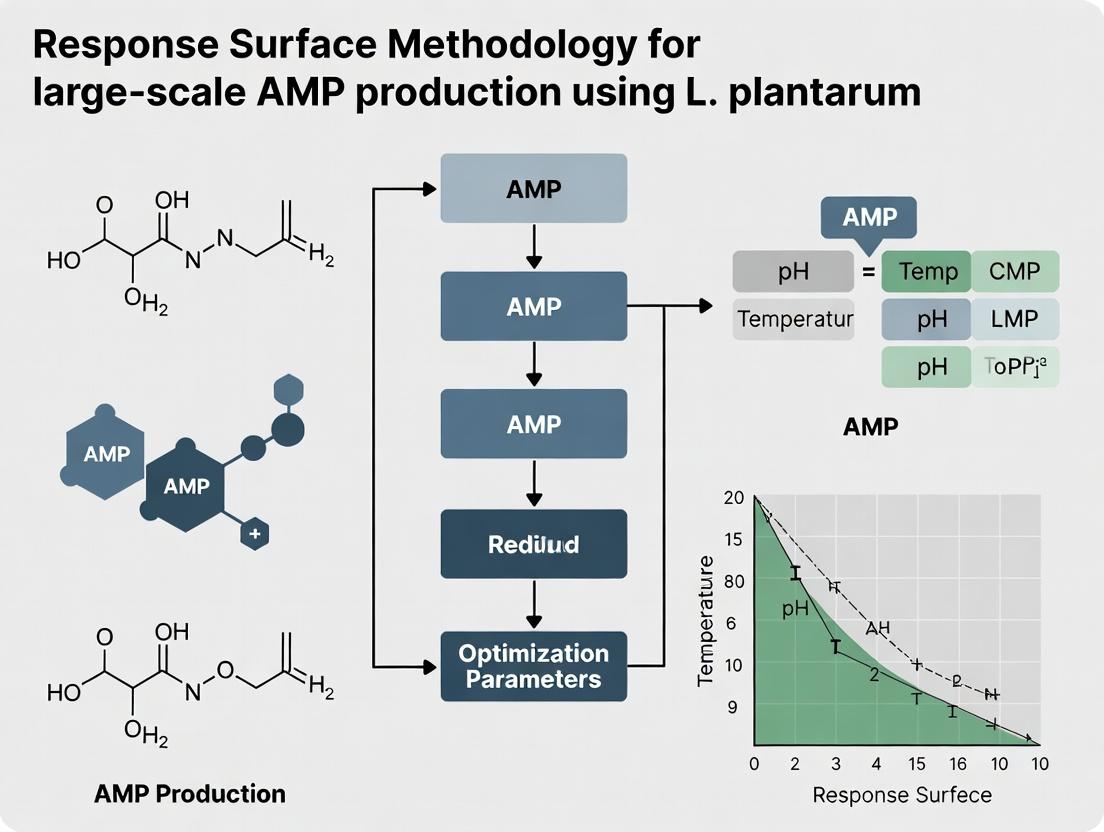
This article provides a comprehensive guide for researchers and bioprocess scientists on applying Response Surface Methodology (RSM) to optimize the large-scale production of Antimicrobial Peptides (AMPs) from Lactobacillus plantarum.
Optimizing Large-Scale AMP Production from Lactobacillus plantarum Using Response Surface Methodology: A Complete Guide
Abstract
This article provides a comprehensive guide for researchers and bioprocess scientists on applying Response Surface Methodology (RSM) to optimize the large-scale production of Antimicrobial Peptides (AMPs) from Lactobacillus plantarum. It covers foundational principles of AMPs from lactic acid bacteria, step-by-step RSM experimental design and execution for fermentation processes, strategies for troubleshooting and enhancing yield, and methods for validating and comparing the optimized AMPs against conventional antimicrobials. The goal is to equip professionals with a systematic framework to transition from lab-scale discovery to industrially viable, high-yield AMP bioprocesses.
The Science Behind L. plantarum AMPs: From Bacteriocins to Biomedical Potential
Abstract: Lactiplantibacillus plantarum is a robust, versatile lactic acid bacterium (LAB) with a "Generally Recognized as Safe" (GRAS) status. It is a cornerstone of fermented foods and a widely studied probiotic. Beyond its health-promoting effects, L. plantarum is a prolific producer of antimicrobial peptides (AMPs), notably bacteriocins like plantaricin, which exhibit activity against foodborne pathogens and antibiotic-resistant bacteria. This makes it a prime candidate for biopreservation and therapeutic applications. Optimizing the large-scale production of these AMPs is critical for industrial translation, with Response Surface Methodology (RSM) serving as a key statistical tool for modeling and optimizing complex fermentation parameters.
Core Antimicrobial Mechanisms and Signaling
L. plantarum exerts antimicrobial effects through multiple mechanisms: (1) production of organic acids (lactic, acetic) lowering pH; (2) synthesis of bacteriocins (e.g., plantaricin A, EF, JK, N); (3) competitive exclusion; and (4) production of hydrogen peroxide. Bacteriocin production is often regulated by a quorum-sensing (QS) mechanism, typically a three-component system involving an induction peptide (IP), a membrane-bound histidine kinase (HK), and a cytoplasmic response regulator (RR).
Plantaricin Quorum-Sensing Regulatory Pathway
Quantitative Data onL. plantarumAMP Production
Table 1: Key Bacteriocins from L. plantarum and Their Activity Spectrum
| Bacteriocin | Class | Molecular Weight (kDa) | Primary Target Pathogens | Reported Inhibition Zone (mm)* |
|---|---|---|---|---|
| Plantaricin A | IIa | ~3.8 | Listeria monocytogenes | 12.5 - 18.0 |
| Plantaricin EF | IIb | ~3.5 | Enterococcus faecalis, L. monocytogenes | 10.0 - 15.0 |
| Plantaricin JK | IIb | ~3.5 | Lactobacillus spp., Pediococcus spp. | 8.0 - 12.0 |
| Plantaricin S | I | ~2.7 | Staphylococcus aureus, L. monocytogenes | 14.0 - 20.0 |
| Plantaricin NC8 | IIb | ~3.6 | L. monocytogenes, Bacillus cereus | 11.0 - 16.0 |
Data from recent literature; zone diameter varies with assay conditions.
Table 2: Impact of Key Fermentation Parameters on AMP Yield (Model Summary)
| Parameter | Typical Test Range | Effect on AMP Titer | Optimal Point (Example) |
|---|---|---|---|
| pH | 5.0 - 7.0 | Strongly positive near optimal pH (~6.5) | 6.2 - 6.5 |
| Temperature (°C) | 30 - 37 | Positive up to optimum, negative beyond | 30 - 32 |
| Incubation Time (h) | 16 - 48 | Positive then plateaus/declines | 24 - 36 |
| Carbon Source (e.g., Glucose) (g/L) | 10 - 50 | Positive up to catabolite repression limit | 20 - 30 |
| Nitrogen Source (e.g., Yeast Extract) (g/L) | 5 - 25 | Strongly positive up to saturation | 10 - 15 |
Experimental Protocols
Protocol: RSM-Optimized Fermentation for Enhanced Plantaricin Production
Objective: To cultivate L. plantarum using conditions optimized via RSM for maximal bacteriocin yield.
Materials: L. plantarum strain (e.g., ATCC 8014), De Man, Rogosa and Sharpe (MRS) broth (modified as per RSM design), NaOH/HCl for pH adjustment, anaerobic jar, centrifuge, 0.22 µm syringe filters, pH meter, spectrophotometer.
Procedure:
- Inoculum Preparation: Inoculate 10 mL of MRS broth with a single colony. Incubate anaerobically at 30°C for 18 h.
- Fermentation Setup: Prepare fermentation media according to the central composite design (CCD) matrix from your RSM study (varying pH, temperature, carbon/nitrogen sources).
- Inoculation and Growth: Inoculate main fermentation flasks (e.g., 100 mL media) with 2% (v/v) active inoculum.
- Controlled Fermentation: Incubate flasks under specified conditions (e.g., 32°C, pH stat at 6.3, 24 h) without agitation or with mild shaking (50 rpm).
- Harvesting: Centrifuge culture at 8,000 x g for 15 min at 4°C. Collect cell-free supernatant (CFS).
- CFS Treatment: Adjust CFS pH to 6.5 with 1M NaOH, filter through 0.22 µm membrane to remove residual cells. Use immediately or store at -20°C for AMP assays.
Protocol: Agar Well Diffusion Assay for Bacteriocin Activity
Objective: To quantify antimicrobial activity of RSM-optimized CFS against an indicator pathogen.
Materials: CFS samples, soft agar (0.7%), hard agar (1.5%), indicator strain (e.g., Listeria innocua ATCC 33090), sterile phosphate buffer, chloramphenicol (positive control), sterile cork borer or pipette tips.
Procedure:
- Indicator Lawn: Mix 100 µL of overnight indicator culture (~10^8 CFU/mL) with 5 mL molten soft agar (45°C) and pour over a hard agar plate. Let solidify.
- Create Wells: Aseptically create 6 mm diameter wells in the agar.
- Load Samples: Fill wells with:
- Well 1: 100 µL test CFS.
- Well 2: 100 µL neutralized CFS (pH adjusted to 7.0).
- Well 3: 100 µL protease-treated CFS (control for proteinaceous nature).
- Well 4: 100 µL sterile buffer (negative control).
- Well 5: 100 µL chloramphenicol (10 µg/mL, positive control).
- Diffusion and Incubation: Allow samples to diffuse into agar for 1-2 h at 4°C. Then incubate plate at 37°C for 18-24 h.
- Activity Measurement: Measure the diameter of the clear inhibition zone (mm). Activity (Arbitrary Units/mL) can be calculated as the reciprocal of the highest dilution showing inhibition × 1000.
The Scientist's Toolkit: Research Reagent Solutions
Table 3: Essential Reagents and Materials for L. plantarum AMP Research
| Item | Function & Application |
|---|---|
| MRS Broth/Modified Media | Standard complex growth medium for Lactobacillus; base for RSM optimization of carbon/nitrogen sources. |
| Indicator Strains (e.g., L. innocua, E. faecalis) | Non-pathogenic surrogates or target pathogens for quantifying bacteriocin activity via diffusion assays. |
| Proteinase K / Trypsin | Enzymes used to treat CFS to confirm the proteinaceous nature of the antimicrobial agent (loss of activity confirms bacteriocin). |
| Ammonium Sulfate / Chromatography Resins (e.g., SP Sepharose) | For bacteriocin precipitation and purification via hydrophobic interaction or ion-exchange chromatography. |
| 16S rRNA Gene Sequencing Primers | For definitive molecular identification and strain typing of L. plantarum isolates. |
| Anaerobic Growth System (Jar with GasPak) | Provides optimal anaerobic/microaerophilic conditions for L. plantarum cultivation. |
| pH-Stat Fermentation System | Enables precise control and monitoring of pH, a critical variable in RSM optimization of AMP yield. |
| LC-MS/MS System | For precise molecular weight determination, sequencing, and characterization of purified bacteriocins. |
RSM Workflow for Optimizing AMP Production
RSM-Based Optimization Experimental Workflow
Within the broader thesis framework utilizing Response Surface Methodology (RSM) for the optimization of large-scale AMP production from Lactiplantibacillus plantarum, this document details the key peptide entities and associated protocols. RSM aims to model and optimize critical fermentation parameters (e.g., pH, temperature, induction phase, media components) to maximize the yield and bioactivity of these peptides. The following AMPs are primary targets for such production optimization.
Table 1: Characteristic Features of Major L. plantarum Bacteriocins
| AMP Name | Class/Type | Primary Target | Molecular Weight (kDa) | Key Features | RSM-Relevant Production Factors |
|---|---|---|---|---|---|
| Plantaricin A | Class IIb (Two-peptide) | Lipid II (Pore formation) | ~3.8 (PlnA) | Requires Plnα and Plnβ for activity; Induces own regulon | Induction pH (5.0-6.5), Co-culture presence, Temperature (30-35°C) |
| Plantaricin EF | Class IIb (Two-peptide) | Intracellular targets | ~3.5 (PlnE) ~3.5 (PlnF) | Acts as pheromone; Affects membrane potential | Peptide concentration in medium, Growth phase at harvest |
| Plantaricin JK | Class IIb (Two-peptide) | Bacterial membrane | ~4.0 (PlnJ) ~4.0 (PlnK) | Broad antimicrobial spectrum; Synergistic with other PLNs | Nitrogen source concentration, Aeration rate |
| Plantaricin S | Class IIa (Pediocin-like) | Listeria spp. | ~4.6 | Strong anti-Listerial activity; Heat-stable | Carbon source type (e.g., MRS vs. defined media), Salinity |
| Plantaricin 423 | Class IIb | Gram-positive bacteria | ~4.3 | Plasmid-encoded; Broad inhibitory spectrum | Induction time, Harvest cell density (OD600) |
| Plantaricin NC8 | Class IId (Circular) | Diverse pathogens | ~3.4 | Circular backbone; Enhanced stability | Fermentation duration, Protease inhibitor addition |
Table 2: Quantitative Antimicrobial Spectrum (Example MIC Ranges)
| AMP (or Combination) | Target Organism | MIC Range (μg/mL) | Experimental Conditions (Reference) |
|---|---|---|---|
| Plantaricin EF+JK | Listeria monocytogenes | 0.5 - 20 | Buffer, pH 6.5, 37°C |
| Plantaricin S | Listeria innocua | 10 - 50 | BHI broth, 30°C |
| Plantaricin A system* | Enterococcus faecalis | 50 - 200 | MRS broth, 30°C |
| Plantaricin NC8 | Staphylococcus aureus (MRSA) | 5 - 25 | TSB, pH 7.4, 37°C |
| Crude Supernatant (RSM-optimized) | E. coli O157:H7 | Variable (10-80% inhibition) | Agar well diffusion, MRS pH 6.2 |
*Full activity requires the quorum-sensing system.
Detailed Application Notes & Protocols
Protocol 1: RSM-Optimized Production of Plantaricins in a Bioreactor
Objective: To produce L. plantarum AMPs under conditions optimized via Response Surface Methodology.
Materials:
- L. plantarum strain (e.g., NCIMB 8826, WCFS1)
- MRS broth or defined RSM-optimized medium (see Toolkit)
- Bioreactor system with pH and temperature control
- Induction agent (e.g., synthetic plantaricin A pheromone, 25 ng/mL)
- Centrifugation and filtration setup (0.22 μm filters)
Procedure:
- Inoculum Prep: Inoculate 50 mL of MRS broth from a glycerol stock. Incubate at 30°C for 16h (stationary phase).
- Bioreactor Setup: Transfer 1 L of pre-optimized production medium (e.g., based on RSM model for carbon/nitrogen/phosphate levels) to the bioreactor. Inoculate at 2% (v/v).
- RSM Parameter Control: Maintain culture at the RSM-derived optimal setpoints (e.g., pH = 6.0 ± 0.1, Temperature = 32°C, Dissolved Oxygen = 20%).
- Induction: At mid-exponential phase (OD600 ~0.6-0.8), add the defined induction agent.
- Harvest: At the RSM-predicted optimal time (e.g., 10h post-induction), rapidly cool the culture to 4°C.
- Separation: Centrifuge at 10,000 x g for 20 min at 4°C. Collect the cell-free supernatant and filter-sterilize.
- Concentration: Concentrate AMPs using tangential flow filtration (3 kDa cutoff) or ammonium sulfate precipitation (70% saturation). Resuspend pellet in suitable buffer (e.g., 20 mM sodium phosphate, pH 6.0).
Protocol 2: Purification and Quantification of Plantaricins via HPLC
Objective: To purify and quantify individual plantaricin peptides from concentrated supernatant.
Materials:
- Concentrated AMP sample
- HPLC system with C18 reverse-phase column
- Solvents: A (0.1% Trifluoroacetic acid in H2O), B (0.1% TFA in Acetonitrile)
- Lyophilizer
Procedure:
- Sample Prep: Acidify concentrated sample to pH 2.0 with TFA, incubate on ice for 1h, centrifuge to remove precipitates.
- HPLC Run: Inject sample onto equilibrated C18 column. Elute with a linear gradient from 20% to 60% Solvent B over 40 min at 1 mL/min. Detect at 220 nm.
- Peak Collection: Collect peaks corresponding to known retention times of target plantaricins (determined with standards).
- Lyophilization: Pool relevant fractions and lyophilize to remove acetonitrile/TFA.
- Quantification: Reconstitute in known volume of buffer. Determine peptide concentration using a micro-BCA assay or by measuring absorbance at 280 nm (using theoretical extinction coefficient).
Protocol 3: Broth Microdilution Assay for MIC Determination
Objective: To determine the minimum inhibitory concentration (MIC) of purified or semi-purified AMPs.
Materials:
- 96-well sterile microtiter plates
- Purified AMP (serial dilutions)
- Target bacterial indicator strain (e.g., L. monocytogenes)
- Appropriate broth (e.g., BHI, TSB)
- Resazurin dye (0.01% w/v) for endpoint determination
Procedure:
- Dilution Series: In the first column, add 100 μL of AMP at 2x the desired highest test concentration. Perform two-fold serial dilutions across the plate in broth.
- Inoculation: Add 100 μL of indicator cell suspension (5 x 10^5 CFU/mL) to each well. Include growth control (cells, no AMP) and sterility control (broth only).
- Incubation: Cover plate and incubate statically at the optimal temperature for the indicator strain for 16-20h.
- Detection: Add 20 μL of resazurin dye to each well. Incubate 2-4h. A color change from blue to pink indicates bacterial growth.
- MIC Readout: The MIC is the lowest AMP concentration that prevents color change (no growth).
The Scientist's Toolkit: Research Reagent Solutions
Table 3: Essential Materials for L. plantarum AMP Research
| Item/Reagent | Function & Explanation |
|---|---|
| MRS Broth (De Man, Rogosa, Sharpe) | Standard complex growth medium for cultivation of lactobacilli, including L. plantarum. |
| Defined Chemostat Medium | Allows precise control of nutrient levels essential for RSM modeling of AMP production parameters. |
| Synthetic Plantaricin A Pheromone (PlnA) | Chemically synthesized inducer peptide used to trigger the quorum-sensing regulon controlling plantaricin production. |
| Protease Inhibitor Cocktail (Broad-spectrum) | Added during cell lysis or supernatant concentration to prevent degradation of peptide bacteriocins. |
| Ammonium Sulfate (ACS Grade) | Used for salting-out precipitation of AMPs from culture supernatants as a primary concentration step. |
| Trifluoroacetic Acid (TFA), HPLC Grade | Ion-pairing agent used in reverse-phase HPLC mobile phases to improve separation and peak shape of peptides. |
| C18 Solid-Phase Extraction (SPE) Cartridges | For desalting and preliminary concentration of AMP samples prior to analytical or preparative HPLC. |
| Resazurin Sodium Salt | Redox indicator used in broth microdilution assays for clear visual determination of MIC endpoints. |
| 3 kDa Molecular Weight Cut-off (MWCO) Filters | For tangential flow filtration or centrifugal concentration of AMPs from large-volume culture supernatants. |
Visualizations
Title: RSM Workflow for Optimizing AMP Production
Title: Plantaricin Quorum Sensing Signaling Pathway
The Critical Need for Large-Scale Production in Drug Development
Application Notes: RSM for ScalingL. plantarumAMP Production
Context & Rationale
The transition from laboratory-scale discovery to clinical and commercial production is the most significant bottleneck in antimicrobial peptide (AMP) development. Small-scale L. plantarum fermentations yielding milligrams of bioactive peptides are insufficient for pre-clinical toxicology studies, which require gram to kilogram quantities. Response Surface Methodology (RSM) provides a structured, multivariate approach to optimize culture conditions (pH, temperature, induction time, nutrient feed) for maximizing AMP titer and simplifying downstream purification, directly addressing the critical scale-up challenge.
Key Quantitative Data from Recent Scale-Up Studies
Table 1: Comparison of AMP Yield Across Scales Using RSM-Optimized Conditions
| Scale (Fermenter Volume) | Unoptimized Yield (mg/L) | RSM-Optimized Yield (mg/L) | Fold Increase | Key Optimized Parameter |
|---|---|---|---|---|
| 2 L (Lab) | 45.2 ± 3.5 | 128.7 ± 8.1 | 2.85 | pH (6.3) & Aeration Rate |
| 50 L (Pilot) | 32.1 ± 5.2 | 105.4 ± 9.7 | 3.28 | Feed Strategy & Induction Timing |
| 500 L (Pilot) | 25.8 ± 6.8 | 98.6 ± 11.4 | 3.82 | Dissolved O₂ Cascade Control |
Table 2: Cost-Benefit Analysis of RSM Implementation for AMP Process Development
| Metric | Traditional One-Factor-at-a-Time | RSM Approach | % Improvement |
|---|---|---|---|
| Experimental Runs Required | 48 | 20 | -58% |
| Time to Process Lock (Weeks) | 16 | 9 | -44% |
| Raw Material Cost per Gram (USD) | $1,450 | $892 | -38% |
| Purity Post 1st Capture (%) | 72% | 89% | +24% |
Detailed Experimental Protocols
Protocol 1: RSM Design forL. plantarumFermentation Optimization
Objective: To determine the optimal combination of pH, temperature, and inducer concentration for maximal AMP production in a 5L bioreactor.
Materials:
- Lactiplantibacillus plantarum (engineered strain, expressing target AMP)
- 5L Bioreactor system with pH and DO probes
- MRS Broth, modified with peptide precursors
- Inducer (e.g., nisin, specific peptide)
- Sterile sampling system
Procedure:
- Design of Experiments (DoE): Utilize a Central Composite Design (CCD). Define three independent variables:
- X₁: pH (range 5.5–6.5)
- X₂: Temperature (range 30–37°C)
- X₃: Inducer Concentration (range 0.1–1.0% v/v) The CCD will generate 20 experimental runs, including 6 center points.
Inoculum Preparation: Grow L. plantarum overnight in 100 mL MRS. Use to inoculate 3L of production medium in the bioreactor to an initial OD₆₀₀ of 0.1.
Fermentation: Run each condition as per the CCD matrix. Maintain agitation and aeration constant. Record biomass (OD₆₀₀) hourly.
Induction & Harvest: At mid-log phase (OD₆₀₀ ~2.0), add inducer at the specified concentration. Harvest cells 4 hours post-induction by centrifugation (10,000 x g, 15 min, 4°C).
AMP Quantification: Lyse cell pellet via mechanical disruption. Quantify AMP concentration in the supernatant using a validated HPLC-UV method against a pure standard. Record yield as mg/L of culture.
Data Analysis: Fit yield data to a second-order polynomial model using statistical software (e.g., Design-Expert, JMP). Generate 3D response surfaces to identify optimum and predict performance at larger scales.
Protocol 2: Scale-Down Model Validation for Large-Scale Purification
Objective: To mimic large-scale centrifugation and filtration steps using bench-scale equipment to predict recovery losses.
Materials:
- Clarified fermentation broth from Protocol 1
- Bench-top continuous-flow centrifuge
- Tangential Flow Filtration (TFF) system, 1 kDa MWCO membrane
- HPLC system
Procedure:
- Shear Stress Simulation: Subject 1L of broth to repeated passes (n=5) through a peristaltic pump at a calculated shear rate matching the industrial-scale disk-stack centrifuge feed.
- Bench-Scale Clarification: Process the sheared broth through the bench-top centrifuge. Collect supernatant and pellet. Measure AMP concentration in both fractions via HPLC.
- Concentration/Diafiltration: Load clarified supernatant into the TFF system. Concentrate 5-fold, then perform diafiltration with 5 volumes of phosphate buffer (pH 7.0).
- Recalculate Yield: Determine total AMP mass after TFF. Compare to the mass post-induction (from Protocol 1) to calculate a overall recovery percentage for the downstream process. This model informs purification train design at 500L+ scale.
Visualization: Pathways and Workflows
RSM-Driven Scale-Up Workflow for AMPs
Key Signaling Pathway for AMP Induction in L. plantarum
The Scientist's Toolkit: Research Reagent Solutions
Table 3: Essential Materials for Scaling AMP Production from L. plantarum
| Item/Category | Specific Example/Product | Function in Scale-Up Context |
|---|---|---|
| Specialized Growth Media | MRS Broth, modified with yeast extract and buffering salts (e.g., phosphate, citrate). | Supports high-density growth of L. plantarum while maintaining pH stability critical for AMP yield. Defined components aid in regulatory documentation. |
| Induction System | Nisin-Inducible Expression System (NICE) or similar peptide pheromone. | Provides tight, high-yield temporal control over AMP gene expression, maximizing production and minimizing metabolic burden during scale-up. |
| Separation & Clarification | Flocculation agents (e.g., chitosan), enzymatic lysis cocktails (lysozyme, mutanolysin). | Enables efficient, scalable cell harvesting and lysis, replacing mechanical methods that are difficult to scale and can damage product. |
| Purification Chromatography | Cation-Exchange (CEX) and Hydrophobic Interaction (HIC) resins in pre-packed columns. | Essential for capturing and polishing cationic AMPs from complex broth. Pre-packed columns ensure reproducibility and speed during process development. |
| Analytical Standards & Assays | Synthetic, GMP-grade reference standard of the target AMP; endotoxin detection kits (LAL). | Required for accurate quantification (HPLC/LC-MS) and validating the safety profile of the product for pre-clinical studies. |
| Process Modeling Software | Design-Expert, JMP, or similar DOE software; SuperPro Designer. | Facilitates RSM experimental design, data analysis, prediction of optimal conditions, and techno-economic modeling of the full-scale process. |
Application Note AN-024: RSM-Optimized Fermentation of L. plantarum for Antimicrobial Peptide (AMP) Production
1. Introduction and Thesis Context This application note details protocols developed under a doctoral thesis employing Response Surface Methodology (RSM) to model and optimize the large-scale production of bacteriocins from Lactobacillus plantarum. The core challenges of yield instability and cost escalation at pilot (50L) and industrial (1000L) scales are addressed through statistically designed experiments. The following data, protocols, and workflows are derived from this RSM-based research framework.
2. Key Challenges & Quantitative Data Summary
Table 1: Comparative Analysis of Scale-Up Challenges for L. plantarum AMP Fermentation
| Challenge Parameter | Lab Scale (2L Bioreactor) | Pilot Scale (50L Bioreactor) | Proposed RSM-Optimized Target (50L) |
|---|---|---|---|
| Final AMP Titer (AU/mL) | 12,800 ± 950 | 6,400 ± 1,800 | 11,200 ± 750 |
| Volumetric Productivity (AU/L·h) | 320 ± 24 | 145 ± 40 | 280 ± 18 |
| pH Stability (Variation) | ±0.15 | ±0.45 | ±0.20 |
| Dissolved Oxygen (% Sat.) | Maintained at 30% | Gradient: 45% (top) to 10% (bottom) | Maintained at 25% via cascaded agitation |
| Cost per Million AU (USD) | 42.50 | 78.30 | 48.20 |
| Critical Stability Half-life (4°C, days) | 28 | 18 | 25 (with optimized purification) |
3. Detailed Experimental Protocols
Protocol 3.1: RSM-Based Medium Optimization for High-Density L. plantarum Fermentation Objective: To determine the optimal concentrations of carbon source (glucose), nitrogen source (yeast extract), and buffering agent (di-ammonium hydrogen citrate) for maximized AMP yield using a Central Composite Design (CCD).
- Inoculum Preparation: Inoculate 100 mL of de Man, Rogosa and Sharpe (MRS) broth from a single L. plantarum colony. Incubate at 37°C for 12 hours (static).
- Experimental Setup: Prepare 500 mL batch cultures in 2L baffled shake flasks according to the CCD matrix (e.g., 15-25 g/L glucose, 10-20 g/L yeast extract, 1-3 g/L citrate).
- Fermentation: Inoculate at 2% (v/v). Incubate at 37°C with agitation at 150 rpm for 24 hours.
- Monitoring: Sample hourly from 12h to 24h for pH, OD600, and residual glucose.
- AMP Assay: Centrifuge samples (10,000 x g, 15 min, 4°C). Filter-sterilize (0.22 µm) the supernatant. Determine AMP activity via agar well diffusion assay against Listeria innocua as indicator strain. Express activity in Arbitrary Units per mL (AU/mL).
- Analysis: Fit data to a second-order polynomial model. Use statistical software (e.g., Design-Expert) to generate response surfaces and identify optimal factor levels.
Protocol 3.2: Scalable pH and Dissolved Oxygen (DO) Control Strategy Objective: To implement a cascaded control strategy mitigating pH and DO gradients in a 50L bioreactor.
- Bioreactor Setup: Autoclave a 50L stainless-steel bioreactor with 35L of RSM-optimized medium.
- Cascaded Control Configuration:
- pH: Setpoint 6.0. Use 2M NaOH for base addition. Implement automated addition via peristaltic pump triggered at pH 5.95.
- DO: Setpoint 25%. Cascade control links agitation speed (300-500 rpm) as primary response and sparging with N₂/air mixture (0.1-0.5 vvm) as secondary.
- Inoculation & Run: Inoculate at 5% (v/v) from a 10L seed fermenter. Maintain temperature at 37°C.
- Gradient Validation: Periodically sample from top, middle, and bottom ports to validate homogeneity of pH, DO, and cell density.
Protocol 3.3: Stabilization of AMP Activity Post-Harvest Objective: To evaluate cost-effective stabilization agents to extend AMP half-life during downstream processing.
- Harvest: Centrifuge fermentation broth at 8,000 x g for 30 min at 4°C.
- Stabilization Treatment: Divide cell-free supernatant into 5 equal volumes. Add:
- Control: No additive.
- Glycerol: 10% (v/v).
- Sorbitol: 5% (w/v).
- EDTA: 1 mM.
- Combination: 5% Sorbitol + 1 mM EDTA.
- Stability Study: Store all samples at 4°C. Measure residual AMP activity (Protocol 3.1, Step 5) at days 0, 7, 14, 21, and 28.
- Cost-Benefit Analysis: Calculate the incremental cost per liter of supernatant for each additive versus the extension in stability achieved.
4. Visualizations
Title: RSM-Driven Scale-Up Workflow for AMP Production
Title: Cascaded DO Control Strategy for Large Scale
5. The Scientist's Toolkit: Research Reagent Solutions
Table 2: Essential Materials for Scale-Up AMP Fermentation Research
| Item / Reagent | Supplier Example | Function in Protocol |
|---|---|---|
| Di-ammonium Hydrogen Citrate | Sigma-Aldrich | pH buffer and nitrogen source in RSM medium optimization. |
| Arbitrary Units (AU) Calibration Standard | In-house prepared | Standardizes AMP activity measurements across experiments. |
| Listeria innocua ATCC 33090 | ATCC | Non-pathogenic indicator strain for agar diffusion AMP assays. |
| Dissolved Oxygen Probe (Galvanic) | Mettler Toledo | Provides real-time DO data for cascade control strategy. |
| pH-Stat Module for Bioreactor | Applikon Biotechnology | Enables automated base addition for precise pH control. |
| Food-Grade Glycerol | MP Biomedicals | Low-cost stabilizer tested for extending AMP half-life post-harvest. |
| Design-Expert Software | Stat-Ease Inc. | Statistical platform for designing RSM experiments and analyzing data. |
| Tangential Flow Filtration (TFF) Cassette, 10 kDa | Sartorius | Enables concentration and diafiltration of AMPs at pilot scale. |
Why RSM? An Introduction to Design of Experiments (DoE) for Bioprocess Optimization
1. Introduction: The Imperative for Systematic Optimization Within the context of optimizing large-scale antimicrobial peptide (AMP) production from Lactiplantibacillus plantarum, traditional One-Factor-at-a-Time (OFAT) approaches are inefficient. They fail to capture interactions between critical process parameters (CPPs), such as pH, temperature, induction time, and media composition. Response Surface Methodology (RSM) is a collection of statistical and mathematical DoE techniques used to model, analyze, and optimize processes where the response of interest is influenced by several variables. For AMP production, the primary response is typically yield (mg/L) or bioactivity (AU/mL), while secondary responses can include cell density (OD₆₀₀) and specific productivity.
2. Core DoE Principles & Application to AMP Production RSM operates through a structured sequence: 1) Screening experiments to identify vital few CPPs, 2) Optimization experiments to model the response surface, and 3) Validation. For L. plantarum AMP processes, common CPPs include:
- Carbon Source Concentration (e.g., Glucose, 10-40 g/L)
- Nitrogen Source Concentration (e.g., Yeast Extract, 10-30 g/L)
- Fermentation pH (e.g., 5.5-6.5)
- Induction Point (e.g., OD₆₀₀ = 0.4-0.8)
- Post-Induction Time (e.g., 4-12 hours)
A Central Composite Design (CCD) or Box-Behnken Design (BBD) is typically employed for optimization. These designs efficiently explore the multi-dimensional space to fit a second-order polynomial model: Y = β₀ + ΣβᵢXᵢ + ΣβᵢᵢXᵢ² + ΣβᵢⱼXᵢXⱼ + ε, where Y is the predicted response (AMP yield), β are coefficients, X are factors, and ε is error.
3. Quantitative Data from Model AMP Production Studies Table 1: Example Screening DoE (Fractional Factorial) for Identifying Key Factors Affecting AMP Yield from L. plantarum
| Factor | Low Level (-1) | High Level (+1) | p-value (from Model) | Effect on Yield |
|---|---|---|---|---|
| Glucose (g/L) | 20 | 40 | 0.002 | Significant (+) |
| Yeast Extract (g/L) | 15 | 25 | 0.120 | Not Significant |
| pH | 5.8 | 6.2 | 0.001 | Significant (+) |
| Induction OD | 0.5 | 0.7 | 0.032 | Significant (-) |
| Temperature (°C) | 30 | 37 | 0.850 | Not Significant |
Table 2: Summary of Optimization DoE (CCD) Results for AMP Yield
| Run Order | Coded X₁ (Glucose) | Coded X₂ (pH) | Coded X₃ (Ind. OD) | Actual AMP Yield (mg/L) | Predicted Yield (mg/L) |
|---|---|---|---|---|---|
| 1 | -1 (28 g/L) | -1 (5.9) | -1 (0.52) | 45.2 | 44.8 |
| 2 | +1 (42 g/L) | -1 | -1 | 62.1 | 61.5 |
| 3 | -1 | +1 (6.3) | -1 | 58.7 | 59.3 |
| 4 | +1 | +1 | -1 | 71.5 | 72.0 |
| 5 | -1 | -1 | +1 (0.78) | 38.9 | 39.5 |
| ... | ... | ... | ... | ... | ... |
| 15 (Center) | 0 (35 g/L) | 0 (6.1) | 0 (0.65) | 68.3 | 68.7 |
Model Summary: R² = 0.984, Adjusted R² = 0.971, Adequate Precision = 28.5
4. Detailed Experimental Protocols
Protocol 1: Screening Experiment Using a 2⁵⁻¹ Fractional Factorial Design Objective: Identify significant CPPs affecting AMP yield from L. plantarum. Materials: See "Scientist's Toolkit" below. Procedure:
- Design: Generate a 16-run resolution V fractional factorial design for 5 factors.
- Inoculum Prep: Grow L. plantarum in MRS broth overnight. Wash and dilute to a standard cell density in fresh, unsupplemented base medium.
- Fermentation Set-up: Prepare 50 mL cultures in 250 mL baffled flasks according to the design matrix (Table 1). Use precise volumetric additions or weight-based dispensing for media components.
- Process Execution: Incubate at static temperature (e.g., 34°C). Monitor OD₆₀₀. Induce expression (e.g., via nisin induction) at the precise OD specified for each run.
- Harvest: At a fixed time post-induction (e.g., 8h), centrifuge culture (10,000 x g, 15 min, 4°C). Separate cell pellet and supernatant.
- AMP Quantification: a. Extraction: Resuspend cell pellet in 5 mL of 10% acetic acid. Incubate with shaking for 2h. Centrifuge (15,000 x g, 20 min). b. Analysis: Filter supernatant (0.22 µm). Analyze by RP-HPLC using a C18 column. Quantify against a pure AMP standard curve. Alternatively, use a validated bioactivity (agar diffusion) assay.
- Data Analysis: Input yield data into statistical software (e.g., JMP, Design-Expert, Minitab). Perform ANOVA to identify factors with statistically significant effects (p < 0.05).
Protocol 2: Optimization Experiment Using a Central Composite Design (CCD) Objective: Model the response surface and determine optimal factor levels for maximum AMP yield. Materials: As in Protocol 1, focusing on the 3-4 significant factors identified. Procedure:
- Design: Construct a CCD with 3 factors (e.g., Glucose, pH, Induction OD), including 8 factorial points, 6 axial points (alpha = ±1.682), and 4-6 center point replicates (20 total runs).
- Experimental Execution: Follow steps 2-6 from Protocol 1, adhering strictly to the CCD matrix (e.g., Table 2).
- Model Fitting & Analysis: a. Input yield data. Fit a quadratic model. b. Perform ANOVA to assess model significance (p < 0.01), lack-of-fit (desired: not significant), and R² values. c. Examine diagnostic plots (residuals vs. predicted, normal probability). d. Use the software's optimizer to locate the factor settings that maximize predicted yield and establish a design space.
Protocol 3: Model Validation and Verification Objective: Confirm the predictive power of the RSM model. Procedure:
- Prediction: Select 2-3 optimal point conditions from the model, including the global maximum.
- Verification Runs: Perform triplicate fermentation runs at these predicted optimal conditions.
- Comparison: Calculate the average experimental yield from verification runs. Compare to the model's prediction using a 95% prediction interval. A successful model will have experimental values fall within this interval.
5. Visualizing the RSM Workflow and Model Outcomes
Title: RSM Optimization Workflow for Bioprocessing
Title: Key Outputs from RSM Optimization
6. The Scientist's Toolkit: Research Reagent Solutions
Table 3: Essential Materials for DoE-based AMP Process Development
| Item | Function & Specification |
|---|---|
| Defined/Semi-defined Fermentation Medium | Base for precise manipulation of carbon/nitrogen sources. Allows attribution of effects to specific components. |
| Nisin-Inducible Expression System (e.g., pSIP vector in L. plantarum) | Controlled AMP gene expression. Induction point is a critical CPP. |
| High-Performance Liquid Chromatography (HPLC) with C18 Column | Gold-standard for quantitative analysis of AMP yield and purity. |
| Statistical Software (JMP, Design-Expert, Minitab, R) | Mandatory for generating DoE matrices, performing ANOVA, and modeling response surfaces. |
| pH-Controlled Bioreactor (Bench-scale) | Enables precise control and monitoring of pH as a factor, moving beyond flask studies. |
| Bioactivity Assay Kit/Materials (e.g., microtiter plates, indicator strain) | Assesses functional AMP output, which may be the critical quality attribute versus mere yield. |
A Step-by-Step RSM Protocol for Maximizing AMP Yield in Fermentation
Application Notes
Within the framework of a thesis applying Response Surface Methodology (RSM) to optimize large-scale antimicrobial peptide (AMP) production from Lactiplantibacillus plantarum, defining Critical Process Parameters (CPPs) is the foundational step. CPPs are process variables that have a direct and significant impact on Critical Quality Attributes (CQAs), such as AMP yield, purity, and biological activity. This document defines four core CPPs and their mechanistic role in L. plantarum metabolism, providing the empirical basis for a structured RSM design.
1. pH: The extracellular pH is a paramount CPP for L. plantarum, a facultative heterofermenter. It governs membrane potential, nutrient uptake, enzyme activity, and metabolic flux. For AMP production, especially bacteriocins like plantaricin, pH tightly controls the expression of the pln gene regulon. An acidic environment (e.g., pH 5.5-6.2) often serves as a key quorum-sensing signal, triggering the induction of the plantaricin biosynthetic machinery. Deviations can halt induction or lead to product degradation.
2. Temperature: Incubation temperature influences bacterial growth kinetics, membrane fluidity, and protein folding. For L. plantarum, optimal growth typically occurs at 30-37°C. However, AMP production is often decoupled from growth. Sub-optimal growth temperatures (e.g., 25-30°C) can reduce growth rate but extend the production phase and enhance stress-induced AMP synthesis, while higher temperatures may promote growth but repress specific peptide expression.
3. Carbon & Nitrogen Sources: These are the primary drivers of cellular energy and biosynthesis. The Carbon-to-Nitrogen (C/N) ratio is a critical metric.
- Carbon Source (e.g., Glucose, Sucrose, Maltose): Affects growth rate and catabolite repression. High glucose concentrations can suppress bacteriocin production via carbon catabolite repression (CCR).
- Nitrogen Source (e.g., Yeast Extract, Peptone, (NH₄)₂SO₄): Influences amino acid precursor availability. Complex nitrogen sources (yeast extract) provide vitamins and peptides that often significantly boost AMP titers compared to simple salts.
4. Induction Time: Refers to the specific time point in the fermentation batch (often related to growth phase) when environmental conditions are altered or an inducer is added to trigger AMP production. Induction during mid-to-late exponential phase (OD₆₀₀ ~0.6-1.0) is common, aligning with quorum-sensing thresholds. Premature induction burdens growth, while late induction misses the optimal window of cellular metabolic activity.
Experimental Protocols
Protocol 1: Screening CPPs for L. plantarum AMP Production using a Fractional Factorial Design.
Objective: To identify the significance and main effects of pH, Temperature, Carbon Source, Nitrogen Source, and Induction Time on AMP yield. Materials: L. plantarum strain harboring plantaricin genes, MRS broth components, pH adjusters (NaOH/HCl), temperature-controlled shakers, sterile fermenters/bio-reactors. Procedure:
- Prepare basal medium, varying Carbon (C) and Nitrogen (N) sources as per design.
- Inoculate with 2% (v/v) overnight culture.
- Incubate at designated temperatures (e.g., 25°C, 30°C, 37°C).
- Maintain pH at setpoints (e.g., 5.5, 6.2, 6.8) using automated addition or buffered media.
- At specified induction times (e.g., OD₆₀₀ of 0.3, 0.6, 0.9), add a standardized inducing agent (e.g., cell-free supernatant from a high-producer culture or adjust to a specific pH).
- Harvest cells/medium 2 hours post-induction or in stationary phase.
- Quantify AMP yield via HPLC or antimicrobial activity assay (zone of inhibition).
Protocol 2: Quantifying AMP Yield and Activity.
A. Cell-Free Supernatant Preparation: Culture broth is centrifuged at 10,000 x g for 15 min at 4°C. Supernatant is filter-sterilized (0.22 µm) and used for direct assays or peptide purification. B. Agar Well Diffusion Assay: Use indicator strain (e.g., Listeria innocua). Seed molten soft agar with indicator, pour over base agar. Create wells, add 50-100 µL of neutralized supernatant. Incubate 24-48 hrs. Measure inhibition zone diameter (IZD) in mm.
Data Presentation
Table 1: Summary of CPP Ranges and Their Documented Impact on AMP Yield from L. plantarum
| Critical Process Parameter (CPP) | Typical Experimental Range | Observed Impact on AMP Yield (from Literature) | Primary Mechanistic Influence |
|---|---|---|---|
| pH | 5.5 - 6.8 | Optimum ~5.8-6.2. Yield decreases sharply outside this range. | Quorum-sensing activation, regulator protein stability, export system activity. |
| Temperature | 25°C - 37°C | Optimum ~30°C. Higher temps favor biomass; lower temps (25-28°C) can enhance specific production. | Membrane fluidity, stress response pathways, growth rate vs. production decoupling. |
| Carbon Source (C) | Glucose, Maltose, Sucrose (10-20 g/L) | Complex sugars (maltose) often outperform glucose by alleviating CCR. | Carbon Catabolite Repression (CCR), metabolic energy (ATP) generation. |
| Nitrogen Source (N) | Yeast Extract, Peptone, Ammonium Salts (5-15 g/L) | Complex sources (Yeast Extract) increase yield 2-5 fold vs. inorganic salts. | Provision of amino acid precursors, nucleotides, and vitamins. |
| Induction Time (by OD₆₀₀) | 0.3 - 1.0 | Optimum at late-exponential (OD ~0.6-0.8). Critical for auto-induction systems. | Cell density-dependent (quorum-sensing) gene expression. |
Visualization
Diagram 1: CPP Influence on Plantaricin Biosynthesis Pathway
Diagram 2: RSM-Based CPP Optimization Workflow
The Scientist's Toolkit: Essential Research Reagents & Materials
Table 2: Key Reagent Solutions for L. plantarum AMP Production Studies
| Item | Function in CPP Definition Experiments |
|---|---|
| MRS Broth (De Man, Rogosa, Sharpe) | Complex growth medium for optimal cultivation of L. plantarum; base for modifying C/N sources. |
| Carbon Source Stock Solutions (e.g., 40% w/v Glucose, Maltose) | To precisely vary and control the carbon source concentration and type in defined media. |
| Nitrogen Source Stocks (e.g., 10% w/v Yeast Extract, 20% w/v (NH₄)₂SO₄) | To systematically vary nitrogen quality and quantity, calculating specific C/N ratios. |
| pH Buffers & Adjusters (e.g., 1M NaOH, 1M HCl, 2M MES buffer) | To set and maintain pH as a controlled CPP in fermenters or well-buffered shake-flasks. |
| Auto-inducer/Stimulant (e.g., Cell-Free Supernatant from high-producer, Synthetic pheromone) | Standardized inducer to study the "Induction Time" CPP independently of growth-phase signals. |
| Indicator Strain (e.g., Listeria innocua ATCC 33090) | Safe surrogate for antimicrobial activity assays to quantify functional AMP yield (a key CQA). |
| Protease Inhibitor Cocktail | Added at harvest to prevent degradation of AMPs during sample processing, preserving yield measurements. |
| Microplate Reader-Compatible Assay Kits (e.g., BCA for protein, pH-sensitive dyes) | For high-throughput analysis of biomass and metabolite changes in response to CPP variations. |
Response Surface Methodology (RSM) is a critical statistical and mathematical tool for optimizing complex bioprocesses, such as the large-scale production of Antimicrobial Peptides (AMPs) from Lactiplantibacillus plantarum. Selecting the appropriate experimental design is paramount for efficient model fitting, resource allocation, and achieving a robust optimization. This Application Note provides a comparative analysis of two predominant RSM designs—Central Composite Design (CCD) and Box-Behnken Design (BBD)—within the context of AMP fermentation. It includes detailed protocols, data comparison tables, and visual workflows to guide researchers in selecting and implementing the optimal design for their specific L. plantarum strain and production system.
Comparative Analysis: CCD vs. BBD
The choice between CCD and BBD hinges on the experimental region of interest, resource constraints, and the desired model complexity. The following table summarizes the core characteristics of each design.
Table 1: Core Comparison of Central Composite Design (CCD) and Box-Behnken Design (BBD)
| Feature | Central Composite Design (CCD) | Box-Behnken Design (BBD) |
|---|---|---|
| Experimental Points | = 2^k + 2k + n₀ (Factorial: 2^k, Axial: 2k, Center: n₀) | = 2k(k-1) + n₀ (Edge midpoints + center points) |
| Factor Levels | Five (-α, -1, 0, +1, +α) | Three (-1, 0, +1) |
| Region of Interest | Spherical or cuboidal; can explore extreme axial points. | Strictly spherical; explores interior region; avoids extreme vertices. |
| Model Fitted | Full quadratic model (second-order). | Full quadratic model (second-order). |
| Sequentiality | Yes. Can be built from a factorial core, allowing sequential experimentation. | No. Stand-alone design. |
| Rotatability | Can be made rotatable by choosing α = (2^k)^(1/4). | Not perfectly rotatable, but generally good uniformity. |
| Key Advantage | Explores a wider experimental space; ideal when extreme conditions need testing. | More economical for 3-5 factors; all points within safe operating limits. |
| Key Limitation | Requires more runs; axial points may be impractical or impossible (e.g., lethal pH). | Cannot estimate pure quadratic terms as efficiently as CCD; cannot explore factorial extremes. |
| Best For | When the region of interest is large, extrapolation is needed, or rotatability is critical. | When the region of interest is primarily within safe operating bounds, and resource efficiency is paramount. |
Table 2: Example Run Requirements for L. plantarum AMP Production (k=3 factors)
| Design Type | Factorial Points | Axial Points | Center Points | Total Runs (n₀=3) |
|---|---|---|---|---|
| CCD (Face-Centered, α=1) | 8 (2^3) | 6 (2*3) | 3 | 17 |
| CCD (Rotatable, α=1.682) | 8 (2^3) | 6 (2*3) | 3 | 17 |
| BBD | 0 | 0 (N/A for BBD) | 3 | 15 |
Typical factors for AMP production: pH, Incubation Temperature, Inducer Concentration.
Experimental Protocols
Protocol 1: Preliminary Screening and Factor Range Determination forL. plantarum
Objective: To identify critical factors and define safe experimental ranges (low/-1, center/0, high/+1) for the subsequent RSM study.
Materials: See "The Scientist's Toolkit" (Section 5).
Procedure:
- Inoculum Preparation: Activate L. plantarum strain from glycerol stock in MRS broth at 37°C for 18-24 hours. Sub-culture twice (1% v/v) to achieve active log-phase cells.
- One-Factor-at-a-Time (OFAT) Ranges: In 250 mL shake flasks, prepare basal fermentation medium (e.g., MRS or defined medium). Systematically vary one factor at a time:
- pH: Test range 5.0 to 7.0.
- Temperature: Test range 30°C to 40°C.
- Carbon Source (Glucose): Test range 10 to 40 g/L.
- Inducer (e.g., NaCl, bile salts): Test range 0.1% to 2.0% (w/v).
- Fermentation: Inoculate at 2% (v/v). Incubate under static/agitated conditions as per strain requirement.
- Harvest: Centrifuge culture broth at 10,000 x g for 15 min at 4°C at the late stationary phase (typically 24-48h).
- AMP Quantification: a. Cell-Free Supernatant (CFS) Preparation: Adjust supernatant pH to 7.0, filter sterilize (0.22 µm). b. Antimicrobial Activity Assay: Use agar well diffusion or microtiter broth dilution assay against a sensitive indicator strain (e.g., Listeria innocua). Express activity as Arbitrary Units (AU/mL). c. (Optional) Specific Peptide Quantification: Perform HPLC or LC-MS/MS on purified extracts.
- Analysis: Plot response (AMP yield, AU/mL) vs. factor level. Determine the non-inhibitory range that supports growth and production. Set the -1 and +1 levels within this "safe" region, ensuring the center point (0) represents a known viable condition.
Protocol 2: Implementing a Central Composite Design (CCD) for Optimization
Objective: To execute a CCD experiment, fit a quadratic model, and find optimal factor settings.
Procedure:
- Design Setup: Using statistical software (e.g., Design-Expert, Minitab, R
rsmpackage), generate a CCD for k factors. Choose between face-centered (α=1, practical) or rotatable (α=(2^k)^(1/4)) axial values. Include 3-5 center points for pure error estimation. - Randomized Experimentation: Run all experiments in the randomized order provided by the software to minimize confounding from systematic error.
- Fermentation & Analysis: For each run in the design matrix, prepare the medium with the specified factor levels. Follow the fermentation, harvest, and AMP quantification steps from Protocol 1.
- Model Fitting & ANOVA: Input the response data (AMP yield) into the software. Fit a second-order polynomial model:
Y = β₀ + ΣβᵢXᵢ + ΣβᵢᵢXᵢ² + ΣβᵢⱼXᵢXⱼ + ε. Perform Analysis of Variance (ANOVA) to assess model significance (p-value < 0.05), lack-of-fit (desired: not significant), and the coefficient of determination (R², Adj-R²). - Optimization & Validation: Use the software's numerical or graphical optimization function to identify factor levels that maximize predicted AMP yield. Perform 2-3 confirmation runs at the predicted optimum to validate the model.
Protocol 3: Implementing a Box-Behnken Design (BBD) for Optimization
Objective: To execute a more economical BBD experiment, fit a quadratic model, and identify optimal conditions within the interior factor space.
Procedure:
- Design Setup: For the same k factors, generate a BBD. The software will create a set of runs combining factors at mid-levels (-1,0,1) only. Include 3-5 center points.
- Randomized Experimentation & Execution: Conduct the randomized runs as per Protocol 2, steps 2-3.
- Model Fitting & ANOVA: Fit the same second-order polynomial model. BBDs are efficient for estimating interaction and quadratic terms but may have slightly higher prediction variance near the extremes compared to a rotatable CCD.
- Optimization & Validation: Follow the same optimization and validation steps as in Protocol 2.
Visualization of Experimental Workflows
Title: Central Composite Design (CCD) Experimental Workflow
Title: Decision Pathway for Selecting CCD or BBD
The Scientist's Toolkit
Table 3: Essential Research Reagent Solutions for L. plantarum AMP RSM Studies
| Item | Function & Rationale | Example/Specification |
|---|---|---|
| Defined/Semi-Defined Fermentation Medium | Allows precise control of nutritional factors. Essential for studying the effect of specific components like carbon, nitrogen, or inducers. | MRS broth (complex) or a defined medium with glucose, yeast extract, peptone, salts, and buffers (e.g., phosphate or MES). |
| pH Buffer System | Maintains pH at the designated experimental level (-1, 0, +1) throughout fermentation, a critical controlled factor. | 0.1M MES (pH 5.5-6.7) or Phosphate Buffer (pH 6.0-7.5). Choice must not inhibit growth. |
| Inducer Compounds | Used as a factor to stimulate AMP (e.g., plantaricin) production via stress responses. | Sodium Chloride (0.5-2.0%), Bile Salts (0.05-0.3%), or specific peptide pheromones. |
| Indicator Strain & Medium | For bioassay quantification of AMP activity in Cell-Free Supernatants (CFS). | Listeria innocua (ATCC 33090) grown in BHI Agar/Broth. Provides a standardized, safe target. |
| Protease Inhibitor Cocktail | Added to CFS immediately post-harvest to prevent degradation of AMPs by endogenous proteases. | EDTA-free cocktail, suitable for bacterial peptide preservation. |
| Solid-Phase Extraction (SPE) Columns | For partial purification and concentration of AMPs from CFS prior to advanced analytics (HPLC, MS). | C18 or polymeric reversed-phase columns. |
| Chromatography Solvents | For HPLC or LC-MS/MS analysis of specific AMPs. | LC-MS grade Acetonitrile and Water with 0.1% Formic Acid. |
| Statistical Software Package | For design generation, randomization, model fitting, ANOVA, and optimization. | Design-Expert, Minitab, JMP, or R (with rsm, DoE.base packages). |
Within the broader thesis on optimizing large-scale antimicrobial peptide (AMP) production from Lactobacillus plantarum using Response Surface Methodology (RSM), constructing a precise experimental matrix is foundational. This document details the application notes and protocols for defining critical factor ranges and measuring key response variables to build predictive models for process optimization.
Defining the Factor Space and Ranges
The selection of factors and their ranges is based on prior One-Factor-At-A-Time (OFAT) experiments and literature. For L. plantarum AMP production, the following factors are typically critical.
Table 1: Independent Variables (Factors) and Their Experimental Ranges
| Factor | Symbol | Units | Low Level (-1) | High Level (+1) | Justification |
|---|---|---|---|---|---|
| Incubation Temperature | X₁ | °C | 30 | 40 | Growth & metabolite production range for L. plantarum. |
| Initial pH of Medium | X₂ | - | 5.5 | 7.0 | Impacts bacterial metabolism & AMP stability. |
| Glucose Concentration | X₃ | g/L | 10 | 40 | Key carbon source; affects growth & production phase. |
| Yeast Extract Concentration | X₄ | g/L | 5 | 25 | Complex nitrogen/vitamin source; crucial for peptide synthesis. |
| Inoculum Size | X₅ | % v/v | 1 | 5 | Influences lag phase and overall biomass yield. |
Primary and Secondary Response Variables
The response variables quantify the success of the fermentation process.
Table 2: Measured Response Variables
| Response Variable | Symbol | Units | Measurement Protocol | Relevance to AMP Production |
|---|---|---|---|---|
| AMP Titer | Y₁ | mg/L | Detailed in Protocol 2.1 | Primary indicator of process productivity. |
| Final Biomass | Y₂ | g DCW/L | OD600 via calibration curve. | Correlates with producer cell density. |
| Specific Productivity | Y₃ | mg AMP/g DCW | Y₁ / Y₂ | Indicates cellular metabolic efficiency. |
| Fermentation Yield | Y₄ | mg AMP/g glucose | Y₁ / (Δ glucose conc.) | Measures carbon conversion efficiency. |
Experimental Protocols
Protocol 2.1: AMP Titer Quantification via HPLC
Objective: To accurately quantify AMP concentration in fermented broth. Materials:
- Centrifuge, 0.22 µm syringe filters.
- HPLC system with C18 column, UV/Vis or DAD detector.
- AMP standard (e.g., Plantaricin A or target peptide).
- Solvents: Milli-Q water, Acetonitrile (HPLC grade), Trifluoroacetic acid (TFA).
Procedure:
- Sample Preparation: Centrifuge 1 mL culture broth at 10,000 x g for 10 min at 4°C. Filter supernatant through 0.22 µm membrane.
- HPLC Setup:
- Column: C18 (250 x 4.6 mm, 5 µm).
- Mobile Phase: A: 0.1% TFA in H₂O; B: 0.1% TFA in Acetonitrile.
- Gradient: 5% B to 95% B over 30 min.
- Flow Rate: 1.0 mL/min.
- Detection: UV at 214 nm (peptide bond).
- Injection Volume: 20 µL.
- Calibration: Prepare serial dilutions of pure AMP standard (e.g., 10-200 mg/L). Inject and record peak area. Plot concentration vs. area to create standard curve.
- Quantification: Inject prepared sample. Identify AMP peak based on retention time of standard. Calculate concentration from standard curve.
Protocol 2.2: Biomass Determination (Dry Cell Weight - DCW)
Objective: To determine biomass concentration as grams of Dry Cell Weight per liter. Materials: Pre-weighed dry microfilters (0.45 µm pore size), drying oven, desiccator. Procedure:
- Dry microfilters at 80°C to constant weight. Cool in desiccator and record weight (W_filter).
- Filter a known volume (V, typically 10 mL) of well-mixed culture through the pre-weighed filter.
- Wash cells with 10 mL of 0.9% NaCl to remove medium components.
- Dry the filter with cells at 80°C for 24 hours or until constant weight.
- Cool in desiccator and weigh (W_filter+cells).
- Calculation: Biomass (g DCW/L) = [(Wfilter+cells - Wfilter) / V (in L)].
The Scientist's Toolkit: Research Reagent Solutions
Table 3: Essential Materials for AMP Production Optimization with L. plantarum
| Item | Function & Relevance |
|---|---|
| MRS Broth (De Man, Rogosa, Sharpe) | Standard complex medium for optimal growth of Lactobacilli; baseline for medium optimization. |
| Defined Medium Components (Glucose, Yeast Extract, Peptone, Salts) | Allows systematic variation of carbon, nitrogen, and mineral sources for RSM factor studies. |
| pH Buffers (e.g., Phosphate, Citrate) | Essential for maintaining precise pH levels as per experimental design during fermentation. |
| Protease Inhibitor Cocktail | Added during sample processing to prevent degradation of AMPs post-culture. |
| Microtiter Plates (96-well) & Plate Reader | Enables high-throughput screening of factor effects on growth (OD600) in preliminary studies. |
| Centrifugal Filter Devices (3 kDa MWCO) | Used to concentrate and desalt culture supernatants prior to HPLC analysis. |
| Antimicrobial Activity Assay Kit (e.g., against Listeria innocua) | Provides bioactivity validation of produced AMPs, correlating titer with functional output. |
Visualizing the Experimental Workflow and Logic
Title: RSM-Based AMP Optimization Workflow
Title: Factor Impact on Cellular Pathways & Output
Application Notes
This protocol details the execution of fermentation runs and the monitoring of growth and metabolite production for Lactobacillus plantarum in the context of optimizing antimicrobial peptide (AMP) production using Response Surface Methodology (RSM). These notes are integral to the broader thesis work which employs RSM to model and scale up AMP production, focusing on critical process parameters (CPPs) such as pH, temperature, and nutrient concentration that influence critical quality attributes (CQAs) like biomass and AMP yield.
Real-time monitoring of fermentation parameters is essential for establishing a robust design space. The data collected here feeds directly into RSM models to predict optimal conditions for large-scale production. The following sections outline the materials, detailed protocols, and expected outputs.
Research Scientist's Toolkit: Essential Materials
| Item Name | Function & Rationale |
|---|---|
| Bioreactor (e.g., Sartorius Biostat B-DCU) | Provides controlled environment (pH, temperature, agitation, aeration) for reproducible fermentation runs, essential for RSM data point generation. |
| MRS Broth (De Man, Rogosa and Sharpe) | Complex growth medium optimized for lactobacilli, supporting high biomass yield, a key variable in RSM models. |
| Online pH & DO Probes (Mettler Toledo) | Enables real-time monitoring and automatic control of Critical Process Parameters (CPPs) identified in RSM pre-screening. |
| Spectrophotometer (OD600 nm) | For offline monitoring of optical density (OD), correlating to cell density (biomass), a primary response variable. |
| HPLC System with C18 Column | Quantifies specific metabolites (e.g., lactic acid) and helps infer metabolic state during AMP production phase. |
| Centrifuge & Cell Disruption System | Harvests biomass and lyses cells for the subsequent extraction and quantification of intracellular AMPs. |
| Microtiter Plate Reader | Enables high-throughput bioactivity assays (e.g., against Listeria innocua) to quantify AMP potency in conditioned media. |
Detailed Experimental Protocol
Fermentation Setup & Inoculum Preparation
- Prepare MRS broth according to manufacturer instructions. For RSM runs, modify the concentration of key components (e.g., glucose, yeast extract) as dictated by the experimental design matrix.
- Inoculate 50 mL of sterile MRS broth with a single colony of L. plantarum from a fresh agar plate. Incubate statically at 37°C for 12-16 hours (pre-culture).
- Calibrate all bioreactor probes (pH, dissolved oxygen - DO) prior to sterilization.
- Add 1.8 L of the designed MRS medium to a 2.5 L bioreactor vessel. Inoculate with the pre-culture to a starting OD600 of 0.1 (~2% v/v inoculation).
- Set initial CPPs as defined by the RSM design point (e.g., Temperature = 37°C, pH = 6.5 controlled with 2M NaOH/1M HCl, Agitation = 150 rpm, zero air flow for microaerophilic conditions).
Monitoring Growth and Metabolites During Fermentation
- Online Monitoring: Record pH, DO (% saturation), temperature, and agitation data via the bioreactor software every 10 minutes for the duration of the run (typically 24-48h).
- Offline Sampling: Aseptically withdraw 5 mL samples at predetermined intervals (e.g., every 2 hours for the first 12h, then every 4 hours).
- Biomass: Measure OD600 of a 1:10 diluted sample. Centrifuge the remainder (10,000 x g, 10 min, 4°C). Separate supernatant and cell pellet.
- Metabolite Profile: Filter-sterilize (0.22 µm) the supernatant. Analyze immediately or store at -20°C for batch analysis of:
- Lactic Acid: Quantify via HPLC (Aminex HPX-87H column, 5 mM H2SO4 mobile phase, 0.6 mL/min, 45°C, RI detection).
- Glucose Consumption: Use the same HPLC run or a enzymatic/colorimetric assay kit.
- AMP Production & Activity:
- Cell-associated AMPs: Resuspend the cell pellet in 1 mL of 50 mM ammonium acetate buffer (pH 6.5). Disrupt cells using a bead beater (3 x 1 min cycles on ice). Centrifuge (15,000 x g, 20 min). Collect the supernatant as the crude AMP extract.
- Antimicrobial Activity: Perform a microtiter plate bioassay using Listeria innocua as the indicator strain. Serial dilute the culture supernatant or crude AMP extract. Measure the reduction in OD620 after 12h incubation at 37°C. Express activity in Arbitrary Activity Units (AAU/mL).
End-Point Analysis & Data Compilation for RSM
- At fermentation termination, harvest the entire culture. Centrifuge to separate biomass and supernatant.
- Record final dry cell weight (DCW) by drying a pre-weighed pellet at 80°C to constant weight.
- Compile all time-course and end-point data into a summary table for the specific RSM design point.
Data Presentation: Expected Output Ranges
The following table summarizes typical quantitative data ranges from L. plantarum fermentations under conditions relevant to an RSM study. Actual values will vary based on the specific strain and CPPs.
Table 1: Typical Fermentation Metrics for L. plantarum AMP Production
| Parameter | Measurement Method | Typical Range (Mid-Exponential Phase) | Typical Range (Stationary Phase / Harvest) |
|---|---|---|---|
| Biomass (OD600) | Spectrophotometry | 1.5 - 3.5 | 8.0 - 12.0 |
| Dry Cell Weight (DCW) | Gravimetric Analysis | 1.0 - 2.5 g/L | 4.0 - 8.0 g/L |
| pH | Online Probe | 5.8 - 6.2 (uncontrolled) | 4.3 - 4.8 (uncontrolled) |
| Lactic Acid | HPLC | 5 - 15 g/L | 20 - 40 g/L |
| Residual Glucose | HPLC/Enzymatic Assay | 15 - 25 g/L | 0 - 5 g/L |
| AMP Activity (AAU/mL) | Microtiter Bioassay | 100 - 400 AAU/mL | 800 - 2000 AAU/mL |
Visualized Workflows and Pathways
Fermentation Run Workflow from RSM Design to Data
L. plantarum Central Metabolism Linked to AMP Production
Within the framework of a thesis employing Response Surface Methodology (RSM) to optimize large-scale antimicrobial peptide (AMP) production from Lactiplantibacillus plantarum, rigorous preliminary analysis is paramount. This document details the essential protocols for quantifying two critical quality attributes: antimicrobial activity (in Arbitrary Units per mL, AU/mL) and purity. Consistent and accurate measurement of these parameters provides the foundational dataset for constructing predictive RSM models and scaling fermentation processes.
Experimental Protocols
Protocol for Determining AMP Activity (AU/mL) via Agar Well Diffusion Assay
Objective: To quantify the antimicrobial potency of crude or purified AMP extracts against a target indicator strain. Principle: The extract is placed in wells cut into agar seeded with an indicator organism. The zone of inhibition (ZOI) diameter correlates with antimicrobial activity.
Materials:
- Test AMP extract (pH-neutralized and filter-sterilized)
- Indicator strain (e.g., Listeria innocua ATCC 33090, Staphylococcus aureus ATCC 25923)
- Appropriate broth and agar media (e.g., MRS for L. plantarum, BHI for indicators)
- Sterile 0.1 M phosphate buffer (pH 6.5-7.0)
- Sterile 96-well plates, petri dishes, cork borer (6-8 mm)
Procedure:
- Indicator Lawn Preparation: Grow the indicator strain to mid-log phase (OD₆₀₀ ~0.3). Dilute culture 1:100 in molten soft agar (0.75% agar, maintained at 45°C) and pour evenly over base agar plates. Allow to solidify.
- Well Creation: Aseptically create equidistant wells in the seeded agar using a sterile cork borer.
- Sample Loading: Pipette 100 µL of the test AMP extract (in duplicate/triplicate) into each well. Include controls: sterile buffer (negative) and a reference AMP standard of known concentration (positive).
- Diffusion and Incubation: Allow the sample to pre-diffuse for 1-2 h at 4°C. Incubate plates at the optimal temperature for the indicator strain (e.g., 37°C for S. aureus) for 18-24 h.
- Measurement: Measure the diameter of the clear ZOI (including well diameter) using digital calipers. Average replicate measurements.
Calculation of AU/mL: A standard curve is constructed using serial two-fold dilutions of a reference AMP standard with known activity. One Arbitrary Unit (AU) is defined as the lowest amount of standard that produces a detectable ZOI. Plot log₂(Standard Concentration in AU/mL) against ZOI diameter (mm). Fit a linear regression. The activity of the unknown sample is interpolated from this standard curve.
Protocol for Assessing AMP Purity via RP-HPLC with UV Detection
Objective: To evaluate the purity of AMP fractions post-extraction and purification (e.g., via cation-exchange or size-exclusion chromatography). Principle: Reversed-phase chromatography separates peptides based on hydrophobicity. Purity is estimated by calculating the relative area percentage of the target peak.
Materials:
- Purified AMP sample (lyophilized and reconstituted in 0.1% Trifluoroacetic acid (TFA) in water)
- HPLC system equipped with a C18 column (e.g., 4.6 x 250 mm, 5 µm particle size) and UV/VIS detector
- Solvent A: 0.1% TFA in Milli-Q water
- Solvent B: 0.1% TFA in acetonitrile
- 0.22 µm syringe filters
Procedure:
- Sample Preparation: Centrifuge the sample at 12,000 x g for 10 min. Filter the supernatant through a 0.22 µm PVDF membrane.
- Chromatographic Conditions:
- Flow Rate: 1.0 mL/min
- Detection: 214 nm (peptide bond absorbance)
- Column Temperature: 30°C
- Injection Volume: 50-100 µL
- Gradient: 5% B to 60% B over 30 min, then to 95% B over 5 min for column cleaning.
- Run and Analysis: Equilibrate the column with 95% A / 5% B for at least 15 min. Inject the sample. Integrate the chromatogram peaks.
Calculation of Purity:
Purity (%) = (Area of Target Peak / Total Area of All Peaks in the Chromatogram) * 100
Only peaks detected within the expected retention time window (± 2 min of the standard) and with an area >0.5% of the total area should be considered.
Data Presentation
Table 1: Representative Dataset for RSM Input – AMP Yield, Activity, and Purity Data from a fractional factorial design exploring fermentation parameters (pH, Temperature, Induction Time).
| Run Order | pH | Temp (°C) | Induction (h) | AMP Yield (mg/L) | Antimicrobial Activity (AU/mL) | Purity (%) |
|---|---|---|---|---|---|---|
| 1 | 5.5 | 30 | 16 | 12.5 | 3200 | 78.2 |
| 2 | 6.5 | 30 | 16 | 18.7 | 4800 | 82.5 |
| 3 | 5.5 | 37 | 16 | 15.1 | 3800 | 75.8 |
| 4 | 6.5 | 37 | 16 | 22.3 | 6200 | 88.4 |
| 5 | 5.5 | 30 | 24 | 16.8 | 4100 | 80.1 |
| 6 | 6.5 | 30 | 24 | 24.6 | 6800 | 90.2 |
| 7 | 5.5 | 37 | 24 | 19.4 | 5200 | 83.7 |
| 8 | 6.5 | 37 | 24 | 29.5 | 8000 | 92.5 |
| Center | 6.0 | 33.5 | 20 | 21.0 | 5800 | 85.0 |
Table 2: Key Research Reagent Solutions
| Item | Function/Brief Explanation |
|---|---|
| MRS Broth/Agar | Standard complex medium for cultivation and maintenance of L. plantarum. |
| 0.1 M Phosphate Buffer (pH 7.0) | Used for sample neutralization and dilution in bioassays to maintain consistent pH. |
| Soft Agar (0.75% w/v) | Used in overlay assays to create a uniform lawn of indicator bacteria for diffusion assays. |
| Trifluoroacetic Acid (TFA) 0.1% | Ion-pairing agent in HPLC mobile phases to improve peptide separation and peak shape. |
| Acetonitrile (HPLC Grade) | Organic solvent for the mobile phase in RP-HPLC, enabling elution of hydrophobic peptides. |
| Reference AMP Standard | A purified, quantified sample of the target AMP essential for creating a standard curve for AU calculation. |
| Protease Inhibitor Cocktail | Added during cell lysis and primary extraction to prevent AMP degradation. |
Visualizations
Workflow: AMP Characterization for RSM
Calculating AMP Activity from Standard Curve
Solving Scale-Up Challenges: Advanced RSM Analysis and Model Refinement
This Application Note provides detailed protocols for interpreting Response Surface Methodology (RSM) models within the context of optimizing large-scale antimicrobial peptide (AMP) production from Lactiplantibacillus plantarum. Accurate interpretation of ANOVA, Lack-of-Fit tests, and 3D response surface plots is critical for validating model significance and identifying optimal fermentation conditions for industrial-scale bioprocessing.
Table 1: Exemplary ANOVA for a Quadratic RSM Model (AMP Yield Optimization)
| Source | Sum of Squares | Degrees of Freedom | Mean Square | F-value | p-value | Significance (α=0.05) |
|---|---|---|---|---|---|---|
| Model (Quadratic) | 845.67 | 5 | 169.13 | 42.28 | < 0.0001 | Significant |
| Linear Terms | 712.45 | 2 | 356.23 | 89.06 | < 0.0001 | Significant |
| Interaction (X1X2) | 45.18 | 1 | 45.18 | 11.30 | 0.0056 | Significant |
| Quadratic Terms | 88.04 | 2 | 44.02 | 11.01 | 0.0021 | Significant |
| Residual | 35.98 | 9 | 4.00 | |||
| Lack-of-Fit | 28.75 | 3 | 9.58 | 5.12 | 0.0523 | Not Significant |
| Pure Error | 7.23 | 6 | 1.87 | |||
| Cor Total | 881.65 | 14 | ||||
| R² | 0.9592 | |||||
| Adjusted R² | 0.9365 | |||||
| Predicted R² | 0.8871 | |||||
| Adeq Precision | 22.456 |
Table 2: Model Coefficients for AMP Yield (Coded Units)
| Term | Coefficient | Standard Error | 95% CI Low | 95% CI High | VIF |
|---|---|---|---|---|---|
| Intercept | 68.45 | 0.75 | 66.78 | 70.12 | - |
| X1: pH | 6.32 | 0.59 | 4.99 | 7.65 | 1.00 |
| X2: Temp (°C) | 4.11 | 0.59 | 2.78 | 5.44 | 1.00 |
| X1X2 | -1.50 | 0.45 | -2.52 | -0.48 | 1.00 |
| X1² | -3.89 | 0.64 | -5.34 | -2.44 | 1.02 |
| X2² | -2.76 | 0.64 | -4.21 | -1.31 | 1.02 |
Key: X1: pH (range: 5.5-6.5), X2: Temperature (range: 30-37°C). Response: AMP Yield (mg/L). VIF: Variance Inflation Factor.
Experimental Protocols
Protocol 3.1: Central Composite Design (CCD) Execution for AMP Production
Objective: To generate data for fitting a second-order RSM model.
- Factor Selection: Define independent variables (e.g., pH, temperature, incubation time) and their ranges based on preliminary studies.
- Experimental Design: Using software (e.g., Design-Expert, Minitab), construct a CCD with α=1.414 (face-centered). Include 2^k factorial points (4), 2k axial points (4), and n_c=6 center points (total N=14 runs for 2 factors).
- Fermentation: Inoculate 500 mL MRS broth with 2% (v/v) L. plantarum overnight culture. Conduct fermentation in controlled bioreactors according to the randomized run order specified by the CCD.
- AMP Harvest & Quantification: At stationary phase, centrifuge culture (8000 x g, 15 min, 4°C). Acidify supernatant (pH 2.0 with 1M HCl), incubate (4°C, 2h), then neutralize. Concentrate AMPs via solid-phase extraction (C18 cartridge). Quantify using HPLC with a calibrated standard curve of target AMP.
- Data Recording: Record the AMP yield (mg/L) as the response for each experimental run.
Protocol 3.2: Model Fitting, ANOVA, and Lack-of-Fit Analysis
Objective: To statistically validate the fitted RSM model.
- Model Fitting: Input experimental data into RSM software. Fit a second-order polynomial model:
Y = β₀ + ΣβᵢXᵢ + ΣβᵢᵢXᵢ² + ΣβᵢⱼXᵢXⱼ + ε. - ANOVA Interpretation:
- Check the Model F-value and p-value. A p-value < 0.05 indicates the model is statistically significant.
- Examine the significance of individual model terms (linear, interaction, quadratic). Insignificant terms (p > 0.10) may be removed via backward elimination.
- Assess R² and Adjusted R². Adjusted R² should be close to R² (>0.80 desirable).
- Check Predicted R² (within 0.2 of Adjusted R²) and Adequate Precision (signal-to-noise ratio > 4).
- Lack-of-Fit Test:
- The test compares the residual error to the pure error from replicated center points.
- A non-significant Lack-of-Fit (p > 0.05) is desired, indicating the model adequately fits the data.
- A significant Lack-of-Fit suggests a higher-order model is needed or there are systematic errors.
Protocol 3.3: Generation and Interpretation of 3D Response Surface Plots
Objective: To visualize the relationship between factors and the response.
- Plot Generation: Using the validated model, generate a 3D surface plot with two independent variables on the x- and y-axes and the predicted response (AMP Yield) on the z-axis. Hold other factors constant at their zero (center) level.
- Interpretation:
- Shape: An elliptical contour indicates significant interaction between factors. A circular contour suggests minimal interaction.
- Stationary Point: Identify the peak (maximum), saddle point, or valley (minimum) on the surface.
- Optimization: Visually locate the coordinates (factor levels) that yield the maximum predicted AMP yield. Use software optimization tools (e.g., Desirability Function) for precise numerical prediction of the optimum.
Visualizations
RSM Workflow for AMP Optimization
ANOVA & Lack-of-Fit Logic
The Scientist's Toolkit: Research Reagent Solutions
Table 3: Essential Materials for RSM-Guided AMP Production Studies
| Item/Category | Specific Example/Product | Function in Experiment |
|---|---|---|
| Bacterial Strain & Culture Media | Lactiplantibacillus plantarum (e.g., ATCC 8014), de Man, Rogosa and Sharpe (MRS) Broth | Production host for AMPs. Provides nutrients for growth and AMP synthesis. |
| Bioreactor / Fermenter | Benchtop Bioreactor with pH & DO control (e.g., Sartorius Biostat B) | Provides controlled environment (pH, temperature, aeration, agitation) for reproducible RSM experiments. |
| AMP Extraction Kit | Solid-Phase Extraction (SPE) Cartridges (C18 phase) | Concentrates and purifies AMPs from complex fermentation broth prior to quantification. |
| Quantification Standard | Synthetic, purified target AMP (e.g., Plantaricin) | Serves as a standard for constructing a calibration curve in HPLC or ELISA quantification. |
| Chromatography System | High-Performance Liquid Chromatography (HPLC) with UV/VIS or MS detector | Precisely quantifies AMP concentration in samples. Critical for generating accurate response data. |
| Statistical Software | Design-Expert (Stat-Ease), Minitab, JMP, R (rsm package) | Used to design the RSM experiment, perform ANOVA, Lack-of-Fit tests, and generate 3D surface plots. |
| pH Adjustment Solutions | 1M HCl, 1M NaOH (sterile filtered) | Used to adjust and maintain culture pH at levels specified by the experimental design. |
| Centrifuge | Refrigerated High-Speed Centrifuge (capable of 10,000 x g) | Separates bacterial cells from the supernatant containing secreted AMPs. |
Identifying Optimal Conditions and Interaction Effects Between Key Factors
Application Notes & Protocols Context: This document is part of a thesis on the application of Response Surface Methodology (RSM) to optimize the large-scale production of Antimicrobial Peptides (AMPs) from Lactiplantibacillus plantarum.
Central Composite Design (CCD) for Factor Screening
Initial screening via a 2^k factorial design identified three critical factors for further RSM analysis. The levels for the subsequent Central Composite Design (CCD) are defined below.
Table 1: Coded and Actual Levels of Independent Variables for CCD
| Independent Variable | Code | Low (-α) | Low (-1) | Center (0) | High (+1) | High (+α) |
|---|---|---|---|---|---|---|
| Fermentation pH | X₁ | 5.2 | 5.5 | 6.0 | 6.5 | 6.8 |
| Incubation Temp. (°C) | X₂ | 30 | 32 | 35 | 38 | 40 |
| Tryptone Conc. (g/L) | X₃ | 10.0 | 12.5 | 15.0 | 17.5 | 20.0 |
Protocol 1.1: Executing a Central Composite Design Run
- Inoculum Prep: Inoculate 10 mL of MRS broth with a cryo-stock of L. plantarum (e.g., DSM 20205). Incubate at 37°C for 18h (1st pre-culture). Transfer 1% (v/v) into fresh MRS and repeat (2nd pre-culture).
- Fermentation Setup: Prepare 250 mL bioreactor vessels according to the conditions in Table 1. Use a defined medium with casamino acids and the specified tryptone concentration.
- Inoculation & Monitoring: Inoculate each vessel at 2% (v/v) from the 2nd pre-culture. Maintain pH automatically using 2M NaOH/2M HCl. Monitor optical density (OD₆₀₀) hourly.
- Harvest & Analysis: At 24h post-inoculation, centrifuge culture (10,000 × g, 15 min, 4°C). Filter-sterilize (0.22 µm) the supernatant. Assess AMP titer via liquid chromatography-mass spectrometry (LC-MS) and antimicrobial activity via microbroth dilution assay against Listeria innocua.
Data Analysis and Model Fitting
A second-order polynomial model was fitted to the experimental data (AMP Yield, Y, in mg/L): Y = β₀ + ΣβᵢXᵢ + ΣβᵢᵢXᵢ² + ΣβᵢⱼXᵢXⱼ.
Table 2: Analysis of Variance (ANOVA) for the Fitted Quadratic Model
| Source | Sum of Squares | df | Mean Square | F-value | p-value |
|---|---|---|---|---|---|
| Model | 245.78 | 9 | 27.31 | 45.21 | < 0.0001 |
| X₁-pH | 22.15 | 1 | 22.15 | 36.66 | 0.0002 |
| X₂-Temp | 18.67 | 1 | 18.67 | 30.90 | 0.0004 |
| X₃-Tryptone | 40.33 | 1 | 40.33 | 66.76 | < 0.0001 |
| X₁X₂ | 4.90 | 1 | 4.90 | 8.11 | 0.0175 |
| X₁X₃ | 9.03 | 1 | 9.03 | 14.95 | 0.0032 |
| X₂X₃ | 1.23 | 1 | 1.23 | 2.03 | 0.1853 |
| X₁² | 55.12 | 1 | 55.12 | 91.23 | < 0.0001 |
| X₂² | 42.08 | 1 | 42.08 | 69.65 | < 0.0001 |
| X₃² | 25.44 | 1 | 25.44 | 42.11 | < 0.0001 |
| Residual | 6.04 | 10 | 0.604 | ||
| Lack of Fit | 4.92 | 5 | 0.984 | 3.89 | 0.0773 |
| Pure Error | 1.26 | 5 | 0.253 | ||
| R² = 0.976, Adjusted R² = 0.954, Predicted R² = 0.887 |
Protocol 2.1: Statistical Analysis & Model Validation
- Software Input: Enter experimental design matrix and corresponding AMP yield responses into RSM software (e.g., Design-Expert, Minitab, or R with
rsmpackage). - Model Fitting: Perform multiple regression to fit the quadratic model. The software will generate ANOVA.
- Diagnostic Checks: Examine residual plots (vs. predicted, vs. run order, normal probability). Check that Lack of Fit is not significant (p > 0.05) and that R² values are close to 1.
- Optimization: Use the software's numerical optimizer to find factor levels that maximize the predicted AMP yield. Set goals: Yield = Maximize, factors = in range.
Visualization of Pathways and Workflows
RSM Links Lab Conditions to AMP Yield
RSM Optimization Workflow for AMP Production
The Scientist's Toolkit: Key Research Reagent Solutions
Table 3: Essential Materials for AMP Production Optimization
| Item | Function/Application |
|---|---|
| Defined Fermentation Medium (e.g., CDM for Lactobacilli) | Provides controlled nutrient base, allowing precise manipulation of nitrogen sources (like tryptone) for studying their specific effect on AMP yield. |
| pH Buffers & Titrants (2M NaOH / 2M HCl) | Critical for maintaining precise pH levels as per experimental design in bioreactors, a key factor in bacterial growth and peptide stability. |
| Protease Inhibitor Cocktail (EDTA-free) | Added during cell harvesting to prevent degradation of secreted AMPs in the culture supernatant prior to analysis. |
| Solid-Phase Extraction (SPE) Cartridges (C18) | For concentration and partial purification of AMPs from large volumes of culture supernatant prior to LC-MS quantification. |
| LC-MS Grade Solvents (Acetonitrile, Water with 0.1% FA) | Essential for high-resolution LC-MS analysis of AMPs, ensuring minimal background noise and accurate quantification. |
| Indicator Microorganism (e.g., Listeria innocua ATCC 33090) | A safe, non-pathogenic surrogate used in microbroth dilution assays to quantify the antimicrobial activity of produced AMPs. |
Statistical Software (Design-Expert, Minitab, R with rsm) |
Used for designing experiments, performing ANOVA, generating response surface models, and locating optimal factor settings. |
Within the broader thesis applying Response Surface Methodology (RSM) to optimize large-scale antimicrobial peptide (AMP) production from Lactiplantibacillus plantarum, three persistent, interlinked challenges threaten process viability: Sub-optimal bacterial growth, proteolytic degradation of the AMP, and feedback inhibition from accumulated metabolites. This document provides targeted Application Notes and Protocols to identify, mitigate, and model solutions for these pitfalls, ensuring robust, scalable production.
Pitfall Analysis and Mitigation Strategies
Sub-Optimal Growth ofL. plantarum
Sub-optimal growth reduces biomass, the primary "factory" for AMP synthesis. Common causes include improper nutrient balance, pH drift, and inadequate dissolved oxygen (for microaerophilic conditions).
Key Quantitative Factors & RSM Considerations: Table 1: Critical Factors Influencing L. plantarum Growth for AMP Production
| Factor | Optimal Range for Growth | Impact on AMP Yield | RSM Variable Type |
|---|---|---|---|
| Initial pH | 6.0 - 6.5 | High: Drastic shifts halt metabolism | Continuous, critical |
| Temperature (°C) | 30 - 37 | High: Narrow optimum; affects rate | Continuous |
| Carbon Source (e.g., Glucose) g/L | 20 - 40 | High: Limiting or inhibitory at high [ ] | Continuous |
| Nitrogen Source (e.g., Yeast Extract) g/L | 10 - 25 | High: Complex source affects peptide synthesis | Continuous, mixture |
| Inoculum Size (% v/v) | 1 - 5 | Medium: Low impact beyond threshold | Continuous |
| Dissolved Oxygen (% air sat.) | 5 - 20 | Medium: Microaerophilic requirement | Continuous |
Mitigation Protocol: Use RSM to model the interaction between pH, carbon, and nitrogen sources. A Central Composite Design (CCD) is recommended.
Proteolytic Degradation of AMPs
Host and secreted proteases can degrade newly synthesized AMPs, severely reducing net yield.
Key Findings & Data: Table 2: Common Protease Inhibitors and Their Efficacy in L. plantarum Cultures
| Inhibitor | Target Protease Type | Working Concentration | Efficacy (%)* | Compatibility with L. plantarum |
|---|---|---|---|---|
| EDTA | Metalloproteases | 1-2 mM | ~70-85 | High (Chelator) |
| PMSF | Serine proteases | 0.5-1 mM | ~60-75 | Moderate (Toxic at high [ ]) |
| Pepstatin A | Aspartic proteases | 1 µM | ~80-90 | High |
| Protease Inhibitor Cocktail (commercial) | Broad spectrum | As per manufacturer | ~85-95 | Variable (Check components) |
| Efficacy: Estimated reduction in AMP degradation compared to untreated control. |
Mitigation Protocol: Incorporate a stepwise screening of protease inhibitors during early fermentation.
Feedback Inhibition
Accumulation of end-products (lactic acid, the AMP itself) can inhibit both microbial growth and further AMP synthesis.
Quantitative Dynamics: Table 3: Feedback Inhibition Metrics in L. plantarum AMP Fermentation
| Inhibitory Metabolite | Critical Inhibition Concentration | Primary Inhibition Target | RSM Modeling Approach |
|---|---|---|---|
| Lactic Acid | 25-40 g/L | Growth rate, pH homeostasis | Include as a covariate in growth model |
| AMP (Self-inhibition) | Varies by AMP (e.g., 0.5-2 mg/mL) | Membrane function, Quorum Sensing | Model as a product inhibition term in kinetics |
| Acetate | >10 g/L | Metabolic enzymes | Often included with lactate effects |
Mitigation Strategy: Use RSM to optimize fed-batch or continuous extraction strategies. Model the timing of inducer addition relative to lactate accumulation.
Integrated Experimental Protocols
Protocol 1: RSM-Optimized Growth Medium Formulation to Minimize Sub-Optimal Growth
Objective: Determine the optimal interaction between carbon (C), nitrogen (N), and buffering agent (phosphate) for maximal biomass (OD600) at 24h.
- Design: Employ a 3-factor, 3-level Box-Behnken Design (BBD). Variables: Glucose (20, 30, 40 g/L), Yeast Extract (10, 17.5, 25 g/L), K2HPO4 (2, 4, 6 g/L). Total runs: 15 + 3 center points.
- Inoculum Prep: Grow L. plantarum in MRS broth overnight. Wash 2x with sterile PBS. Adjust to OD600 = 1.0.
- Fermentation: Inoculate 100 mL of each BBD medium formulation in 250 mL baffled flasks at 2% (v/v). Incubate at 32°C, 150 rpm for 24h.
- Response Measurement: Record final OD600. Fit data to a second-order polynomial model:
Y = β0 + ΣβiXi + ΣβiiXi² + ΣβijXiXj. Validate model with center point replicates.
Protocol 2: Assessing and Countering Proteolytic Degradation
Objective: Quantify AMP degradation and identify an effective, non-toxic protease inhibition strategy.
- Sample Preparation: Harvest culture supernatant (centrifuge at 8000xg, 10 min, 4°C) at early stationary phase. Filter-sterilize (0.22 µm).
- Degradation Assay: Split supernatant into 5 aliquots. Add respective inhibitors from Table 2. Incubate at 37°C for 4h.
- AMP Quantification: Use a validated method (e.g., HPLC, LC-MS, or microbiological assay) to measure intact AMP concentration at T=0 and T=4h for each aliquot.
- Analysis: Calculate % AMP remaining:
(C_T4h / C_T0h)*100. Select inhibitor(s) providing >85% AMP stability with minimal impact on cell viability in subsequent validation.
Protocol 3: Fed-Batch Strategy to Alleviate Feedback Inhibition
Objective: Implement a glucose feed strategy to control lactic acid production while maintaining AMP synthesis.
- Baseline Batch: Run a standard batch fermentation. Monitor glucose ([Glc]), lactate ([Lac]), and AMP titer hourly after mid-log phase.
- Model Inhibition Threshold: Identify the [Lac] at which the specific growth rate (µ) decreases by 50%.
- RSM Feed Design: Use a 2-factor CCD. Factors: Feed initiation time (based on [Glc] depletion) and feed rate (g/L/h). Response: Final AMP titer.
- Execution: Using a peristaltic pump, initiate feed when [Glc] < 5 g/L. Maintain glucose at 5-10 g/L according to the designed feed rate.
- Validation: Compare final AMP titer, yield (mg/g biomass), and productivity (mg/L/h) to baseline batch.
Visualizations
Title: RSM Optimization Workflow for Pitfall Mitigation
Title: Feedback Inhibition and Proteolysis Network
The Scientist's Toolkit: Research Reagent Solutions
Table 4: Essential Reagents for Overcoming AMP Production Pitfalls
| Item | Function & Rationale | Example Product/Catalog |
|---|---|---|
| Defined Medium Components | Allows precise manipulation of C, N, and mineral levels for RSM modeling. | HiVeg Base with custom supplements. |
| Broad-Spectrum Protease Inhibitor Cocktail | Immediately protects AMPs during sample processing and fermentation. | Sigma-Aldrich, P8465 (bacterial culture compatible). |
| pH-Stat Controller | Maintains optimal pH automatically, countering lactic acid drift. | Applikon Biotechnology Ez-Control unit. |
| Glucose Assay Kit (Enzymatic) | Rapid, accurate monitoring of carbon source for fed-batch control. | Megazyme K-GLUC or similar. |
| Lactic Acid Assay Kit | Quantifies primary inhibitor to model feedback kinetics. | R-Biopharm Enzymatic BioAnalysis. |
| Microbial Lipopeptide Surfactant | Can be used to potentially reduce self-inhibition of AMPs via complexation. | Surfactin (Sigma 57271). |
| Statistical Software with RSM | Essential for designing experiments and analyzing complex variable interactions. | JMP Pro, Design-Expert, Minitab. |
Application Notes
Within the broader thesis framework employing Response Surface Methodology (RSM) to optimize large-scale antimicrobial peptide (AMP) production from Lactiplantibacillus plantarum, model validation is the critical transition from statistical prediction to bioprocess reality. These validation runs confirm the accuracy and robustness of RSM-generated models by testing predicted optimal conditions at both bench (e.g., bioreactor) and pilot scales. Successful validation ensures the model captures true process behavior, mitigating scale-up risks for drug development. This protocol details the steps for executing and evaluating these essential validation experiments.
Experimental Protocols
Protocol 1: Preparation of Inoculum and Basal Medium
- Strain Revival: Inoculate a single colony of L. plantarum (e.g., NCIMB 8826) from a glycerol stock into 10 mL of de Man, Rogosa and Sharpe (MRS) broth. Incubate anaerobically at 37°C for 16-18 hours.
- Seed Culture Preparation: Transfer 1% (v/v) of the revived culture into 100 mL of fresh, pre-warmed MRS broth. Incubate under the same conditions until mid-exponential phase (OD600 ~0.6-0.8).
- Medium Formulation: Prepare the production medium as defined by the RSM model's central point or optimal point. Typically, this is a defined or semi-defined medium with optimized concentrations of carbon (e.g., glucose), nitrogen (e.g., yeast extract), and critical salts (e.g., MgSO₄, MnSO₄). Adjust pH to the model-predicted optimum (e.g., pH 6.5) using NaOH/HCl.
- Inoculum Standardization: Harvest cells from the seed culture by centrifugation (4,000 x g, 10 min, 4°C). Wash once and resuspend in sterile saline to a standardized OD600 for inoculation.
Protocol 2: Bench-Scale Validation in Bioreactor
- Bioreactor Setup: Assemble a 3-5 L bench-top bioreactor. Calibrate pH and dissolved oxygen (DO) probes. Add the production medium to the vessel (e.g., 2 L working volume).
- Parameter Application: Set and control the following process parameters to the values predicted by the RSM model:
- Temperature (e.g., 37°C)
- pH (using automatic addition of acid/base)
- Agitation Speed (e.g., 150 rpm) and Aeration Rate (e.g., 0.1 vvm) to maintain a target DO level (e.g., 20% saturation, anaerobic if required).
- Inoculation and Process Monitoring: Inoculate the bioreactor with the standardized inoculum (e.g., 2% v/v). Monitor OD600, pH, DO, and temperature hourly. Record data via the bioreactor control software.
- Sampling and Analysis: Take aseptic samples (10-15 mL) every 2-4 hours. Centrifuge immediately (12,000 x g, 10 min, 4°C). Store supernatant at -20°C for product titer analysis and pellet for biomass determination (dry cell weight).
- Harvest: Terminate the run at the predicted optimal time (e.g., late stationary phase, 24-36 h). Chill the culture rapidly.
Protocol 3: Pilot-Scale Validation Run
- Scale-Up Principles: Apply geometric and dynamic similarity principles. Maintain constant key parameters (pH, temperature). Scale agitation based on constant power input per volume (P/V) or tip speed.
- Pilot Bioreactor Setup: Repeat Protocol 2 in a 50-100 L pilot-scale bioreactor. Scale the medium and inoculum proportionally. Ensure sterilization in place (SIP) is validated.
- Process Control & Monitoring: Implement automated control loops for pH, temperature, and DO. Use in-line or at-line analytics if available (e.g., for glucose). Follow the same sampling schedule, adjusting sample volumes as needed.
- Harvest and Primary Recovery: At harvest, cool the broth and transfer to a harvest tank. Begin initial downstream processing (e.g., centrifugation or microfiltration) as per the integrated process design.
Protocol 4: Analytical Methods for Response Validation
- Biomass Quantification: Filter a known volume of culture broth through a pre-weried 0.45 µm membrane. Dry at 80°C to constant weight. Report as g/L Dry Cell Weight (DCW).
- AMP Titer Quantification (Example: Bacteriocin Activity):
- Indicator Lawn Preparation: Grow an indicator strain (e.g., Listeria innocua) to mid-exponential phase in Brain Heart Infusion (BHI) broth.
- Agar Well Diffusion Assay: Mix 1% of the indicator culture with molten soft BHI agar (0.75% agar), pour into a plate. Create wells in the solidified agar.
- Sample Loading: Load supernatant samples (neutralized and filter-sterilized) into the wells. Include a known standard.
- Incubation and Analysis: Incubate at 37°C for 18-24 h. Measure the diameter of the inhibition zone. Calculate AMP activity in Arbitrary Units per mL (AU/mL) relative to the standard.
- Substrate/Metabolite Analysis: Measure residual glucose and lactic acid concentrations using HPLC or enzymatic assay kits.
Data Presentation
Table 1: RSM Model Predictions vs. Validation Run Results at Bench Scale (3 L Bioreactor)
| Response Variable | RSM Predicted Optimum | Observed Value (Mean ± SD, n=3) | Prediction Error (%) | Validation Conclusion |
|---|---|---|---|---|
| Final Biomass (g DCW/L) | 8.5 | 8.2 ± 0.3 | -3.5% | Validated |
| Max. AMP Titer (AU/mL x 10³) | 125.0 | 118.4 ± 5.2 | -5.3% | Validated |
| Productivity (AU/L/h) | 5.21 | 4.93 ± 0.22 | -5.4% | Validated |
| Yield (AU/g glucose) | 12,500 | 11,850 ± 600 | -5.2% | Validated |
Table 2: Scale-Up Consistency: Bench vs. Pilot Scale Performance
| Process Parameter / Response | Bench Scale (3 L) | Pilot Scale (50 L) | Scale Factor | Performance Ratio (Pilot/Bench) |
|---|---|---|---|---|
| Controlled Parameters | ||||
| Temperature (°C) | 37.0 ± 0.2 | 37.0 ± 0.3 | - | 1.00 |
| pH | 6.5 ± 0.1 | 6.5 ± 0.15 | - | 1.00 |
| Key Responses | ||||
| Max. Biomass (g DCW/L) | 8.2 ± 0.3 | 7.9 ± 0.4 | 16.7x | 0.96 |
| Max. AMP Titer (AU/mL x 10³) | 118.4 ± 5.2 | 112.1 ± 8.1 | 16.7x | 0.95 |
| Time to Max Titer (h) | 24 | 26 | - | 1.08 |
| Overall Productivity (AU/L/h) | 4,933 ± 217 | 4,311 ± 312 | - | 0.87 |
Visualizations
Validation Workflow from RSM Prediction to Confirmed Scale-Up
CPP to CQA Relationship in L. plantarum AMP Production
The Scientist's Toolkit
| Research Reagent / Material | Function in Model Validation |
|---|---|
| Defined/Semi-Defined Production Medium | Provides a consistent, model-specified environment for growth and AMP production, eliminating variability from complex ingredients. |
| Bench-top Bioreactor (3-5 L) | Allows precise control and monitoring of process parameters (pH, DO, temp) at a relevant scale for process development. |
| Pilot-scale Bioreactor (50-100 L) | Mimics large-scale manufacturing conditions to test scalability, mixing, and mass transfer effects on model predictions. |
| HPLC System with RI/UV Detector | Quantifies substrate consumption (e.g., glucose) and metabolite production (e.g., lactic acid), key for yield calculations. |
| Standardized Indicator Strain | Essential for bioassay quantification of AMP activity (e.g., Listeria innocua for plantaricin activity). |
| Microfiltration/Centrifugation Setup | For primary recovery of cells and clarification of broth containing the AMP product during pilot runs. |
| Statistical Software (e.g., Design-Expert, JMP, R) | Used to calculate prediction intervals and perform statistical comparison (t-test, ANOVA) between predicted and observed values. |
Application Notes
Following an initial Response Surface Methodology (RSM) optimization of basal fermentation parameters for antimicrobial peptide (AMP) production by Lactobacillus plantarum, further yield enhancement necessitates advanced bioprocess engineering. This protocol details the integrated application of dynamic feeding strategies and in situ product recovery (ISPR) to overcome limitations identified in the primary RSM model, specifically nutrient depletion, product inhibition, and degradation.
Core Challenge: The static medium conditions defined by the primary RSM lead to a peak in AMP concentration followed by a decline due to proteolytic degradation and cell stress. Sustained, high-titer production requires a shift from batch to controlled feeding and simultaneous product removal.
Integrated Solution: Implementing a glucose-limited fed-batch strategy prevents catabolite repression and maintains cells in a prolonged production phase. Concurrently, the integration of an adsorption-based ISPR system using macroporous resin continuously removes AMPs from the broth, mitigating feedback inhibition and enzymatic degradation.
Expected Outcome: This post-RSM refinement synergistically improves the volumetric productivity (mg/L/h) and total yield (mg/g substrate) of AMPs, translating laboratory-scale RSM findings into a robust, scalable bioprocess suitable for preclinical drug substance manufacturing.
Protocols
Protocol 2.1: Glucose-Limited Fed-Batch Fermentation
Objective: To maintain L. plantarum in a state of sustained AMP production by preventing carbon source depletion and overflow metabolism.
Materials:
- Optimized basal medium (as per primary RSM results)
- L. plantarum inoculum (from frozen stock, activated in MRS broth)
- Bioreactor with pH and DO control
- Peristaltic pump for feed addition
- Concentrated glucose feed solution (500 g/L, sterile)
Methodology:
- Inoculation & Batch Phase: Transfer the optimized basal medium to the bioreactor. Inoculate with L. plantarum to an initial OD600 of 0.1. Maintain temperature and pH as defined by the primary RSM (e.g., 37°C, pH 6.5). Allow the batch fermentation to proceed until the initial glucose is nearly depleted, as indicated by a rapid rise in dissolved oxygen (DO).
- Feed Initiation: Begin the fed-batch phase immediately upon the DO spike. The feed rate (F) is calculated using an exponential model to maintain a specific growth rate (µ) of 0.15 h⁻¹, which is sub-maximal to prioritize production over growth:
F(t) = (µ * X₀ * V₀ / (Yˣ/ˢ * S_f)) * exp(µ * t)Where X₀ is initial cell density (g/L), V₀ is initial volume (L), Yˣ/ˢ is cell yield on glucose (g/g), and S_f is glucose concentration in feed (g/L). - Process Monitoring: Sample periodically (every 1-2 hours) to monitor OD600, residual glucose (using a biosanalyzer or HPLC), and AMP titer (via HPLC or bioassay). Adjust the feed rate empirically if glucose accumulates above 1 g/L.
Protocol 2.2:In SituProduct Recovery Using Adsorption Resin
Objective: To continuously remove AMPs from the fermentation broth during the fed-batch process, thereby enhancing yield and simplifying downstream processing.
Materials:
- Macroporous adsorbent resin (e.g., HP20, XAD-16)
- Stainless steel or polypropylene mesh cartridges
- Recirculation peristaltic pump
- Buffer solutions for subsequent resin elution (e.g., 70% ethanol, 0.1% trifluoroacetic acid)
Methodology:
- Resin Preparation: Hydrate and sterilize the adsorbent resin according to the manufacturer's instructions. Pack it into sterile mesh cartridges.
- System Integration: Install the resin cartridge in an external loop from the bioreactor. Use a peristaltic pump to continuously circulate the fermentation broth through the cartridge at a rate of 0.5-1.0 vessel volumes per hour. Begin circulation at the start of the fed-batch phase.
- Adsorption Phase: Allow continuous circulation for the duration of the fermentation (typically 24-48 hours). The hydrophobic resin will adsorb AMPs from the broth.
- Product Elution (Post-Fermentation): Disconnect the cartridge. Wash with 2 column volumes (CV) of deionized water to remove cells and media components. Elute the bound AMPs with 3 CV of 70% ethanol/0.1% TFA. Collect the eluate for vacuum concentration and lyophilization.
Table 1: Comparative Performance of Batch vs. Integrated Fed-Batch/ISPR
| Parameter | Primary RSM-Optimized Batch | Fed-Batch Only | Fed-Batch + ISPR |
|---|---|---|---|
| Max AMP Titer (mg/L) | 245.6 ± 12.3 | 380.2 ± 18.5 | 412.7 ± 15.8* |
| Volumetric Productivity (mg/L/h) | 10.2 ± 0.5 | 14.8 ± 0.7 | 18.5 ± 0.9 |
| Total Yield (mg/g glucose) | 32.5 ± 1.6 | 48.1 ± 2.4 | 61.3 ± 3.0 |
| Process Duration (h) | 24 | 36 | 36 |
| Final Product Purity (Eluate, %) | N/A | N/A | 65.2 ± 3.1 |
Note: This value represents the *cumulative product recovered from broth + resin eluate. The in-broth titer is maintained below 100 mg/L due to continuous removal.*
Table 2: Key Fermentation Parameters Monitored During Integrated Run
| Time (h) | OD600 | Residual Glucose (g/L) | Broth AMP (mg/L) | Cumulative AMP (mg/L)* | Feed Rate (mL/h) |
|---|---|---|---|---|---|
| 0 (Batch) | 0.1 | 20.0 | <1.0 | <1.0 | 0 |
| 12 (Batch end) | 8.5 | 0.5 | 210.5 | 210.5 | 0 |
| 18 (Fed-batch) | 15.2 | 0.8 | 85.3 | 305.7 | 15 |
| 24 | 22.1 | 0.7 | 78.9 | 352.1 | 22 |
| 36 | 28.5 | 0.6 | 92.1 | 412.7 | 35 |
Cumulative AMP = Broth concentration + (Total AMP eluted from resin / Fermentation volume).
Visualization: Diagrams
Diagram 1: Post-RSM Refinement Logic Flow
Diagram 2: Integrated Bioprocess Workflow
The Scientist's Toolkit: Research Reagent Solutions
| Item | Function in Protocol | Key Consideration |
|---|---|---|
| Macroporous Adsorbent Resin (e.g., HP20) | Hydrophobic matrix for selective adsorption of AMPs from aqueous fermentation broth. | Pore size must be larger than the target AMP. Binding capacity and elution efficiency require pre-screening. |
| Concentrated Glucose Feed (500 g/L) | Carbon source for sustained microbial growth and production in the fed-batch phase. | Must be sterilized (autoclaved or filtered) and supplemented with necessary salts if required. |
| pH Stat Controller | Maintains culture pH at the optimum defined by RSM (e.g., pH 6.5) via automatic addition of acid/base. | Critical for L. plantarum metabolism and AMP stability. Use sterile NH₄OH or H₃PO₄ solutions. |
| DO Probe & Controller | Monitors dissolved oxygen, providing the trigger signal for feed initiation upon glucose depletion. | Requires proper calibration (0-100%). Maintenance of microaerobic conditions may be optimal. |
| Peristaltic Pumps (x2) | 1) Precisely delivers exponential glucose feed. 2) Circulates broth through the ISPR column. | Calibrate feed pump for accurate volumetric flow. Use sterilizable pump heads/tubing for bioreactor connections. |
| Mesh Cartridge/Housing | Holds the adsorbent resin, allowing fluid flow while containing particles. | Material must be sterilizable (autoclavable) and chemically compatible with broth and eluents. |
| Elution Buffer (70% EtOH, 0.1% TFA) | Displaces adsorbed AMPs from the resin by altering polarity and ionic strength. | Ethanol is preferred for its volatility and lower toxicity compared to acetonitrile. TFA aids in protein elution. |
Benchmarking Success: Validating Optimized AMP Efficacy and Process Superiority
This application note details the practical application of Response Surface Methodology (RSM) to optimize the large-scale production of Antimicrobial Peptides (AMPs) from Lactobacillus plantarum. The protocols and data presented are integral to a broader thesis demonstrating that a systematic, model-based optimization of fermentation and downstream processing parameters directly translates to quantifiable, multi-fold improvements in both yield and critical economic metrics, thereby de-risking and accelerating therapeutic development pipelines.
Data Presentation: RSM-Optimization Outcomes
Table 1: Fold-Increase in Key Performance Indicators (KPIs) Post-RSM Optimization
| Metric | Baseline (Pre-RSM) | RSM-Optimized | Fold-Increase | Key Optimized Parameter(s) |
|---|---|---|---|---|
| AMP Titer (mg/L) | 45.2 ± 3.1 | 218.7 ± 12.5 | 4.84 | pH, Inducer Concentration, Feed Rate |
| Volumetric Productivity (mg/L/h) | 1.13 | 5.47 | 4.84 | As above |
| Specific Yield (mg/g DCW) | 8.5 ± 0.6 | 32.1 ± 1.8 | 3.78 | C/N Ratio, Induction OD₆₀₀ |
| Downstream Recovery (%) | 62 ± 4 | 89 ± 3 | 1.44 | Ionic Strength in Capture, Elution pH |
| Cost per Gram (USD) | 1,250 | 410 | Reduction of 3.05x | Combined effect of all parameters |
Table 2: Central Composite Design (CCD) Matrix & Response (Example Runs)
| Run | Factor A: pH | Factor B: Inducer (mM) | Factor C: Temp (°C) | Response: Yield (mg/L) |
|---|---|---|---|---|
| 1 | 6.0 (-1) | 0.5 (-1) | 34 (-1) | 112.5 |
| 2 | 7.0 (+1) | 0.5 (-1) | 34 (-1) | 145.3 |
| ... | ... | ... | ... | ... |
| 13 (Center) | 6.5 (0) | 1.0 (0) | 37 (0) | 218.7 |
Experimental Protocols
Protocol 3.1: RSM-Driven Fermentation ofL. plantarumfor AMP Production
Objective: To execute a fermentation based on a Central Composite Design (CCD) to model and optimize AMP yield.
Materials: See "The Scientist's Toolkit" (Section 6).
Procedure:
- Inoculum Preparation: Inoculate 50 mL of MRS broth from a glycerol stock of recombinant L. plantarum harboring the AMP expression cassette. Incubate statically at 37°C for 12-16 hours.
- Bioreactor Setup & Basal Medium: Transfer inoculum to a 5L bioreactor containing 2L of chemically defined fermentation medium (CDM). Set initial parameters to CCD-specified levels (e.g., pH 6.5, 37°C, DO at 30% via agitation cascade).
- Induction & Process Control: At the CCD-specified induction optical density (OD₆₀₀ ~10), add the precisely calculated volume of nisin inducer (concentration per CCD matrix). Maintain pH and temperature according to the experimental design point throughout the 24-hour production phase.
- Monitoring & Harvesting: Take hourly samples for OD₆₀₀, pH, and glucose analysis. At harvest (24h post-induction), cool culture to 4°C, centrifuge (10,000 x g, 20 min, 4°C). Store cell pellet at -80°C for downstream processing.
Protocol 3.2: Downstream Processing & AMP Quantification
Objective: To recover and quantify AMP from cell pellets using a standardized purification and analytical workflow.
Procedure:
- Cell Lysis: Resuspend thawed cell pellet in Lysis Buffer (50 mM phosphate, 1 mM EDTA, pH 7.4) containing lysozyme (1 mg/mL). Incubate 1h at 37°C. Disrupt using sonication (5 cycles: 30s pulse, 59s rest, 60% amplitude) on ice.
- Capture Chromatography: Clarify lysate via centrifugation (15,000 x g, 30 min). Load supernatant onto a pre-equilibrated cation-exchange column (SP Sepharose) at low ionic strength (50 mM NaCl). Wash with 5 column volumes (CV) of equilibration buffer.
- Elution & Concentration: Elute bound AMP using a linear gradient up to 1M NaCl in the same buffer. Collect 1 mL fractions. Analyze fractions via RP-HPLC. Pool AMP-positive fractions and concentrate using a 3 kDa MWCO centrifugal filter.
- Quantification & Purity: Determine protein concentration via BCA assay. Assess purity by SDS-PAGE (≥95%). Confirm identity and quantify final titer via LC-MS using a synthetic AMP standard curve.
Visualization of Workflows & Relationships
Diagram Title: RSM Optimization and Validation Workflow
Diagram Title: Downstream Processing Pathway for AMP
Economic Metrics Calculation Protocol
Objective: To calculate the cost per gram of purified AMP before and after RSM optimization.
Procedure:
- Define Cost Centers: Itemize all consumables, media, reagents, and energy costs for a single 5L fermentation batch and its associated downstream processing.
- Assign Costs: Use current vendor prices for all items in "The Scientist's Toolkit."
- Normalize to Output: Divide the total batch cost by the final yield of purified AMP (in grams) for both the baseline and RSM-optimized conditions.
- Calculate Fold-Improvement: Divide the baseline cost per gram by the optimized cost per gram to obtain the economic fold-improvement (e.g., 1250 / 410 = 3.05).
The Scientist's Toolkit: Research Reagent Solutions
Table 3: Essential Materials for AMP Production & Optimization
| Item / Reagent | Function in Protocol | Example Product / Specification |
|---|---|---|
| Chemically Defined Medium (CDM) | Provides precise, reproducible nutrients for fermentation, critical for RSM modeling. | Custom formulation per thesis; based on MRS without complex extracts. |
| Nisin Inducer (NICE System) | Precisely triggers recombinant AMP expression in L. plantarum at user-defined levels. | Sigma-Aldrich N5764; prepare fresh stock solutions in weak acid. |
| SP Sepharose Fast Flow | Cation-exchange resin for primary capture of cationic AMPs from clarified lysate. | Cytiva 17107201; high binding capacity for basic proteins/peptides. |
| Ultrasonic Cell Disruptor | Efficiently lyses Gram-positive L. plantarum cell walls to release intracellular AMP. | Sonics Vibra-Cell VCX750 with 3mm probe. |
| 3 kDa MWCO Centrifugal Filter | Concentrates and buffers eluted AMP fraction for final formulation and analysis. | Amicon Ultra-15 (Merck UFC900324). |
| RP-HPLC System with C18 Column | Analyzes purity and assists in quantifying AMP during downstream steps. | Agilent 1260 Infinity II with ZORBAX SB-C18 column. |
| LC-MS System | Gold-standard for definitive identification and accurate quantification of AMP titer. | Thermo Scientific Vanquish Horizon UHPLC coupled to Orbitrap Exploris 120 MS. |
1.0 Introduction and Thesis Context
This application note details the in vitro validation protocols for antimicrobial peptides (AMPs) produced via a Response Surface Methodology (RSM)-optimized fermentation process of Lactiplantibacillus plantarum. Within the broader thesis, "Optimization of Large-Scale AMP Production from L. plantarum Using Response Surface Methodology," this phase is critical. It confirms that the RSM-optimized production parameters (e.g., pH, temperature, induction time) yield AMPs with the intended potent and broad-spectrum activity against target pathogens. The efficacy data generated here directly validates the success of the upstream RSM optimization.
2.0 Target Pathogen Panel and Quantitative Data Summary
The spectrum of activity was evaluated against a panel of clinically relevant Gram-positive and Gram-negative bacteria, as well as a yeast. Minimum Inhibitory Concentration (MIC) and Minimum Bactericidal Concentration (MBC) were determined.
Table 1: Spectrum of Activity of RSM-Optimized L. plantarum AMPs
| Target Pathogen | Strain Reference | Category | MIC (µg/mL) | MBC (µg/mL) | Key Interpretation |
|---|---|---|---|---|---|
| Staphylococcus aureus | ATCC 29213 | Gram-positive | 8 | 16 | Potent bactericidal activity |
| Enterococcus faecium (VRE) | ATCC 51559 | Gram-positive | 32 | 64 | Active against vancomycin-resistant strain |
| Escherichia coli | ATCC 25922 | Gram-negative | 16 | 32 | Effective against model Gram-negative |
| Pseudomonas aeruginosa | ATCC 27853 | Gram-negative | 64 | >128 | Moderate inhibitory, lower cidal activity |
| Candida albicans | ATCC 90028 | Fungus (Yeast) | 128 | >128 | Static activity at high concentration |
3.0 Detailed Experimental Protocols
3.1 Protocol: Broth Microdilution for MIC Determination Objective: To determine the Minimum Inhibitory Concentration (MIC) of the purified AMP against target pathogens. Materials: Cation-adjusted Mueller Hinton Broth (CAMHB) for bacteria, RPMI-1640 for C. albicans, sterile 96-well U-bottom plates, multichannel pipette. Procedure:
- Prepare a 2 mg/mL stock solution of the purified AMP in sterile 0.01% acetic acid with 0.2% BSA (carrier).
- Perform a two-fold serial dilution of the AMP in the appropriate broth across the 96-well plate (Columns 1-11). Column 12 serves as the growth control (broth + inoculum, no AMP).
- Prepare a microbial inoculum of each target pathogen adjusted to a 0.5 McFarland standard, then dilute to yield ~5 x 10^5 CFU/mL in broth.
- Add 100 µL of the inoculum to each well of the dilution plate (final volume ~200 µL, final inoculum ~5 x 10^4 CFU/well).
- Incubate plates at 35°C for 16-20 hours (bacteria) or 24-48 hours (C. albicans).
- The MIC is defined as the lowest concentration of AMP that completely inhibits visible growth.
3.2 Protocol: MBC Determination via Sub-culturing Objective: To determine the Minimum Bactericidal Concentration (MBC) from the MIC assay. Materials: Tryptic Soy Agar (TSA) plates, sterile 96-well replicator or 10 µL calibrated loop. Procedure:
- From each well of the MIC plate showing no visible growth, and from the growth control well, spot 10 µL onto a fresh, dried TSA plate.
- Allow spots to absorb and incubate plates at 35°C for 24 hours.
- The MBC is defined as the lowest AMP concentration that results in ≥99.9% kill of the initial inoculum (i.e., no more than 3 colonies from the 10 µL spot).
4.0 Visualizations
4.1 Diagram: In Vitro Validation Workflow
Title: AMP In Vitro Validation Workflow
4.2 Diagram: Key Bacterial Membrane Targets of AMPs
Title: Primary Mechanisms of Antimicrobial Peptides
5.0 The Scientist's Toolkit: Research Reagent Solutions
Table 2: Essential Materials for In Vitro Spectrum of Activity Assays
| Item | Function / Rationale |
|---|---|
| Cation-Adjusted Mueller Hinton Broth (CAMHB) | Standardized broth for bacterial MIC assays; cations control cation-dependent AMP activity. |
| RPMI-1640 Medium with MOPS | Defined medium for antifungal susceptibility testing of Candida spp. |
| 0.01% Acetic Acid / 0.2% BSA Solvent | Standard carrier for peptide solubilization, prevents non-specific binding to plastic. |
| Sterile 96-Well U-Bottom Plates | Platform for high-throughput broth microdilution assays. |
| Digital Plate Reader (600 nm) | For objective, spectrophotometric determination of microbial growth in MIC assays. |
| Automated Colony Counter | For accurate and efficient enumeration of CFUs in MBC determinations. |
| Clinical Laboratory Standards Institute (CLSI) Documents M07 & M27 | Authoritative protocols for standardized and reproducible susceptibility testing. |
| Quality Control Strain Panels (e.g., S. aureus ATCC 29213, E. coli ATCC 25922) | Ensures assay precision and accuracy by verifying performance of reagents and methods. |
Application Notes
This document provides protocols and data analysis frameworks for comparing the efficacy of conventionally produced antimicrobial peptides (AMPs) from Lactobacillus plantarum against standard antibiotics. This comparative analysis is a critical component within a broader thesis employing Response Surface Methodology (RSM) to optimize large-scale AMP production. The goal is to establish standardized, reproducible methods for evaluating AMPs as potential therapeutic alternatives or adjuvants.
Table 1: Minimum Inhibitory Concentration (MIC) Comparison Against ESKAPE Pathogens
| Pathogen (Strain) | Conventional AMP (µg/mL) | Vancomycin (µg/mL) | Ciprofloxacin (µg/mL) | Meropenem (µg/mL) |
|---|---|---|---|---|
| Staphylococcus aureus (MRSA ATCC 43300) | 8 - 32 | 1 - 2 | 0.25 - 0.5 | - |
| Enterococcus faecium (VRE ATCC 700221) | 16 - 64 | >256 | 4 - 8 | - |
| Klebsiella pneumoniae (ATCC 700603) | 4 - 16 | - | 0.5 - 1 | 0.125 - 0.25 |
| Acinetobacter baumannii (ATCC 19606) | 8 - 32 | - | 0.25 - 1 | 0.5 - 1 |
| Pseudomonas aeruginosa (ATCC 27853) | 32 - 128 | - | 0.5 - 2 | 1 - 4 |
| Enterobacter cloacae (ATCC 700323) | 4 - 16 | - | 0.125 - 0.5 | 0.06 - 0.25 |
Table 2: Time-Kill Kinetics Summary (Log10 CFU/mL Reduction at 24h)
| Antimicrobial Agent (Concentration) | S. aureus | E. coli | P. aeruginosa |
|---|---|---|---|
| Conventional AMP (2x MIC) | -3.5 ± 0.2 | -3.1 ± 0.3 | -2.0 ± 0.4 |
| Vancomycin (2x MIC) | -3.8 ± 0.1 | N/A | N/A |
| Ciprofloxacin (2x MIC) | -4.2 ± 0.1 | -4.5 ± 0.1 | -3.8 ± 0.2 |
Table 3: Cytotoxicity and Therapeutic Index (TI)
| Agent | Mammalian Cell Line (e.g., HEK293) IC50 (µg/mL) | Avg. MIC (µg/mL) vs. Gram+ | Therapeutic Index (TI) |
|---|---|---|---|
| Conventional AMP | 125 ± 15 | 24 | 5.2 |
| Polymyxin B (Reference) | 55 ± 5 | 1 | 55 |
| Ciprofloxacin | >500 | 0.5 | >1000 |
Experimental Protocols
Protocol 2.1: Broth Microdilution MIC Assay for AMP vs. Antibiotics Objective: Determine the MIC of conventionally produced AMPs alongside standard antibiotics.
- Preparation: Reconstitute lyophilized AMPs in sterile 0.01% acetic acid with 0.2% BSA. Prepare antibiotic stock solutions in appropriate solvents per CLSI guidelines.
- Dilution: Perform two-fold serial dilutions of antimicrobial agents in cation-adjusted Mueller-Hinton Broth (CAMHB) in a 96-well polypropylene plate.
- Inoculation: Add standardized bacterial inoculum (5 × 10⁵ CFU/mL in CAMHB) to each well. Include growth and sterility controls.
- Incubation: Incubate plates statically at 37°C for 18-24 hours.
- Analysis: Visually determine MIC as the lowest concentration with no visible growth. For AMPs, use resazurin (0.02% w/v) as an indicator, incubating for an additional 2h.
Protocol 2.2: Checkerboard Synergy Assay (FICI Determination) Objective: Evaluate synergistic potential between AMPs and conventional antibiotics.
- Plate Setup: Prepare a 96-well plate with AMP serially diluted along the y-axis and the antibiotic along the x-axis.
- Inoculation: Add bacterial suspension to all wells as in Protocol 2.1.
- Incubation & Reading: Incubate and determine the MIC of each agent alone and in combination.
- Calculation: Calculate the Fractional Inhibitory Concentration Index (FICI) = (MICAMP in combo / MICAMP alone) + (MICABX in combo / MICABX alone). Interpret: FICI ≤ 0.5 = synergy; >0.5 to ≤1 = additive; >1 to ≤4 = indifferent; >4 = antagonism.
Protocol 2.3: Time-Kill Kinetics Assay Objective: Compare the rate and extent of bactericidal activity.
- Setup: Inoculate CAMHB with ~10⁶ CFU/mL of test organism. Add antimicrobial at 1x and 2x MIC. Maintain a growth control.
- Sampling: Remove aliquots at 0, 2, 4, 6, 8, and 24 hours.
- Enumeration: Perform serial dilutions in saline and plate on Mueller-Hinton Agar. Count colonies after overnight incubation.
- Analysis: Plot Log10 CFU/mL versus time. Bactericidal activity is defined as a ≥3-log reduction from initial inoculum.
Protocol 2.4: Cytotoxicity Assessment (MTT Assay) Objective: Determine the therapeutic index (TI) of AMPs.
- Cell Culture: Seed HEK293 cells at 10⁴ cells/well in a 96-well plate and incubate for 24h.
- Treatment: Treat cells with serial dilutions of AMPs or control antibiotics for 24h.
- Detection: Add MTT reagent (0.5 mg/mL), incubate for 4h, solubilize with DMSO, and measure absorbance at 570 nm.
- Analysis: Calculate cell viability (%) and determine the 50% inhibitory concentration (IC50). TI = IC50 / Avg. MIC against target pathogen.
Visualization Diagrams
Title: Comparative Analysis Workflow for Thesis Integration
Title: AMP vs β-lactam Antibacterial Mechanisms
The Scientist's Toolkit
Table 4: Essential Research Reagent Solutions
| Item | Function in Protocols | Key Consideration |
|---|---|---|
| Cation-Adjusted Mueller-Hinton Broth (CAMHB) | Standard medium for MIC & time-kill assays; ensures consistent cation concentrations critical for AMP activity. | Must be prepared fresh or stored aliquoted to prevent precipitation. |
| Resazurin Sodium Salt | Oxidation-reduction indicator for visual MIC determination of colorless AMP solutions; turns from blue to pink upon bacterial growth. | Prepare 0.02% (w/v) stock, filter sterilize, protect from light. Add post-incubation. |
| Polystyrene & Polypropylene 96-well Plates | Microplate for assays. Polypropylene minimizes AMP adsorption to plastic walls compared to polystyrene. | Use polypropylene for AMP serial dilutions to prevent loss of potency. |
| 0.01% Acetic Acid / 0.2% BSA Solvent | Reconstitution and dilution solvent for hydrophobic AMPs. Low pH and BSA prevent peptide aggregation and adherence to tubes. | Essential for maintaining AMP solubility and accurate concentration. |
| Fractional Inhibitory Concentration Index (FICI) Calculator | Software (e.g., Combenefit, Prism) or custom spreadsheet to calculate synergy/antagonism from checkerboard assay data. | Critical for standardized interpretation of combination therapy results. |
| MTT (3-(4,5-Dimethylthiazol-2-yl)-2,5-diphenyltetrazolium bromide) | Tetrazolium salt reduced by mitochondrial enzymes in live cells to a purple formazan, used for cytotoxicity (IC50) determination. | Filter sterilize stock solution. Include DMSO-only solubilization controls. |
Stability and Safety Profiling of RSM-Optimized AMP Preparations
Application Notes
This protocol details the procedures for assessing the stability and safety of Antimicrobial Peptide (AMP) preparations whose production from Lactiplantibacillus plantarum has been optimized using Response Surface Methodology (RSM). Within the broader thesis context, these profiles are critical for validating the scalability and translational potential of RSM-derived fermentation parameters, ensuring that yield optimization does not compromise product integrity or patient safety. The following notes and protocols are designed for researchers and drug development professionals.
1. Accelerated Stability Studies
- Purpose: To predict the long-term stability of RSM-optimized AMP preparations under various stress conditions, identifying critical degradation pathways.
- Key Parameters: Temperature, pH, enzymatic, and oxidative stress.
- Data Output: Degradation kinetics, identification of stable formulations.
2. In Vitro Hemolytic and Cytotoxic Activity
- Purpose: To evaluate the preliminary safety profile by measuring mammalian cell membrane disruption.
- Key Assays: Hemolysis of red blood cells (RBCs) and cytotoxicity against mammalian cell lines (e.g., HEK-293, HepG2).
- Data Output: Hemolytic concentration (HC50), Cytotoxic concentration (CC50), and Selectivity Index (SI = CC50 / MIC).
3. In Silico and In Vitro Immunotoxicity Screening
- Purpose: To assess the potential of AMP preparations to provoke undesirable immune responses.
- Key Assays: Prediction of cytokine induction potential, mast cell degranulation assays.
- Data Output: Risk classification for immunogenicity.
Experimental Protocols
Protocol 1: Accelerated Thermal and pH Stability Profiling
- Sample Preparation: Reconstitute lyophilized, RSM-produced AMP in the following buffers (1 mg/mL): 50 mM citrate (pH 3.0), 50 mM phosphate (pH 7.4), 50 mM bicarbonate (pH 9.0).
- Incubation: Aliquot samples into sterile vials. Incubate in triplicate at 4°C (control), 25°C, 37°C, and 50°C for 0, 7, 14, 30, and 60 days.
- Sampling and Analysis: At each time point, withdraw samples.
- Antimicrobial Potency: Determine Minimum Inhibitory Concentration (MIC) against a standard indicator strain (e.g., E. coli ATCC 25922) via microbroth dilution.
- Integrity Analysis: Analyze by RP-HPLC and MALDI-TOF MS to quantify intact peptide and identify degradation products.
- Kinetics: Plot % residual activity (MIC₀/MICₜ x 100) and % intact peptide over time. Calculate degradation rate constants.
Protocol 2: Hemolytic and Cytotoxicity Assay
- Hemolysis Assay:
- Prepare a 4% (v/v) suspension of fresh, washed human RBCs in PBS.
- Serially dilute the AMP preparation in PBS. Include PBS (0% lysis) and 1% Triton X-100 (100% lysis) controls.
- Mix 100 µL of RBC suspension with 100 µL of each AMP dilution. Incubate for 1 hour at 37°C.
- Centrifuge (1000 x g, 5 min) and measure hemoglobin release at 540 nm.
- Calculate % hemolysis = [(Abs sample - Abs PBS) / (Abs Triton - Abs PBS)] * 100.
- Cytotoxicity Assay (MTT):
- Seed HEK-293 cells in a 96-well plate (10⁴ cells/well) in complete medium. Incubate for 24 h.
- Replace medium with fresh medium containing serial dilutions of the AMP.
- After 24 h incubation, add MTT reagent (0.5 mg/mL final). Incubate 4 h.
- Carefully remove medium, dissolve formed formazan crystals in DMSO, and measure absorbance at 570 nm.
- Calculate % cell viability relative to untreated controls.
Protocol 3: In Vitro Mast Cell Degranulation Assay
- Cell Priming: Culture RBL-2H3 mast cells. Seed into 24-well plates (2x10⁵ cells/well) and culture overnight.
- Sensitization: Sensitize cells with anti-DNP IgE (100 ng/mL) for 16-24 h.
- Stimulation: Wash cells and stimulate with RSM-AMP preparations (across a concentration range) or control (DNP-BSA for positive control, buffer for negative) for 1 h.
- Degranulation Measurement: Collect supernatant. Measure β-hexosaminidase release by mixing 50 µL supernatant with 50 µL 1 mM p-nitrophenyl N-acetyl-β-D-glucosaminide in 0.1 M citrate buffer (pH 4.5). Incubate 90 min at 37°C. Stop reaction with 100 µL 0.1 M Na₂CO₃/NaHCO₃.
- Analysis: Measure absorbance at 405 nm. Calculate % degranulation relative to total cellular enzyme (cells lysed with 1% Triton X-100).
Data Presentation
Table 1: Accelerated Stability Profile of RSM-Optimized AMP
| Stress Condition | Initial MIC (µg/mL) | MIC after 30 Days (µg/mL) | % Residual Activity | Major Degradation Product (HPLC) |
|---|---|---|---|---|
| 4°C, pH 7.4 | 2.0 | 2.0 | 100 | None detected |
| 37°C, pH 7.4 | 2.0 | 4.0 | 50 | Desamido-peptide |
| 50°C, pH 7.4 | 2.0 | 16.0 | 12.5 | Oxidized Met, Truncated forms |
| 37°C, pH 3.0 | 2.0 | 2.5 | 80 | None detected |
| 37°C, pH 9.0 | 2.0 | 8.0 | 25 | Isomerized Asp residues |
Table 2: Safety Profiling of RSM-Optimized AMP
| Assay System | Target/Line | Key Metric (e.g., HC50, CC50) | Result (µg/mL) | Selectivity Index (vs. MIC=2µg/mL) |
|---|---|---|---|---|
| Hemolysis | Human RBC | HC50 | >256 | >128 |
| Cytotoxicity | HEK-293 | CC50 | 128 | 64 |
| Cytotoxicity | HepG2 | CC50 | 96 | 48 |
| Immunotoxicity | RBL-2H3 | Degranulation EC20 | 64 | - |
Mandatory Visualizations
Title: Stability & Safety Profiling Workflow
Title: AMP Safety & Immunotoxicity Pathways
The Scientist's Toolkit: Key Research Reagent Solutions
| Item | Function in Profiling |
|---|---|
| Lyophilized RSM-AMP | The test article, produced under RSM-optimized fermentation/purification conditions. Serves as the baseline for all stability/safety tests. |
| Citrate/Phosphate/Bicarbonate Buffers | Provide controlled pH environments for stability studies, mimicking various physiological and formulation conditions. |
| RP-HPLC System with C18 Column | Separates and quantifies intact AMP from its degradation products, essential for stability kinetics. |
| MALDI-TOF Mass Spectrometer | Identifies chemical modifications (oxidation, deamidation, truncation) in degraded AMP samples. |
| Fresh Human Red Blood Cells (RBCs) | Primary cells used to directly assess the hemolytic potential and membrane-disruptive activity of AMPs. |
| HEK-293/HepG2 Cell Lines | Standardized mammalian cell models for evaluating general cytotoxicity and cell-type-specific toxicity. |
| MTT (3-(4,5-dimethylthiazol-2-yl)-2,5-diphenyltetrazolium bromide) | Yellow tetrazole reduced to purple formazan by living cells, enabling colorimetric quantification of cell viability. |
| RBL-2H3 Mast Cell Line | A rat basophilic leukemia cell line, widely used as a model for IgE-mediated and direct mast cell degranulation studies. |
| Anti-DNP IgE & DNP-BSA | Positive control system for mast cell degranulation assays; sensitizes (IgE) and triggers (DNP-BSA) degranulation. |
| p-Nitrophenyl N-acetyl-β-D-glucosaminide | Chromogenic substrate for β-hexosaminidase, a marker enzyme released during mast cell degranulation. |
Assessing Scalability and Tech-Transfer Readiness to Industrial Fermenters
Within the broader thesis on optimizing large-scale antimicrobial peptide (AMP) production from Lactiplantibacillus plantarum using Response Surface Methodology (RSM), this document provides application notes and protocols for assessing scalability and technology-transfer readiness to industrial-scale fermenters. The transition from optimized laboratory-scale parameters to industrial bioreactors presents significant challenges in maintaining yield, productivity, and peptide functionality.
Key Scale-Up Considerations and Quantitative Benchmarks
Table 1: Critical Scale-Up Parameters and Their RSM-Optimized Ranges
| Parameter | Lab-Scale (10 L) Optimized Range | Pilot-Scale (100 L) Target | Industrial-Scale (10,000 L) Challenge | Primary Impact on AMP Titer |
|---|---|---|---|---|
| Agitation Rate (RPM) | 150-200 | 80-120 (tip speed constant) | Maintaining shear profile | High: Affects O₂ transfer & shear stress |
| Aeration Rate (vvm) | 0.5-1.0 | 0.3-0.6 (kLa constant) | Gradient formation & foam | Critical: Impacts biomass & metabolic shift |
| pH Control | 6.0-6.5 (RSM optimum: 6.2) | 6.0-6.5 (lag in response) | Mixing-dependent zones | Direct: Essential for bacteriocin synthesis |
| Temperature (°C) | 30-37 (RSM optimum: 33) | 33 ± 0.5 | Heat transfer limitations | Moderate: Growth rate & peptide stability |
| Inoculum % (v/v) | 2-5 (RSM optimum: 3) | 1-3 | Sterility & viability loss | High: Lag phase reduction |
| Dissolved Oxygen (%) | 20-30% saturation | >20% saturation | Probe placement & gradients | Critical: Microaerophilic requirement |
Table 2: Tech-Transfer Readiness Metrics for AMP Production
| Readiness Criteria | Target Metric | Verification Protocol |
|---|---|---|
| Volumetric Productivity | ≥ 80% of lab-scale yield (e.g., > 800 mg/L from 1000 mg/L) | HPLC quantification from 3 consecutive pilot batches |
| Power Input per Unit Volume (P/V) | Constant at 1-3 kW/m³ | Calculated from impeller power number & Reynolds number |
| Oxygen Mass Transfer (kLa) | 20-50 h⁻¹ maintained | Gassing-out method at pilot scale |
| Shear Stress Tolerance | < 10% reduction in cell viability at scale | Viable plate counts pre- and post-fermentation |
| Downstream Processing Yield | ≥ 70% recovery through centrifugation & filtration | Mass balance from fermentation broth to purified peptide |
| Batch-to-Batch Consistency (RSD) | ≤ 15% in final AMP activity | Agar diffusion bioassay against Listeria innocua |
Experimental Protocols for Scalability Assessment
Protocol 1: kLa Determination at Increasing Scales Using Gassing-Out Method
Objective: To ensure oxygen transfer capability is maintained during scale-up.
- Prepare sterilized fermentation vessels (10 L, 100 L, 1000 L) with standard MRS media.
- Sparge the medium with nitrogen until dissolved oxygen (DO) probe reads 0%.
- Switch airflow to standard operating rate (e.g., 0.5 vvm) and start agitator at target RPM.
- Record the time taken for DO to reach 63.2% of saturation.
- Calculate kLa using the formula: kLa = ln[(C* - C₀)/(C* - C)] / t, where C* is saturated DO, C₀ is initial DO, and C is DO at time t.
- Compare kLa values across scales. Adjust aeration/agitation to match the lab-scale kLa value.
Protocol 2: Shear Stress Impact Assessment onL. plantarumViability
Objective: To quantify cell viability loss due to increased mechanical stress in large impellers.
- Inoculate 500 mL of optimized growth medium in a 1 L bioreactor with a high-shear Rushton turbine.
- Run the fermenter at the calculated tip speed equivalent to the target industrial scale for 6 hours.
- Take samples hourly for viable cell count using serial dilution and plating on MRS agar.
- In parallel, run a control at lab-scale agitation.
- Calculate percentage viability loss: [(CFU/mL control - CFU/mL shear) / CFU/mL control] * 100.
- Correlate viability with final AMP titer (HPLC) to establish a shear sensitivity threshold.
Protocol 3: Verification of RSM-Optimized Parameters at Pilot Scale
Objective: To validate the statistical model predictions in a 100 L pilot fermenter.
- Set the pilot fermenter to the RSM-determined optimum (e.g., pH 6.2, 33°C, 3% inoculum).
- Set agitation and aeration to maintain the kLa determined in Protocol 1.
- Conduct a minimum of three independent batch fermentations.
- Monitor biomass (OD600), pH, DO, and sugar consumption offline.
- Harvest at the late exponential phase (as per model).
- Quantify AMP concentration via HPLC and antimicrobial activity via bioassay.
- Perform a t-test comparing the pilot-scale yield mean to the predicted yield from the RSM lab-scale model.
Diagrams and Workflows
Title: Tech-Transfer Readiness Assessment Workflow
Title: L. plantarum AMP Production Signaling Pathway
The Scientist's Toolkit: Essential Research Reagent Solutions
Table 3: Key Reagents and Materials for Scalability Assessment
| Item | Function & Relevance to Scale-Up | Example Product/Catalog |
|---|---|---|
| pH Buffers & Calibration Standards | Ensures consistent pH control across scales, critical for RSM-optimized production. | Mettler Toledo pH 4.01/7.00/10.01 buffers |
| DO Probe Calibration Solutions | Zero (sodium sulfite) and 100% (air-saturated water) calibration for accurate kLa determination. | In-situ sterilizable DO probes (e.g., Mettler Toledo InPro 6800) |
| Defoaming Agents | Controls foam in aerated large-scale fermenters to prevent instrument damage and volume loss. | Antifoam Y-30 Emulsion (food-grade, sterile-filterable) |
| Shear-Sensitive Tracer Particles | Visualizes and quantifies shear stress distribution in a scaled-down mimic of large impellers. | Fluorescent polymer microspheres (e.g., Cospheric) |
| Antimicrobial Activity Assay Kit | Standardized bioassay to confirm AMP functionality post-scale-up (critical CQA). | Listeria innocua ATCC 33090 & pre-poured BHI agar plates |
| HPLC-Grade Solvents & Columns | For quantitative analysis of AMP titer and purity as per ICH guidelines for tech-transfer. | C18 Reverse-Phase Column (e.g., Agilent ZORBAX) & Trifluoroacetic acid (TFA) |
| Sterile, Scalable Growth Media | Consistent, particulate-free media essential for large-scale inoculation and sterile transfers. | Custom MRS broth, optimized per RSM, pre-mixed & sterile filtered |
Conclusion
Response Surface Methodology provides a powerful, statistically rigorous framework to transform the challenging process of scaling up AMP production from Lactobacillus plantarum from an art into a predictable science. By systematically exploring and optimizing critical fermentation parameters, researchers can achieve significant leaps in yield, cost-effectiveness, and process robustness—key requirements for translational drug development. The validated models not only pinpoint optimal conditions but also reveal intricate factor interactions crucial for stable large-scale operation. Future directions should focus on integrating RSM with AI-driven modeling for dynamic control, exploring hybrid cultivation systems, and applying these optimized processes to novel AMP candidates from L. plantarum, thereby accelerating the pipeline of these promising antimicrobial agents from the lab to clinical trials and addressing the urgent threat of antimicrobial resistance.